Five things you probably didn't know about Notre Dame Cathedral in Paris
Notre Dame Cathedral, set to reopen after extensive restoration following the 2019 fire, remains a Gothic architectural marvel and a symbol of Paris. Key details include its role as the starting point for measuring distances in France, its 19th-ce...
By AP | Updated:
LIVE | Inside the restored Notre Dame as French President Macron visit the Cathedral
Notre Dame Cathedral, which is set to reopen to the public on Sunday after a five-year restoration following a devastating fire, stands as a jewel of Gothic architecture, a symbol of Paris and a tourist mecca. But behind the grandeur of the cathedral, which took 182 years to build between the 12th and 14th centuries, lie some surprising stories. From medieval myths to modern-day mysteries, here are five special things to know about this Paris landmark:
The heart of France, literally Notre Dame's importance goes beyond its architecture and history - it's literally the point from which all roads in France begin.
In front of the cathedral, embedded in the cobblestones, lies a modest bronze-and-stone slab with the inscription "point zero des routes de France," meaning "starting point of the roads of France.'' This plaque marks the starting point for measuring distances between Paris and other cities across the country.
While the plaque was installed in 1924, the idea of a national "ground zero" dates to 1769. King Louis XV envisioned a central reference for France's growing network of roads, a concept that tied the nation's geography to its heart in Paris. The great gargoyle myth Those scary stone creatures on Notre Dame might seem ancient, but not all of them are what they appear. The actual gargoyles, which are monster-shaped gutters used to drain rainwater, have been around since the time of the cathedral's construction. But the dramatic, monster-like figures often depicted on postcards and movies are chimera, and they're much newer.
ADVERTISEMENT
In the 19th century, the architect Eugene Viollet-le-Duc, who was in charge of renovating the then-decaying building, added these creatures to add to the mystique of the cathedral. Viollet-le-Duc drew inspiration from Victor Hugo's famous book 'The Hunchback of Notre Dame'' to create these demonic animal figures with personified expressions.
How to tell them apart? Gargoyles resemble horizontal spikes coming out of the facade and have holes in their spouts to allow water to drain.
Preserved gargoyles of Notre-Dame de Paris cathedral. A revolutionary makeover During the French Revolution, which saw waves of protest against the Church, Notre Dame wasn't exactly treated like a revered cathedral. In 1793, revolutionaries stripped it of its religious symbols and renamed it "Notre-Dame de la Raison" (Our Lady of Reason).
ADVERTISEMENT
Instead, the cathedral hosted festivals celebrating science and Enlightenment ideas, and for a short time, it was even used as a wine warehouse.
Religious services resumed in 1795, and Notre Dame regained its sacred status on the impulse of French emperor Napoleon I, who held his coronation there in 1804, immortalised in a famous painting by Jacques-Louis David.
ADVERTISEMENT
The beheaded kings who returned centuries later In 1792, revolutionaries also decapitated 28 statues from Notre Dame's facade, mistaking them for French monarchs. They were actually ancient kings of Judah, biblical ancestors of Jesus. The heads were thought lost forever, possibly destroyed or sold as building materials.
But in 1977, workers renovating a courtyard in Paris' 9th arrondissement uncovered hundreds of fragments of stone sculptures. Experts confirmed they were the missing heads of Notre Dame's kings. How they ended up buried there remains a mystery.
Today, 22 of the heads have been restored and are displayed at the Cluny Museum in Paris. Their discovery is considered one of the most remarkable archaeological finds in the city's modern history. A fiery wake-up call on lead dust The 2019 fire that almost destroyed Notre Dame revealed a serious health risk. When the flames melted the roof, tons of toxic lead dust were released into the air and settled across Paris.
The problem? Authorities discovered there were no rules to measure the danger of outdoor lead dust. This wasn't just a Paris issue - major cities like London and Rome, and even the World Health Organization, don't have guidelines for outdoor lead pollution.
The Notre Dame fire highlighted a hidden problem, forcing officials to take a closer look at their safety standards. It took four months for the city to complete a deep-clean operation of the sidewalks even as tourists, residents and merchants walked streets around the cathedral daily.
Travelling to Europe? How to get 5 year Multiple-Entry Schengen Visa
1/7
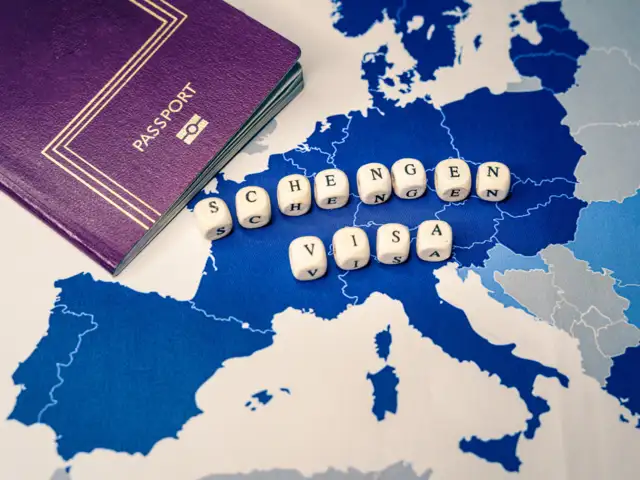
If you are entering the Schengen Area from a country where there is no visa-free travel agreement, you need to apply for a Schengen visa. The four main Schengen Visa types—A, B, C, and D—are available for these.
The most common kind of Schengen visa, known as a Uniform Schengen Visa, encompasses kinds A, B, and C and allows you to visit any Schengen Zone country once every six months for up to 90 days. It also gives you access to your airport transit visa. If you're traveling to Europe for a short time, you will require this visa.
If you are entering the Schengen Area from a country where there is no visa-free travel agreement, you need to apply for a Schengen visa. The four main Schengen Visa types—A, B, C, and D—are availabl..
Read More
The 26 countries that comprise the Schengen area. The European Union counts 23 of the 27 as members. The remaining four nations make up the Non-European Union nations and are particular members of the European Free Trade Association (EFTA). These four non-EU nations are Norway, Liechtenstein, Iceland, and Switzerland.
The other 23 nations are Germany, Austria, Czech Republic, Estonia, Finland, Denmark, Greece, Belgium, Slovenia, Italy, Hungary, Latvia, Lithuania, Malta, Luxemburg, Netherlands, Poland, Portugal, Slovakia, France, Sweden, Spain and Croatia.
The 26 countries that comprise the Schengen area. The European Union counts 23 of the 27 as members. The remaining four nations make up the Non-European Union nations and are particular members of th..
Read More
The purpose of a Schengen visa is to allow travel through or short-term stays of up to 90 days within any 180-day period inside the Schengen area. A visa given by one Schengen state is valid in all other Schengen states; however, you must apply for the visa in the country of your principal destination.
If you plan to visit more than one Schengen country, but none of them will be your primary destination, you must apply for a visa from the region you will enter first.
The purpose of a Schengen visa is to allow travel through or short-term stays of up to 90 days within any 180-day period inside the Schengen area. A visa given by one Schengen state is valid in all o..
Read More
The EU Visa Code permits the issuing of multiple-entry visas for multiple visits to Schengen member states; however, the conditions for doing this were not made clear and unambiguous.
The new Visa Code established several conditions that visa holders must meet in order to obtain a Schengen Visa. It became operative on February 2 and is applicable to the foreign embassies, consulates, and visa centers of the Schengen member states.
The EU Visa Code permits the issuing of multiple-entry visas for multiple visits to Schengen member states; however, the conditions for doing this were not made clear and unambiguous.The new Visa Cod..
Read More
One sort of Schengen visa that you can obtain from India to travel to any Schengen country is a 5-year multiple-entry visa. A five-year MEV is available to individuals who have obtained and lawfully utilized a multiple-entry visa in the last three years, which must have been valid for at least two years.
During a five-year period, this visa grants you unrestricted travel into 26 European countries, provided you don't over the 90/180-day limit.
One sort of Schengen visa that you can obtain from India to travel to any Schengen country is a 5-year multiple-entry visa. A five-year MEV is available to individuals who have obtained and lawfully ..
Read More
To be eligible for a multiple-entry or long-term Schengen visa, you must meet the following requirements in addition to often visiting the Schengen Area.
You must provide evidence of why they will require multiple entries into the Schengen Area throughout the next year(s).
You must have a perfect visa record, which means they you never overstayed your visa's duration while in the Schengen Area or worked illegally.
To be eligible for a multiple-entry or long-term Schengen visa, you must meet the following requirements in addition to often visiting the Schengen Area.You must provide evidence of why they will req..
Read More
A 5-year multiple entry Schengen visa costs the same as a conventional short-stay visa, i.e., €80, despite allowing you to make repeated visits totaling less than 90 days during the validity of the visa.
A 5-year multiple entry Schengen visa costs the same as a conventional short-stay visa, i.e., €80, despite allowing you to make repeated visits totaling less than 90 days during the validity of the v..






 Under Notre Dame cathedral, a 'dig of the century' unearths 1,700 years of history2026-06-02T04:39:20Z

