Saturn's outermost ring much bigger than thought
The ring, called the 'Phoebe ring', is believed to contain dust and ice particles ejected from Saturn's outer moon, Phoebe, after micrometeoroid and other impacts.
By PTI | Updated:

WASHINGTON: Saturn's faint outermost ring is much bigger than thought, spanning an area of sky nearly 7,000 times larger than Saturn itself, astronomers have found.
Douglas Hamilton, with the University of Maryland, and colleagues identified images taken by NASA's infrared sky-mapping WISE telescope and found that the outermost ring, discovered in 2009, contains mostly small particles.
The ring, called the 'Phoebe ring', is believed to contain dust and ice particles ejected from Saturn's outer moon, Phoebe, after micrometeoroid and other impacts, 'Discovery News' reported.
The ring is tilted at an angle of 27 degrees, relative to the other seven known rings, and like Phoebe, orbits Saturn in a backwards, or retrograde, direction.
The researchers working with NASA's infrared Spitzer Space Telescope who discovered the 'Phoebe ring' in 2009 estimated at the time that the ring was likely over two hundred times the radius of its host planet, according to 'Phys.org'.
The new images taken from NASA's WISE probe suggest the ring is over 270 times the radius of Saturn, researchers said.
The Phoebe ring begins about 3.7 million miles away from Saturn and fans out a 'surprisingly' distant 10 million miles, with a vertical expanse of about 1.5 million miles, making it well over 10 times larger than what was previously believed to be Saturn's largest ring, the E ring, researchers said.
The study is published in the journal Nature.
Douglas Hamilton, with the University of Maryland, and colleagues identified images taken by NASA's infrared sky-mapping WISE telescope and found that the outermost ring, discovered in 2009, contains mostly small particles.
The ring, called the 'Phoebe ring', is believed to contain dust and ice particles ejected from Saturn's outer moon, Phoebe, after micrometeoroid and other impacts, 'Discovery News' reported.
The ring is tilted at an angle of 27 degrees, relative to the other seven known rings, and like Phoebe, orbits Saturn in a backwards, or retrograde, direction.
The researchers working with NASA's infrared Spitzer Space Telescope who discovered the 'Phoebe ring' in 2009 estimated at the time that the ring was likely over two hundred times the radius of its host planet, according to 'Phys.org'.
The new images taken from NASA's WISE probe suggest the ring is over 270 times the radius of Saturn, researchers said.
ADVERTISEMENT
The Phoebe ring begins about 3.7 million miles away from Saturn and fans out a 'surprisingly' distant 10 million miles, with a vertical expanse of about 1.5 million miles, making it well over 10 times larger than what was previously believed to be Saturn's largest ring, the E ring, researchers said.
The study is published in the journal Nature.
Download
The Economic Times Business News App for the Latest News in Business, Sensex, Stock Market Updates & More.
The Economic Times Business News App for the Latest News in Business, Sensex, Stock Market Updates & More.
Download
The Economic Times News App for Quarterly Results, Latest News in ITR, Business, Share Market, Live Sensex News & More.
The Economic Times News App for Quarterly Results, Latest News in ITR, Business, Share Market, Live Sensex News & More.
Text: Agencies
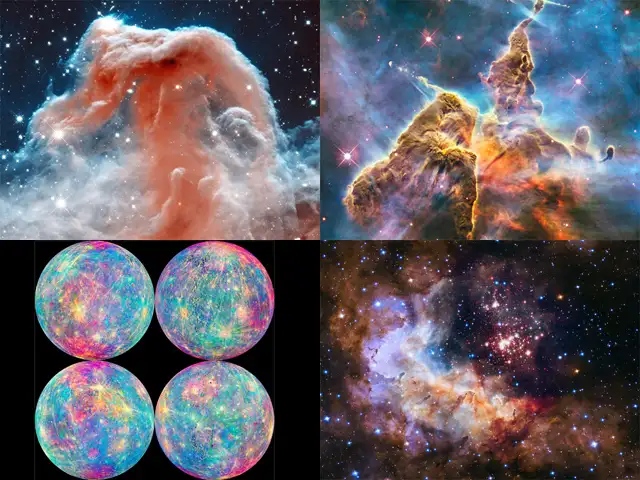
The vast expanse of space remains a mysterious, yet exciting world! With NASA regularly releasing images of the space and that of the Earth as seen from the International Space Station, we take a look at ten mesmerising pictures.
The vast expanse of space remains a mysterious, yet exciting world! With NASA regularly releasing images of the space and that of the Earth as seen from the International Space Station, we take a look at ten mesmerising pictures.

ADVERTISEMENT


