NASA captures epic image of Earth from 1.6 million km
Data from EPIC will be used to measure ozone and aerosol levels in atmosphere, cloud height, vegetation properties and the UV reflectivity of Earth.
By PTI | Updated:

WASHINGTON: NASA has captured the first image of the sunlit side of Earth from a distance of 1.6 million kilometres, which prompted US President Barack Obama to tweet about the need to protect the "only planet we have."
The colour images of Earth from NASA's Earth Polychromatic Imaging Camera ( EPIC) on the Deep Space Climate Observatory (DSCOVR) satellite are generated by combining three separate images to create a photographic-quality image.
The image clicked on July 6 clearly shows desert sand structures, river systems and complex cloud patterns, NASA said.
"Just got this new blue marble photo from @NASA. A beautiful reminder that we need to protect the only planet we have," Obama tweeted on his official account @POTUS.
The camera takes a series of 10 images using different narrowband filters - from ultraviolet to near infrared.
"This first DSCOVR image of our planet demonstrates the unique and important benefits of Earth observation from space," said NASA Administrator Charlie Bolden.
"DSCOVR's observations of Earth, as well as its measurements and early warnings of space weather events caused by the Sun, will help every person to monitor the ever-changing Earth, and to understand how our planet fits into its neighbourhood in the solar system," said Bolden.
These initial Earth images show the effects of sunlight scattered by air molecules, giving the images a characteristic bluish tint.
The EPIC team now is working on a rendering of these images that emphasises land features and removes this atmospheric effect.
Once the instrument begins regular data acquisition, new images will be available every day, 12 to 36 hours after they are acquired by EPIC. These images will be posted to a dedicated web page by September.
"The high quality of the EPIC images exceeded all of our expectations in resolution," said Adam Szabo, DSCOVR project scientist at NASA's Goddard Space Flight Centre in Greenbelt, Maryland.
The satellite was launched in February and recently reached its planned orbit at the first Lagrange point or L1, about one million miles from Earth towards the Sun.
It's from that unique vantage point that the EPIC instrument is acquiring science quality images of the entire sunlit face of Earth.
Data from EPIC will be used to measure ozone and aerosol levels in Earth's atmosphere, cloud height, vegetation properties and the ultraviolet reflectivity of Earth.
NASA will use this data for a number of Earth science applications, including dust and volcanic ash maps of the entire planet.
The colour images of Earth from NASA's Earth Polychromatic Imaging Camera ( EPIC) on the Deep Space Climate Observatory (DSCOVR) satellite are generated by combining three separate images to create a photographic-quality image.
The image clicked on July 6 clearly shows desert sand structures, river systems and complex cloud patterns, NASA said.
"Just got this new blue marble photo from @NASA. A beautiful reminder that we need to protect the only planet we have," Obama tweeted on his official account @POTUS.
The camera takes a series of 10 images using different narrowband filters - from ultraviolet to near infrared.
"This first DSCOVR image of our planet demonstrates the unique and important benefits of Earth observation from space," said NASA Administrator Charlie Bolden.
ADVERTISEMENT
"DSCOVR's observations of Earth, as well as its measurements and early warnings of space weather events caused by the Sun, will help every person to monitor the ever-changing Earth, and to understand how our planet fits into its neighbourhood in the solar system," said Bolden.
These initial Earth images show the effects of sunlight scattered by air molecules, giving the images a characteristic bluish tint.
The EPIC team now is working on a rendering of these images that emphasises land features and removes this atmospheric effect.
Once the instrument begins regular data acquisition, new images will be available every day, 12 to 36 hours after they are acquired by EPIC. These images will be posted to a dedicated web page by September.
ADVERTISEMENT
"The high quality of the EPIC images exceeded all of our expectations in resolution," said Adam Szabo, DSCOVR project scientist at NASA's Goddard Space Flight Centre in Greenbelt, Maryland.
The satellite was launched in February and recently reached its planned orbit at the first Lagrange point or L1, about one million miles from Earth towards the Sun.
ADVERTISEMENT
It's from that unique vantage point that the EPIC instrument is acquiring science quality images of the entire sunlit face of Earth.
Data from EPIC will be used to measure ozone and aerosol levels in Earth's atmosphere, cloud height, vegetation properties and the ultraviolet reflectivity of Earth.
NASA will use this data for a number of Earth science applications, including dust and volcanic ash maps of the entire planet.
Download
The Economic Times Business News App for the Latest News in Business, Sensex, Stock Market Updates & More.
The Economic Times Business News App for the Latest News in Business, Sensex, Stock Market Updates & More.
Download
The Economic Times News App for Quarterly Results, Latest News in ITR, Business, Share Market, Live Sensex News & More.
The Economic Times News App for Quarterly Results, Latest News in ITR, Business, Share Market, Live Sensex News & More.
Related Articles
 NASA is training AI on billions of Earth observations and the results could change climate research2026-06-15T13:19:50Z
- Snake dance in space? NASA astronaut captures mesmerising view across Earth from SpaceX spacecraft2026-06-11T07:30:44Z
- NASA's Artemis III crew: A test pilot, an Italian, a record-holder and a first-timer2026-06-10T01:33:26Z
Text: Agencies
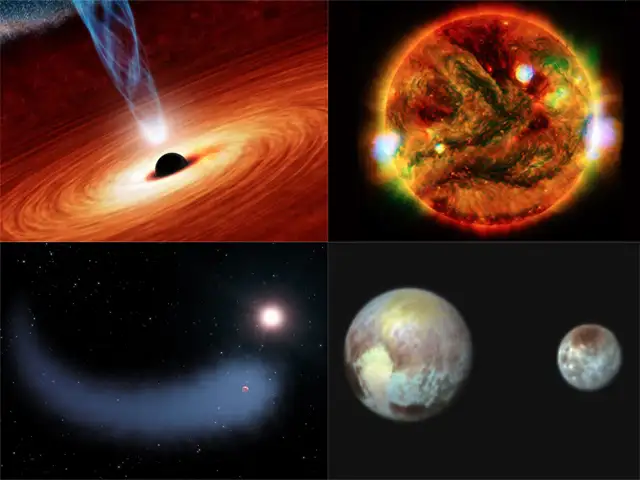
NASA never failed to mesmerize mankind with magnificent images from the outer world. Recently, NASA's spacecraft 'New Horizons' made a historical pass by Pluto making the United States the first to explore the dwarf planet.
Here let's look at the 21 most interesting images of the space and Earth.
NASA never failed to mesmerize mankind with magnificent images from the outer world. Recently, NASA's spacecraft 'New Horizons' made a historical pass by Pluto making the United States the first to explore the dwarf planet.
Here let's look at the 21 most interesting images of the space and Earth.

ADVERTISEMENT


