
'Best ever' simulation solves 40-year black hole mystery
1/3
Not a hole actually
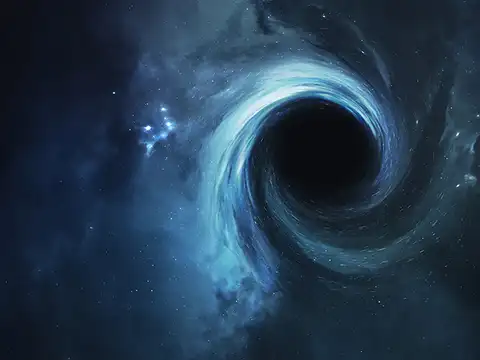
A black hole is born when a large star collapses in on itself. Far from being a "hole", they are instead incredibly dense objects with a gravitational pull so strong that nothing, not even light, may escape them.
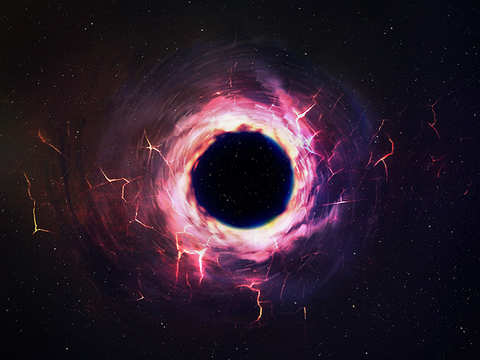
As they suck in matter such as gas, dust and space debris, they form an accretion disk — a churning mass of super-accelerated particles that are among the brightest objects in the Universe — around them.
It is the accretion disk that can be seen as a blurry halo around the image of the black hole released in April from the Event Horizon Telescope.
But accretion disks are nearly always tilted at an angle to the orientation of the black hole, known as its equatorial plane.
As they suck in matter such as gas, dust and space debris, they form an accretion disk — a churning mass of super-accelerated particles that are among the brightest objects in the Universe — around them.
It is the accretion disk that can be seen as a blurry halo around the image of the black hole released in April from the Event Horizon Telescope.
But accretion disks are nearly always tilted at an angle to the orientation of the black hole, known as its equatorial plane.
2/3
Why black holes suck
In 1975, Nobel Prize-winning physicist John Bardeen and astrophysicist Jacobus Petterson theorised that a rotating black hole would cause the inner region of a tilted accretion disk to line up with the black hole's equatorial plane.
But no model could ever work out how, precisely, that would happen. Until now.
But no model could ever work out how, precisely, that would happen. Until now.
3/3
It's like a dart hitting bullseye
Alexander Tchekhovskoy, assistant professor of physics and astronomy at Northwestern's Weinberg College of Arts and Sciences, likened matter accumulating near a black hole to throwing a dart towards the board at random.
"If you don't really aim it will never hit the bullseye," he said. "In the same way, when (matter) falls into the black hole it has some rotation but this rotation will have nothing generally to do with how the black hole rotates. The two rotations will not know anything about each other."
"If you don't really aim it will never hit the bullseye," he said. "In the same way, when (matter) falls into the black hole it has some rotation but this rotation will have nothing generally to do with how the black hole rotates. The two rotations will not know anything about each other."