
$28 million: The cost of flying into space with the world's richest man Jeff Bezos
1/5
Trip to space with Jeff Bezos
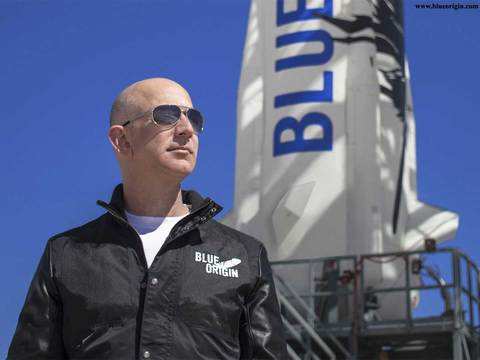
An unnamed bidder paid $28 million at auction Saturday for a seat alongside Jeff Bezos on board the first crewed spaceflight of the billionaire's company Blue Origin next month.

2/5
Unnamed space tourist
The Amazon founder revealed this week that both he and his brother Mark would take a place on board the company's New Shepard launch vehicle on July 20, to fly to the edge of space and back. They will be joined by the winner of Saturday's charity auction, whose identity will be disclosed in coming weeks, and by a fourth, as yet unnamed space tourist.

3/5
All about the auction
Saturday's successful bidder beat out some 20 rivals in an auction launched on May 19 and wrapped up with a 10-minute, livecast frenzy. Bidding had reached $4.8 million by Thursday, but shot up spectacularly in the final live auction, rising by million dollar increments.
Amazon Top Deals
POWERED BY

Crompton Ozone 75 Litres Desert Air Cooler for home | Large & Easy Clean Ice Chamber | 4-Way Air Deflection | High Density Honeycomb Pads | Everlast Pump | Auto Fill| 3 Year Brand Warranty
₹9,798Buy Now43%
OFF

atomberg Studio Smart+ 1200mm BLDC Ceiling Fan with IoT & Remote | BEE 5 star Rated Energy Efficient Ceiling Fan | High Air Delivery with LED Indicators | 3 Year Warranty (Earth Brown)
₹5,882Buy Now36%
OFF
LG 32 L Convection Microwave Oven (MC3286BRUM, Black, 360° Motorised Rotisserie for Bar-be-queing, 301 Auto Cook Menu, Stainless steel cavity, Indian Cuisine, Tandoor Se, Steam Clean & Diet Fry)
₹19,340Buy Now19%
OFF
4/5
The proceeds
The proceeds -- aside from a six percent auctioneer's commission -- will go to Blue Origin's foundation, Club for the Future, which aims to inspire future generations to pursue careers in STEM -- science, technology, engineering and mathematics.
5/5
The journey
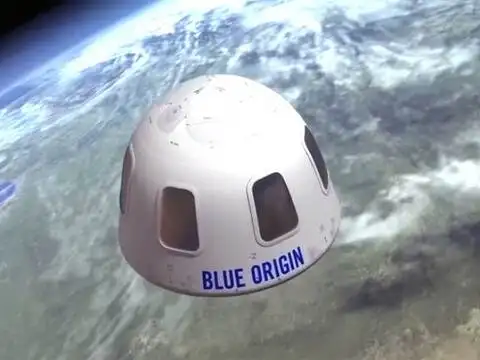
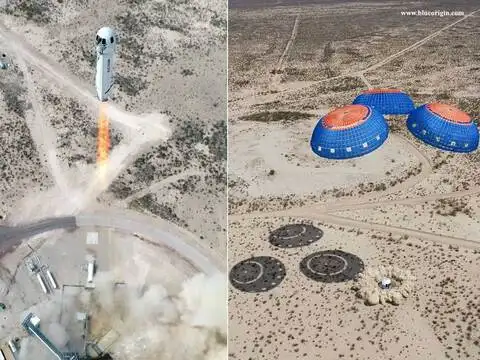
Taking off from a desert in western Texas, the New Shepard trip will last a total of 10 minutes, four of which passengers will spend above the Karman line that marks the recognized boundary between Earth's atmosphere and space. After lift-off, the capsule separates from its booster, then spends four minutes at an altitude exceeding 60 miles (100 kilometers), during which time those on board experience weightlessness and can observe the curvature of Earth from space. The booster lands autonomously on a pad two miles from the launch site, and the capsule floats back to the surface with three large parachutes that slow it down to about a mile per hour when it lands.