Section 377: Here is everything you need to know
The issue of Section 377 was first raised by NGO Naaz Foundation, which had approached the Delhi High Court in 2001.
By ET Online | Updated:

PTI
In a landmark judgement for the LGBT community in the country, the Supreme Court lifted a colonial-era ban on gay sex on Thursday
A five-judge constitution bench headed by Chief Justice Dipak Misra had reserved its verdict on July 17 after hearing various stakeholders for four days, including gay rights activists. Besides the CJI, the bench also comprised justices R F Nariman, A M Khanwilkar, D Y Chandrachud and Indu Malhotra.
The Centre, which had initially sought adjournment for filing its response to the petitions, had later left to the wisdom of the court the issue of legality of the penal provision on the aspects of criminalising consensual unnatural sex between two consenting adults.
The Centre had said that the other aspects of the penal provision dealing with minors and animals should be allowed to remain in the statute book. Section 377 refers to 'unnatural offences' and says whoever voluntarily has carnal intercourse against the order of nature with any man, woman or animal, shall be punished with imprisonment for life, or with imprisonment of either description for a term which may extend to 10 years, and shall also be liable to pay a fine.
What is Section 377?
Section 377 refers to 'unnatural offences' and says whoever voluntarily has carnal intercourse against the order of nature with any man, woman or animal, shall be punished with imprisonment for life, or with imprisonment of either description for a term which may extend to 10 years, and shall also be liable to pay a fine.
The issue of Section 377 was first raised by NGO Naaz Foundation, which had in 2001 approached the Delhi High Court which had decriminalised sex between consenting adults of the same gender by holding the penal provision as "illegal". This 2009 judgement of the high court was overturned in 2013 by the apex court which had also dismissed the review plea against which the curative petitions were filed which are pending.
The apex court had commenced the hearing on the fresh writ petitions challenging re-criminalisation of consensual gay sex between two adults, rejecting the Centre's plea seeking postponement of the proceedings by four weeks.
It had in 2013 restored the criminality of the sexual relationship between persons of the same sex, after the Delhi High Court had decriminalised it in 2009. At the outset of the hearing, the five-judge bench on July 10 had made it clear that it was not going into the curative petitions and would adjudicate on the fresh writ petitions in the matter.
Section 377 and child abuse
Implications for heterosexuals
Section 377 also included consensual sexual acts of adults such as oral and anal sex in private which were treated as unnatural and punishable.
The petitioners
The apex court heard the writ petitions filed by dancer Navtej Jauhar, journalist Sunil Mehra, chef Ritu Dalmia, hoteliers Aman Nath and Keshav Suri and business executive Ayesha Kapur and 20 former and current students of the IITs.
They have sought decriminalisation of consensual sex between two consenting adults of the same sex by declaring section 377 of IPC as illegal and unconstitutional.
Is 'Section 377' legitimate?
Coming from different parts of the country with diverse religion, age, sex and other backgrounds, the petitioners said that section 377 legitimises the stigma associated with sexual orientation and its expression something which is essential, fundam
The Supreme Court has scrapped Section 377 of the IPC, decriminalising the 158-year-old colonial law which criminalises consensual gay sex.

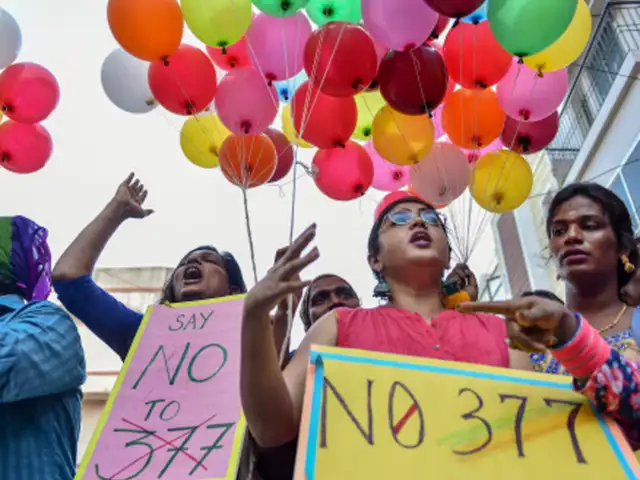
Section 377 refers to 'unnatural offences' and says whoever voluntarily has carnal intercourse against the order of nature with any man, woman or animal, shall be punished with imprisonment for life, or with imprisonment of either description for a term which may extend to 10 years, and shall also be liable to pay a fine. In pic: A participant from the LGBT community, “shackled” by section 377 of the Indian Penal Code, makes a silent appeal to decriminalise homosexuality in India
A five-judge constitution bench headed by Chief Justice Dipak Misra had reserved its verdict on July 17 after hearing various stakeholders for four days, including gay rights activists. Besides the CJI, the bench also comprised justices R F Nariman, A M Khanwilkar, D Y Chandrachud and Indu Malhotra.
The Centre, which had initially sought adjournment for filing its response to the petitions, had later left to the wisdom of the court the issue of legality of the penal provision on the aspects of criminalising consensual unnatural sex between two consenting adults.
The Centre had said that the other aspects of the penal provision dealing with minors and animals should be allowed to remain in the statute book. Section 377 refers to 'unnatural offences' and says whoever voluntarily has carnal intercourse against the order of nature with any man, woman or animal, shall be punished with imprisonment for life, or with imprisonment of either description for a term which may extend to 10 years, and shall also be liable to pay a fine.
What is Section 377?
Section 377 refers to 'unnatural offences' and says whoever voluntarily has carnal intercourse against the order of nature with any man, woman or animal, shall be punished with imprisonment for life, or with imprisonment of either description for a term which may extend to 10 years, and shall also be liable to pay a fine.
ADVERTISEMENT
Delhi HC's 2009 verdict The issue of Section 377 was first raised by NGO Naaz Foundation, which had in 2001 approached the Delhi High Court which had decriminalised sex between consenting adults of the same gender by holding the penal provision as "illegal". This 2009 judgement of the high court was overturned in 2013 by the apex court which had also dismissed the review plea against which the curative petitions were filed which are pending.
The apex court had commenced the hearing on the fresh writ petitions challenging re-criminalisation of consensual gay sex between two adults, rejecting the Centre's plea seeking postponement of the proceedings by four weeks.
It had in 2013 restored the criminality of the sexual relationship between persons of the same sex, after the Delhi High Court had decriminalised it in 2009. At the outset of the hearing, the five-judge bench on July 10 had made it clear that it was not going into the curative petitions and would adjudicate on the fresh writ petitions in the matter.
Section 377 and child abuse
ADVERTISEMENT
Child rights activists had criticised the Delhi HC verdict of de-criminalising homosexuality on the ground that Section 377 was needed to tackle cases of child abuse. However, the enactment of the Protection of Children from Sexual Offences (POCSO) Act 2012 removed the need to use Section 377 as POCSO is more child-friendly and much more stringent.Implications for heterosexuals
Section 377 also included consensual sexual acts of adults such as oral and anal sex in private which were treated as unnatural and punishable.
ADVERTISEMENT
The petitioners
The apex court heard the writ petitions filed by dancer Navtej Jauhar, journalist Sunil Mehra, chef Ritu Dalmia, hoteliers Aman Nath and Keshav Suri and business executive Ayesha Kapur and 20 former and current students of the IITs.
They have sought decriminalisation of consensual sex between two consenting adults of the same sex by declaring section 377 of IPC as illegal and unconstitutional.
Is 'Section 377' legitimate?
Coming from different parts of the country with diverse religion, age, sex and other backgrounds, the petitioners said that section 377 legitimises the stigma associated with sexual orientation and its expression something which is essential, fundam
The Supreme Court has scrapped Section 377 of the IPC, decriminalising the 158-year-old colonial law which criminalises consensual gay sex.





Download
The Economic Times Business News App for the Latest News in Business, Sensex, Stock Market Updates & More.
The Economic Times Business News App for the Latest News in Business, Sensex, Stock Market Updates & More.
Download
The Economic Times News App for Quarterly Results, Latest News in ITR, Business, Share Market, Live Sensex News & More.
The Economic Times News App for Quarterly Results, Latest News in ITR, Business, Share Market, Live Sensex News & More.
ADVERTISEMENT


