'PM Narendra Modi believes in systematic changes, not doles'
"The focus of the Budget is on agriculture, rural development and infrastructure, which is also a reflection of the government’s commitment to raise investment."
By Ravish Tiwari, ET Bureau | Updated:

NEW DELHI: The government eschewed populism in the Budget ahead of a string of state polls to focus instead on the objectives that led to its demonetisation drive and to step up public investment, particularly in agriculture, rural development and infrastructure.
The move to restrict cash transactions beyond Rs 3 lakh, for instance, is aimed at curbing black money and incentivising formal economy, senior officials said. The government was not under pressure to dole out populist measures, they said. “Populist announcements win you praise for a single day. Measures rooted in some social or economic rationale have been preferred,” said one of the officials, who did not wish to be identified. “PM Modi doesn’t believe in doles. He believes in systematic changes that can result in sabka saath, sabka vikas,” he said.
PM Modi said, “The focus of the Budget is on agriculture, rural development and infrastructure, which is also a reflection of the government’s commitment to raise investment and create employment opportunities.”
The Budget also sought to encourage more individual tax payers and small businesses to become tax compliant by reducing personal income tax in the lowest bracket as well as tax for small-scale industries. “The 5% tax relief is to tempt a large number of potential taxpayers to join the tax net,” said another official. The PM also highlighted lowering of taxes on personal income tax and small businesses with a turnover of up to Rs 50 crore. The move appeared to be an attempt to cushion the small businesses after reports that demonetisation hit them hard.
The move to restrict cash transactions beyond Rs 3 lakh, for instance, is aimed at curbing black money and incentivising formal economy, senior officials said. The government was not under pressure to dole out populist measures, they said. “Populist announcements win you praise for a single day. Measures rooted in some social or economic rationale have been preferred,” said one of the officials, who did not wish to be identified. “PM Modi doesn’t believe in doles. He believes in systematic changes that can result in sabka saath, sabka vikas,” he said.
PM Modi said, “The focus of the Budget is on agriculture, rural development and infrastructure, which is also a reflection of the government’s commitment to raise investment and create employment opportunities.”
The Budget also sought to encourage more individual tax payers and small businesses to become tax compliant by reducing personal income tax in the lowest bracket as well as tax for small-scale industries. “The 5% tax relief is to tempt a large number of potential taxpayers to join the tax net,” said another official. The PM also highlighted lowering of taxes on personal income tax and small businesses with a turnover of up to Rs 50 crore. The move appeared to be an attempt to cushion the small businesses after reports that demonetisation hit them hard.
Download
The Economic Times Business News App for the Latest News in Business, Sensex, Stock Market Updates & More.
The Economic Times Business News App for the Latest News in Business, Sensex, Stock Market Updates & More.
Download
The Economic Times News App for Quarterly Results, Latest News in ITR, Business, Share Market, Live Sensex News & More.
The Economic Times News App for Quarterly Results, Latest News in ITR, Business, Share Market, Live Sensex News & More.
Related Articles
 Human-centric technology at heart of India's AI ambitions: PM Narendra Modi at Bharat Innovates 20262026-06-14T15:47:10Z
- PM Narendra Modi to chair 11th Governing Council Meeting of NITI Aayog on June 112026-06-10T09:22:44Z
- President Droupadi Murmu writes to PM Narendra Modi; says India witnessed significant transformations during his tenure2026-06-10T09:02:07Z
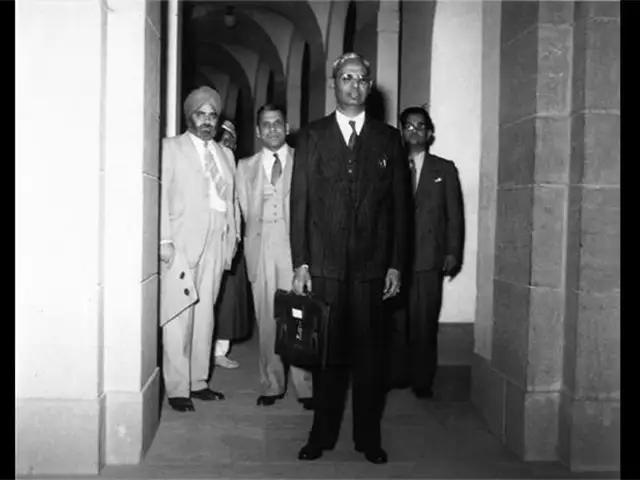
The first budget of Independent India was presented by the first finance minister R K Shanmukham Chetty. This was from the seven-and-a-half period from August 15, 1947 to March 31, 1948. The budget estimate for total revenues was a mere Rs 171.15 crore. A fiscal deficit was a paltry Rs 204.59 cr.

ADVERTISEMENT


