NASA warns of more dangerous solar flares that can hit mobile and power on Earth
Solar flares are dangerous for Earth, as the radiation it releases can interfere with our radio communications. These storms impact every electronic and communication system, from the internet to power, and are also capable of destroying satellites.
By ET Spotlight Special |

AP
US space agency NASA has warned that the Sun is expected to release more frequent horrific solar flares in the near future as it nears the peak of its 11-year cycle called the solar maximum.
Solar flares are dangerous for Earth, as the radiation it releases can interfere with our radio communications. These storms impact every electronic and communication system, from the internet to power, and are also capable of destroying satellites.
"Solar events will continue to increase as we near the solar maximum in 2025, and our lives and technology on Earth, as well as satellites and astronauts in space, will be impacted, '' NASA warned in its latest blog.
According to the space agency, the Sun is going through the Solar Cycle 25, which started in December 2019. This time period implies that the Sun’s activity will continue to increase till it reaches peak levels during the solar cycle.
Solar storms release coronal mass ejections (CME) towards the Earth. The CME leads to geomagnetic storms on Earth and affects all electrical infrastructure here.
NASA also released a video of a solar flare event to show how it affects the Earth communication systems.
"With more CME activity comes an increase in space weather events including solar flares and solar eruptions, which can impact radio communications, electric power grids, and navigation signals, as well as pose risks to spacecraft and astronauts," NASA added.
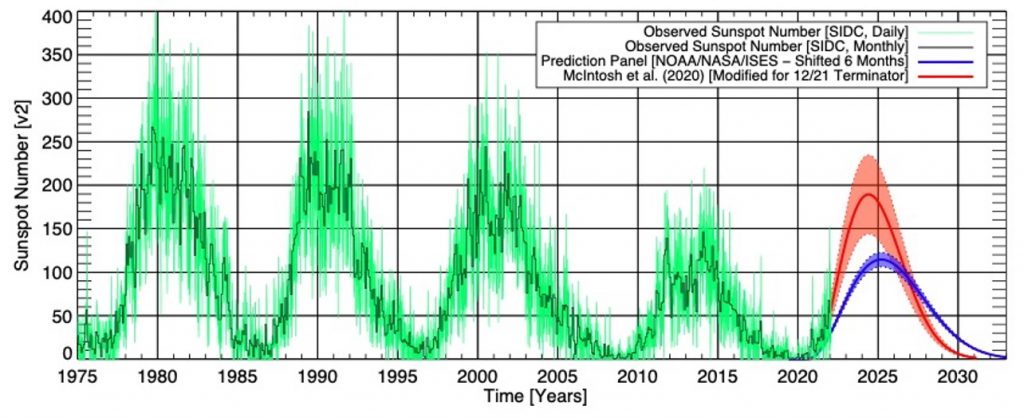
(In pic: This chart shows the original predicted number of sunspots, represented as the blue line. The green lines show the observed sunspots, which are trending toward the red line – the McIntosh et al. study – which predicts a higher number of sunspots. Source: Nasa Blog)
Solar flares are dangerous for Earth, as the radiation it releases can interfere with our radio communications. These storms impact every electronic and communication system, from the internet to power, and are also capable of destroying satellites.
"Solar events will continue to increase as we near the solar maximum in 2025, and our lives and technology on Earth, as well as satellites and astronauts in space, will be impacted, '' NASA warned in its latest blog.
According to the space agency, the Sun is going through the Solar Cycle 25, which started in December 2019. This time period implies that the Sun’s activity will continue to increase till it reaches peak levels during the solar cycle.
Solar storms release coronal mass ejections (CME) towards the Earth. The CME leads to geomagnetic storms on Earth and affects all electrical infrastructure here.
NASA also released a video of a solar flare event to show how it affects the Earth communication systems.
ADVERTISEMENT
A coronal mass ejection (CME) – a huge cloud of solar material that erupts from the Sun – can carry the mass of ove… https://t.co/51Svxndd1Z
— NASA Sun & Space (@NASASun) 1659289528000"With more CME activity comes an increase in space weather events including solar flares and solar eruptions, which can impact radio communications, electric power grids, and navigation signals, as well as pose risks to spacecraft and astronauts," NASA added.
(In pic: This chart shows the original predicted number of sunspots, represented as the blue line. The green lines show the observed sunspots, which are trending toward the red line – the McIntosh et al. study – which predicts a higher number of sunspots. Source: Nasa Blog)
Download
The Economic Times Business News App for the Latest News in Business, Sensex, Stock Market Updates & More.
The Economic Times Business News App for the Latest News in Business, Sensex, Stock Market Updates & More.
Download
The Economic Times News App for Quarterly Results, Latest News in ITR, Business, Share Market, Live Sensex News & More.
The Economic Times News App for Quarterly Results, Latest News in ITR, Business, Share Market, Live Sensex News & More.
Related Articles
 Northern lights tonight: Powerful solar flare may spark aurora display across Northern U.S.2026-03-30T16:29:49Z
- ISRO warns of radio blackouts as M and X-class solar flares hit Earth: Check what the X8.3 flare is and its effects2026-02-04T17:10:38Z
- Space weather in focus after Airbus fleet recall, experts raise questions about solar flare theory2025-12-06T07:26:22Z
ADVERTISEMENT


