Here are the 3 architects of modern China who changed its fortune
The seven people forming the Politburo Standing Committee are the most powerful politicians in the Chinese governance system.
By TNN | Updated:

The 19th National Congress of the Communist Party of China was held in Beijing from October 18 to October 24. The convention is held every five years, the national congress being the highest body within the Communist Party of China responsible for taking key decisions such as changes in party leadership as well as assessment of its achievements and future direction. Western media maintains the congress is a symbolic political exercise and important decisions are made much before the actual meeting.
What is the hierarchy of China's political system?
The seven people forming the Politburo Standing Committee are the most powerful politicians in the Chinese governance system. They form a collective leadership where each has a rank from one to seven. It is believed the concept of collective leadership was developed to avoid the economic despair caused by wrong judgments during unopposed rule by an outsized leader.
What went wrong in the past?
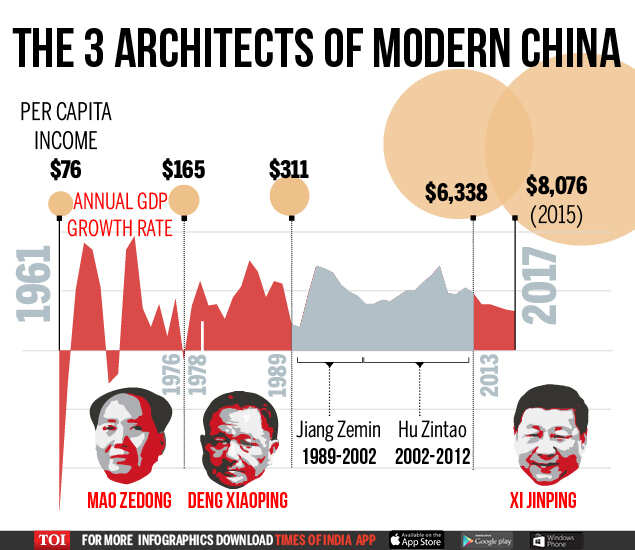
As China did not have the capital needed for industrialisation, leaders of the communist revolution, including Mao Zedong, came up with the idea of a labour intensive method of industrialisation, believing that China would be able to bypass slow industrialisation by first accumulating capital and then investing in machinery. A key development of the ‘Great Leap Forward (1958 to early 1960s)', as the new policy was called, was the installation of small backyard steel furnaces in villages and urban neighbourhoods that were expected to accelerate industrialisation. Hasty and overzealous implementation backfired as the steel produced was of very poor quality. This apart, large-scale diversion of farm labour disrupted agriculture, causing a famine that is believed to have killed millions. By early 1960, the programme was repealed. The unrest of the ‘Great Leap' years, followed by Mao's Cultural Revolution (1966-76) in which he tried to retain his popularity by defanging opponents, also threw the Chinese economy into turmoil.
When did the Chinese economy start its recovery?
Is China now a capitalist country?
Tough to say. Ownership rules are complicated making it difficult to view its economy through the traditional prism of differentiating capitalism from communism. Land is opened up for commercial use but government owns the plots leased to individuals. Small and medium industries are private but have close links with the local government while many big industries are owned by the government.
What is the hierarchy of China's political system?
The seven people forming the Politburo Standing Committee are the most powerful politicians in the Chinese governance system. They form a collective leadership where each has a rank from one to seven. It is believed the concept of collective leadership was developed to avoid the economic despair caused by wrong judgments during unopposed rule by an outsized leader.
What went wrong in the past?
As China did not have the capital needed for industrialisation, leaders of the communist revolution, including Mao Zedong, came up with the idea of a labour intensive method of industrialisation, believing that China would be able to bypass slow industrialisation by first accumulating capital and then investing in machinery. A key development of the ‘Great Leap Forward (1958 to early 1960s)', as the new policy was called, was the installation of small backyard steel furnaces in villages and urban neighbourhoods that were expected to accelerate industrialisation. Hasty and overzealous implementation backfired as the steel produced was of very poor quality. This apart, large-scale diversion of farm labour disrupted agriculture, causing a famine that is believed to have killed millions. By early 1960, the programme was repealed. The unrest of the ‘Great Leap' years, followed by Mao's Cultural Revolution (1966-76) in which he tried to retain his popularity by defanging opponents, also threw the Chinese economy into turmoil.
When did the Chinese economy start its recovery?
ADVERTISEMENT
After Mao's death, China was led by Deng Xiaoping who pushed reforms — reducing government control of the means of production. Starting with de-collectivising of farms, Deng pushed reforms in the industrial sector that initially allowed small-scale privatisation and gradually opened the Chinese economy to foreign investors. Deng's regime saw improved living standards, but increased income inequality — something Mao had dreamed of eradicating. The economic reforms benefitted the elite; thousands were disappointed. Rising inflation, lack of political participation because of one-party system and restriction on freedom of press sparked the 1989 Tiananmen Square protest that was brutally suppressed by government. Although it raised some opposition against the reforms, Deng went on with privatisation.Is China now a capitalist country?
Tough to say. Ownership rules are complicated making it difficult to view its economy through the traditional prism of differentiating capitalism from communism. Land is opened up for commercial use but government owns the plots leased to individuals. Small and medium industries are private but have close links with the local government while many big industries are owned by the government.
Download
The Economic Times Business News App for the Latest News in Business, Sensex, Stock Market Updates & More.
The Economic Times Business News App for the Latest News in Business, Sensex, Stock Market Updates & More.
Download
The Economic Times News App for Quarterly Results, Latest News in ITR, Business, Share Market, Live Sensex News & More.
The Economic Times News App for Quarterly Results, Latest News in ITR, Business, Share Market, Live Sensex News & More.
Related Articles
 China, India see top firms lose market cap share in AI lag2026-06-29T00:46:24Z
- Alternatives to OpenAI, Anthropic: With US prime AI off the table, India opts for fine China2026-06-29T00:31:00Z
- China emerges as key growth driver for India's frozen shrimp exports; US remains top market in FY262026-06-28T14:31:50Z
ADVERTISEMENT


