Understanding nuclear fusion milestone and what does it mean?
Nuclear fusion refers to the process which provides the sun with its energy.
By ET Spotlight Special |

Agencies
Scientists in the US have got major breakthroughs in their pursuit of a technique that could produce a practically endless supply of energy. A plus point of Nuclear fusion is that it does not depend on substances such as fossil fuels and also does not produce any harmful gasses. As a result, Nuclear fusion can prove to be extremely helpful in climate change.
In nuclear fusion, two atoms are heated up and compelled to fuse to form a heavier atom. It is the opposite of nuclear fission, which is the splitting apart of heavy atoms. Electricity is currently produced via nuclear fission in nuclear power plants.
At the National Ignition Facility (NIF) at Lawrence Livermore National Laboratory in California, a weak laser beam is divided and its energy is increased to produce 192 laser beams. These are used to generate X-rays by heating the hohlraum, a small gold container, to a temperature greater than 3 million degrees Celsius.
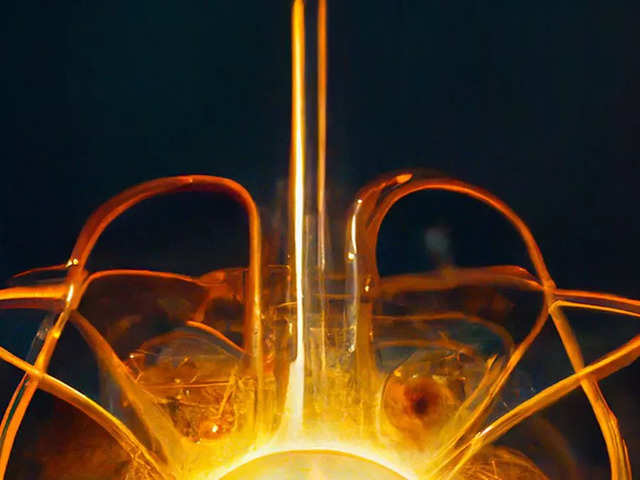
A millimeter-sized capsule within the hohlraum is heated by these X-rays. Further, the capsule contains two forms of hydrogen: deuterium and tritium. Due to the heat, the surface of the capsule blows up outwards. As a result, the contents of the capsule implode. The end outcome is that fusion takes place in the fuel's hottest region, producing helium nuclei.
The difference in mass between one helium nucleus and the combination of one deuterium and one tritium nucleus is released as a burst of energy. The helium nuclei created in this process can transfer their kinetic energy to the remaining fuel under the correct circumstances, heating it and igniting further fusion.
What is nuclear fusion?
Nuclear fusion refers to the process which provides the sun with its energy. In a nutshell, it entails the collision of light atoms to create heavier ones, which releases enormous amounts of energy in the process.In nuclear fusion, two atoms are heated up and compelled to fuse to form a heavier atom. It is the opposite of nuclear fission, which is the splitting apart of heavy atoms. Electricity is currently produced via nuclear fission in nuclear power plants.
At the National Ignition Facility (NIF) at Lawrence Livermore National Laboratory in California, a weak laser beam is divided and its energy is increased to produce 192 laser beams. These are used to generate X-rays by heating the hohlraum, a small gold container, to a temperature greater than 3 million degrees Celsius.









A millimeter-sized capsule within the hohlraum is heated by these X-rays. Further, the capsule contains two forms of hydrogen: deuterium and tritium. Due to the heat, the surface of the capsule blows up outwards. As a result, the contents of the capsule implode. The end outcome is that fusion takes place in the fuel's hottest region, producing helium nuclei.
ADVERTISEMENT
The difference in mass between one helium nucleus and the combination of one deuterium and one tritium nucleus is released as a burst of energy. The helium nuclei created in this process can transfer their kinetic energy to the remaining fuel under the correct circumstances, heating it and igniting further fusion.
FAQs:
- Nuclear Fusion does not depend on which substance ?
Nuclear Fusion does not depend on substances such as fossil fuels and also does not produce any harmful gasses. - What is Nuclear Fusion ?
Nuclear fusion refers to the process which provides the sun with its energy.
Download
The Economic Times Business News App for the Latest News in Business, Sensex, Stock Market Updates & More.
The Economic Times Business News App for the Latest News in Business, Sensex, Stock Market Updates & More.
Download
The Economic Times News App for Quarterly Results, Latest News in ITR, Business, Share Market, Live Sensex News & More.
The Economic Times News App for Quarterly Results, Latest News in ITR, Business, Share Market, Live Sensex News & More.
Related Articles
 How a 14-year-old American built a nuclear fusion device in his parents’ garage2026-05-19T10:36:34Z
- Nuclear fusion startup Pranos raises $6.8 million in round co-led by Pi Ventures, Ankur Capital2026-03-24T00:30:00Z
- Trump Media to merge with nuclear fusion company that wants to power AI2025-12-19T16:22:54Z
ADVERTISEMENT


