Two new exoplanets covered with water found by explorers
Exoplanet explorers have discovered new planets, Kepler-138c and d, covered with water.
By ET Spotlight Special |

Agencies
According to a new study published on Thursday in Nature Astronomy, two planets 218 light years away from Earth are water worlds.
Two exoplanets encircling a star, which is a red dwarf, were found to be "water worlds," where water makes up a significant portion of the planet's mass, according to evidence discovered by a team led by scientists at the University of Montreal.
These worlds are unlike any planets in our solar system and are situated in a planetary system 218 light years away in the constellation Lyra.

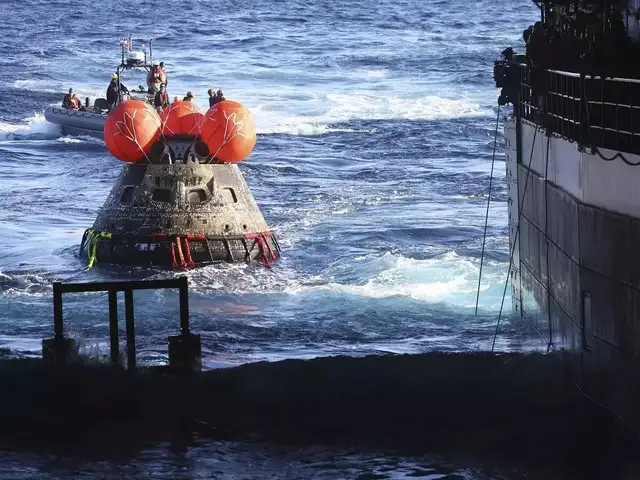
The Artemis 1 mission, which involved a more than 25-day cruise around the Moon with the goal of bringing humans there in a few years, was successfully completed on Sunday when NASA's Orion spacecraft safely splashed down in the Pacific.
A thorough analysis of this planetary system, also known as Kepler-138, was just published by the team which Caroline Piaulet led from the (iREx), the Institute for Research on Exoplanets, at the University of Montreal.
Exoplanets Kepler-138c and Kepler-138d may be primarily made of water, according to research by Piaulet and colleagues using Hubble by NASA and the now-retired Spitzer space observatories.
Water was not directly found at Kepler-138c and d. Still, by reaching the masses and sizes of the planets to standards, astronomers suppose that up to half of their volume should be composed of substances that are weightier than helium or hydrogen but lighter than rock. Water is the most prevalent of these potential materials.
Two exoplanets encircling a star, which is a red dwarf, were found to be "water worlds," where water makes up a significant portion of the planet's mass, according to evidence discovered by a team led by scientists at the University of Montreal.
These worlds are unlike any planets in our solar system and are situated in a planetary system 218 light years away in the constellation Lyra.




A thorough analysis of this planetary system, also known as Kepler-138, was just published by the team which Caroline Piaulet led from the (iREx), the Institute for Research on Exoplanets, at the University of Montreal.
Exoplanets Kepler-138c and Kepler-138d may be primarily made of water, according to research by Piaulet and colleagues using Hubble by NASA and the now-retired Spitzer space observatories.
ADVERTISEMENT
The Kepler Space Telescope NASA has previously found these two planets and Kepler-138b, a tiny planetary partner nearer to the star. The latest investigation also discovered proof of a fourth planet. Water was not directly found at Kepler-138c and d. Still, by reaching the masses and sizes of the planets to standards, astronomers suppose that up to half of their volume should be composed of substances that are weightier than helium or hydrogen but lighter than rock. Water is the most prevalent of these potential materials.
FAQs:
- What do Kepler-138c and d mean?
The exoplanets are known as Kepler-138c and Kepler-138d, respectively. Both have a radius around 1.5 times that of Earth and are described as "soggy worlds" with interiors made of hard metal and thick, steamy atmospheres. - What does an exoplanet mean?
Any planet outside of our solar system is an exoplanet. Most exoplanets circle different stars, while rogue planets, free-floating exoplanets unattached to any principal, orbit the galactic centre.
Download
The Economic Times Business News App for the Latest News in Business, Sensex, Stock Market Updates & More.
The Economic Times Business News App for the Latest News in Business, Sensex, Stock Market Updates & More.
Download
The Economic Times News App for Quarterly Results, Latest News in ITR, Business, Share Market, Live Sensex News & More.
The Economic Times News App for Quarterly Results, Latest News in ITR, Business, Share Market, Live Sensex News & More.
ADVERTISEMENT


