On Saturn's giant moon Titan, James Webb Space Telescope finds clouds
Clouds have been discovered on one of the solar system's most intriguing moons, according to the James Webb Space Telescope’s images.
By ET Spotlight Special |

Agencies
In November, the space observatory focused its infrared telescope on Titan, Saturn's giant moon. It possesses the sole thick atmosphere in our solar system, four times denser than Earth's. Titan's atmosphere is composed primarily of nitrogen and methane, giving it a fuzzy, orange look. This heavy cloud prevents visible light from bouncing off the moon's surface, making specific details difficult.
On November 5, the Webb telescope observed a brilliant cloud in Titan's northern hemisphere and, shortly after, a second cloud in the atmosphere. The enormous cloud was discovered near Kraken Mare, Titan's most extensive known liquid sea of methane on the moon's surface.
Titan possesses bodies comparable to the ones seen on Earth, but its lakes, rivers and seas are formed of liquid methane and ethane, which create clouds and showers from the sky. Titan may have an interior liquid water ocean, according to researchers.
Conor Nixon, a planetary scientist at NASA Goddard Space Flight Centre in Greenbelt, said that detecting clouds is exciting because it validates long-held computer model predictions about Titan's climate, which said that clouds would form quickly in the mid-northern hemisphere during late summer when the surface is warmed by the Sun.
Nixon is also the Titan's principal investigator for the Webb observation programme. The scientists are reviewing the Webb data at the W. M. Keck Observatory in Hawaii to see whether more observations could tell whether or not the clouds were moving or changing shape.
On November 5, the Webb telescope observed a brilliant cloud in Titan's northern hemisphere and, shortly after, a second cloud in the atmosphere. The enormous cloud was discovered near Kraken Mare, Titan's most extensive known liquid sea of methane on the moon's surface.
Titan possesses bodies comparable to the ones seen on Earth, but its lakes, rivers and seas are formed of liquid methane and ethane, which create clouds and showers from the sky. Titan may have an interior liquid water ocean, according to researchers.
Conor Nixon, a planetary scientist at NASA Goddard Space Flight Centre in Greenbelt, said that detecting clouds is exciting because it validates long-held computer model predictions about Titan's climate, which said that clouds would form quickly in the mid-northern hemisphere during late summer when the surface is warmed by the Sun.
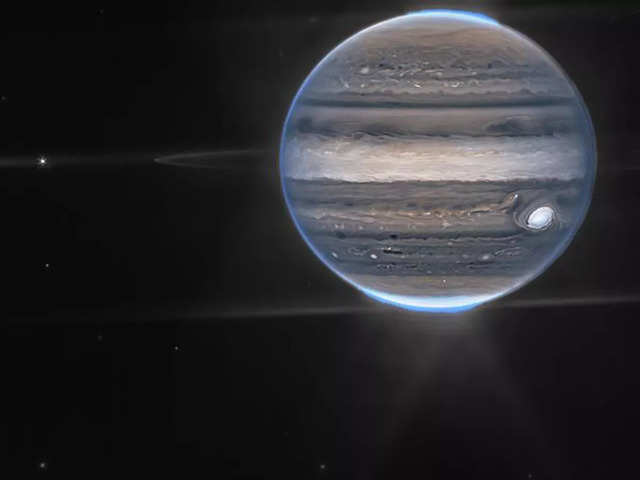
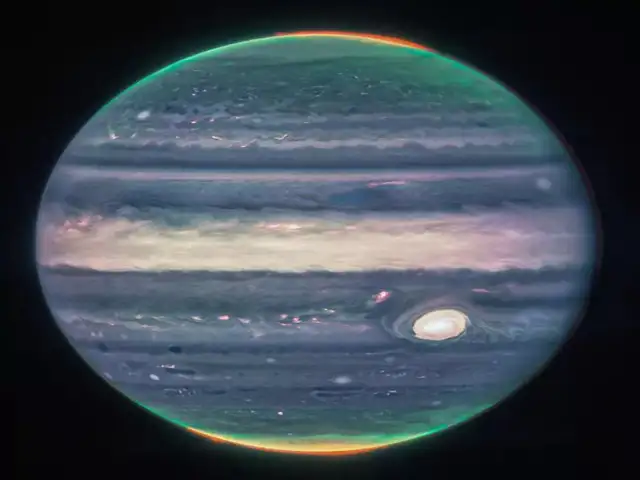
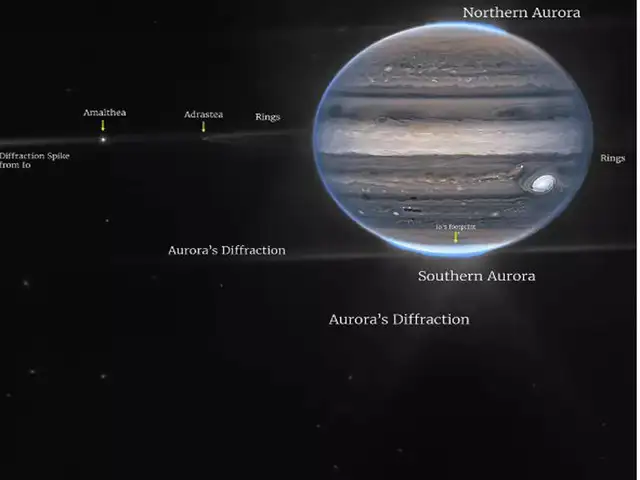
The world's newest and biggest space telescope is showing Jupiter as never before, auroras and all. Scientists released the shots on Monday of the solar system's biggest planet. The James Webb Space Telescope took the photos in July, capturing unprecedented views of Jupiter's northern and southern lights, and swirling polar haze.


Nixon is also the Titan's principal investigator for the Webb observation programme. The scientists are reviewing the Webb data at the W. M. Keck Observatory in Hawaii to see whether more observations could tell whether or not the clouds were moving or changing shape.
ADVERTISEMENT
FAQs:
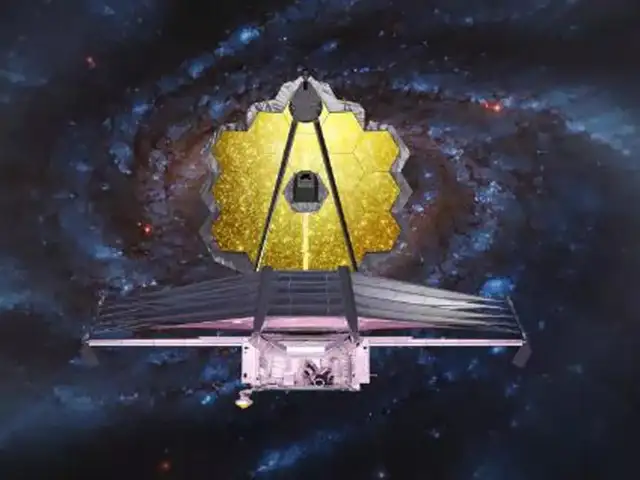
- What is the James Webb Space Telescope?
The James Webb Space Telescope is an infrared astronomy space telescope. - What is Titan?
Titan is the giant moon of Saturn, and it is also the Solar System's second-largest natural satellite. It is the only known moon with a dense atmosphere and the only known object in space other than Earth, with unambiguous evidence of stable bodies of surface liquid.
Download
The Economic Times Business News App for the Latest News in Business, Sensex, Stock Market Updates & More.
The Economic Times Business News App for the Latest News in Business, Sensex, Stock Market Updates & More.
Download
The Economic Times News App for Quarterly Results, Latest News in ITR, Business, Share Market, Live Sensex News & More.
The Economic Times News App for Quarterly Results, Latest News in ITR, Business, Share Market, Live Sensex News & More.
Related Articles
 Bid management firm ContraVault AI raises $3.1 million from Chiratae, Titan; eyes US expansion2026-06-16T14:51:45Z
- Bharathiraja: A towering titan who injected raw, rural realism into Tamil cinema2026-06-10T06:05:12Z
- Quote of the day by Celine Dion: 'There's no such thing as aging, but maturing and...' - inspiring life lessons on aging, maturity, self-acceptance and how growing old is a path to gain more knowledge by Grammy-winning singer of Titanic's theme song, My Heart Will Go On2026-06-06T13:39:46Z
ADVERTISEMENT


