MQ-9 Reaper: All about the US drone that crashed into the Black Sea
The MQ-9 Reaper is a more recent and larger variant of the MQ-1 Predator drone, which was utilized by the U.S. Air Force until 2018. The Reapers are swifter, have superior sensors, and can carry more weapons, as per an Air Force statement.
By The Feed | Updated:
AP
FILE - A U.S. MQ-9 drone is on display during an air show at Kandahar Airfield, Afghanistan, Tuesday, Jan. 23, 2018. A Russian fighter jet Tuesday, Marc 14, 2023, struck the propeller of a U.S. MQ-9 drone surveillance drone over the Black Sea, causing American forces to bring down the unmanned aerial vehicle in international waters, the U.S. military said, an incident that highlighted soaring U.S.-Russian tensions over Moscow's war in Ukraine. (AP Photo/Massoud Hossaini, File)
An MQ-9 Reaper drone belonging to the United States Air Force crashed into the Black Sea when it was intercepted by two Russian Su-27 fighter jets near the Crimean peninsula, leading to tensions between the two countries. Since Russia initiated its full-scale invasion of Ukraine in February 2022, this is the first documented physical contact between the Russian and U.S. military forces.
For both surveillance and strikes, the MQ-9 Reapers are used by the United States, and for a long time, they have been observing Russian naval forces over the Black Sea.
The drone's armament, exact location, and mission details were not provided by the Pentagon, except that it was conducting intelligence, surveillance, and reconnaissance activities.
The said aircraft would probably be utilized for gathering U.S. intelligence pertaining to the war in Ukraine, which is one of the most significant contributions of the West to Kyiv's effort to resist invading Russian forces.
Russia announced its intention to salvage the drone debris from the ocean, while Washington stated that it could remain unrecoverable and that preventative measures had been implemented to prevent Russia from obtaining intelligence from the debris.
What is an MQ-9 Reaper?
ADVERTISEMENT
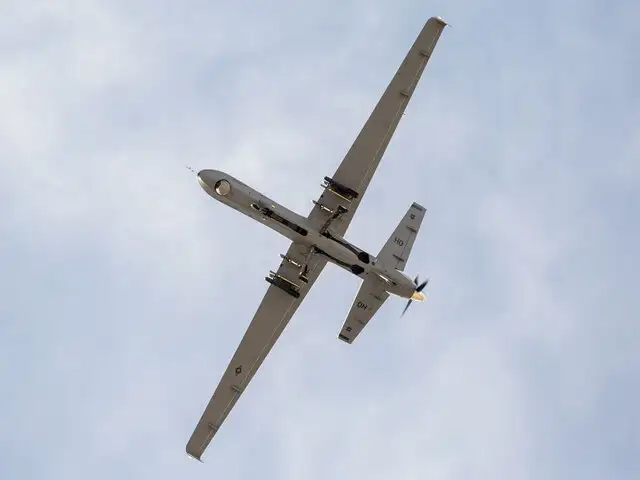
The MQ-9 Reaper is a large unmanned Air Force aircraft that is operated remotely by a two-person team consisting of a rated pilot and an enlisted aircrew member. The aircraft features a 66-foot wingspan, a Honeywell engine, a ground control station, and satellite equipment.
A team of pilots and sensor operators stationed on the ground remotely control the Reapers, often from a significant distance away. While the pilot manages the takeoff, flight path, and landing, the sensor operators handle cameras and surveillance gear.
During the Iraq and Afghanistan wars, the Reaper was regularly deployed for surveillance and airstrikes, and it can be equipped with up to eight laser-guided missiles, including Hellfire missiles and other advanced munitions. With the ability to loiter over targets for over 27 hours, the Reaper can be armed or unarmed, and it is about 36 feet long, 12 feet high, and weighs approximately 4,900 pounds (2,220 kg) when it is empty. It can reach an altitude of up to 50,000 feet and has a range of about 1,400 nautical miles.
Introduced in 2007, the Reaper replaced the smaller Predator drones in the Air Force's inventory. The cost of each Reaper is roughly $32 million.
ADVERTISEMENT
According to General Atomics Aeronautical Systems Inc, its manufacturer, the drone can travel at a top speed of 275 mph and can carry 3,900 pounds of fuel, making it suitable for lengthy missions. Some of the models are capable of flying continuously for up to 34 hours.
Despite the MQ-9 Reaper's ability to release bombs and missiles, it is vulnerable to attack due to its sluggish speed and lack of defensive capabilities.
ADVERTISEMENT
The MQ-9 Reaper is a more recent and larger variant of the MQ-1 Predator drone, which was utilized by the U.S. Air Force until 2018. The Reapers are swifter, have superior sensors, and can carry more weapons, as per an Air Force statement.
India keeps an eye on drone warfare even as it considers buying the US MQ-9 Reaper
1/5
According to a report by ET, India is keeping a close watch on the high profile Armenia-Azerbaijan conflict that has been replete with dramatic drone footage of air strikes. Air Chief Marshal RKS Bhadauria said that India has similar capability available – a reference to the Israeli origin Harop/Harpy suicide drones in service – but UAVs are very susceptible to enemy action and have to be part of a larger mix of weapons in any conflict. (Representative Image)
According to a report by ET, India is keeping a close watch on the high profile Armenia-Azerbaijan conflict that has been replete with dramatic drone footage of air strikes. Air Chief Marshal RKS Bha..
Read More
“There will always be limitations when drones are used to attack in the way they have been used in this conflict. Some will fall to enemy action and a percentage will succeed. One should have a combination of such assets…(but) we cannot plan to win a war with just these,” the Air Chief said in response to a question by ET. “Drones are an important part for surveillance and intelligence gathering. Their role in the build up to a conflict is very important. However, once the conflict starts, they do become susceptible to enemy action, which is a known fact,” he said. (Representative Image)
“There will always be limitations when drones are used to attack in the way they have been used in this conflict. Some will fall to enemy action and a percentage will succeed. One should have a combi..
Read More
The Defence Ministry has not yet reached any conclusion over procurement of 30 armed drones from US-based General Atomics as the Indian Air Force has raised apprehensions over their usefulness. The deal is valued at approximately $3 billion. With the disputed borders with China and Pakistan active at the same point of time, the Defence Ministry has clearly stated that they are not in a hurry to sanction procurement in the name of emergency. India was earlier looking for procurement of 30 drones from General Atomics. The three services were expected to get 10+10+10 of the MQ-9 Reaper, which has already been approved by US President Donald Trump's administration.
The Defence Ministry has not yet reached any conclusion over procurement of 30 armed drones from US-based General Atomics as the Indian Air Force has raised apprehensions over their usefulness. The d..
Read More
Indian Army Vice Chief Lieutenant General S.K. Saini said on October 10 that amongst other threats, drones and UAVs stand out in their innovative employment and destructive potential. "Considering their low cost, multi-use and dense proliferation, the threat will no doubt increase manifold in the years to come," he said. "In this context, third dimension threats may take precedence in the near future, for which we need to plan now. Both hard kill and soft kill counter-drone solutions including swarm technology are the need of the hour," he pointed out. (Representative Image)
Indian Army Vice Chief Lieutenant General S.K. Saini said on October 10 that amongst other threats, drones and UAVs stand out in their innovative employment and destructive potential. "Considering th..
Read More
As Seema Sirohi, columnist for The Economic Times writes, given the border situation with China, India will soon lease two drones from the US government for naval surveillance while the procurement process for the sale of 30 armed predator drones, well, drones on. The two leased drones will not be armed but will have censors. Leasing was seen as the quickest way to get ‘eyes’ on the situation.
As Seema Sirohi, columnist for The Economic Times writes, given the border situation with China, India will soon lease two drones from the US government for naval surveillance while the procurement p..
The U.S. Department of Homeland Security, NASA, the UK Royal Air Force, the Italian Air Force, the French Air Force, and the Spanish Air Force have all procured MQ-9s.
The Reaper is primarily utilized for gathering intelligence and secondarily for targeting dynamic execution. The United States Air Force asserts that it has a unique capacity to strike, coordinate, and survey high-value, fleeting, and time-sensitive targets, owing to its extensive loiter time, wide-range sensors, multi-mode communication system, and precision weaponry. Moreover, the Reaper is capable of carrying out a range of tasks such as intelligence, surveillance and reconnaissance, close air support, combat search and rescue, precision strike, buddy-lase, convoy and raid overwatch, route clearance, target development, and terminal air guidance.
The MQ-9 has distinctive capabilities that make it particularly suited for supporting combatant commanders' goals by executing irregular warfare operations.
FILE PHOTO: A U.S. Air Force MQ-9 Reaper drone sits in a hanger at Amari Air Base, Estonia, July 1, 2020. REUTERS/Janis Laizans
Why do the US and other countries use Drones?
Compared to manned aircraft with similar capabilities, drones are usually more affordable and safer for operators due to their lack of need for a pilot. Additionally, drones have the unique ability to gather intelligence material for extended periods, as they can loiter for hours. General Atomics reports that drones cost approximately $3,500 per flight hour, which is significantly less than the $8,000 per flight hour required to operate an F-16.
The Air Force states that they can procure four MQ-9 aircraft, complete with sensors, ground control station, and satellite link, for a total of $56.5 million.
Several Reapers lost
"According to General Atomics, the MQ-9 has displayed proficiency in air-to-air combat during Air Force assessments. Moreover, it can be fitted with a "Self Protect Pod" which can identify potential threats and counter surface-to-air weaponry."
Recent years have seen the loss of numerous MQ-9 Reapers, which serve as a mainstay of the U.S. military's aerial surveillance arsenal, including losses due to enemy fire.
In 2019, one of the drones was downed over Yemen by a surface-to-air missile fired by Houthi rebels, according to the U.S. Central Command.
Media outlets have reported that a U.S. MQ-9 crashed in Libya in 2022, and another was lost during a training exercise in Romania earlier that same year.
The United States has utilized these aircraft in Afghanistan, Iraq, and Syria. Despite criticism of the drones' involvement in attacks resulting in civilian deaths, proponents argue that their capacity for precise targeting minimizes collateral damage.



 US lost 42 aircraft, including fighter jets, MQ-9 Reaper drones in Iran war: Report2026-05-20T02:57:29Z

