
Nobel Prize in Physics 2025: John Clarke, Michel H. Devoret, and John M. Martinis are honoured for breakthrough discovery in “quantum mechanical tunnelling”
1/6
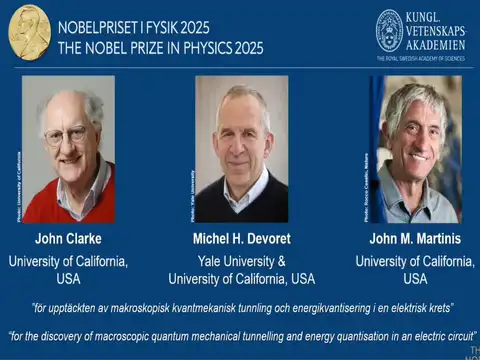
The 2025 physics laureates
John Clarke (UC Berkeley), Michel H. Devoret (Yale; also UCSB), and John M. Martinis (UCSB) share the Physics Nobel for showing that quantum rules—usually seen with tiny particles—can appear in an electrical circuit you can hold in your hand. Their experiments made abstract ideas concrete.
2/6
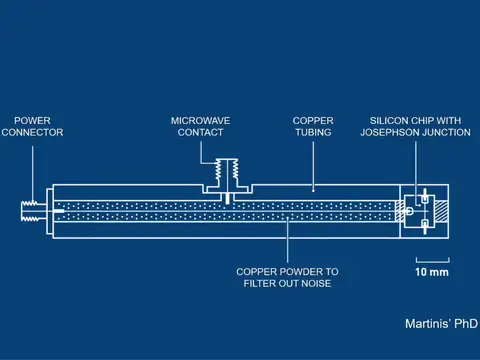
What they proved
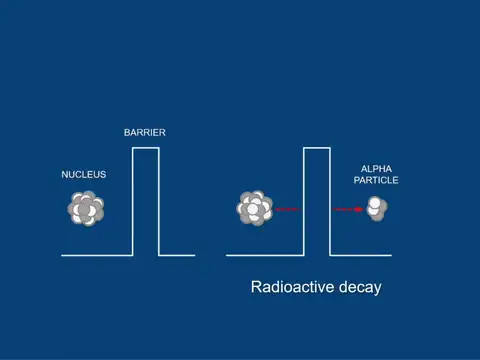
They built a special superconducting circuit that can slip through an energy barrier (quantum “tunnelling”) and can only take in or give out energy in fixed packets (“quantised” energy). Both effects were observed at a macroscopic scale, not just in single atoms or electrons.
3/6
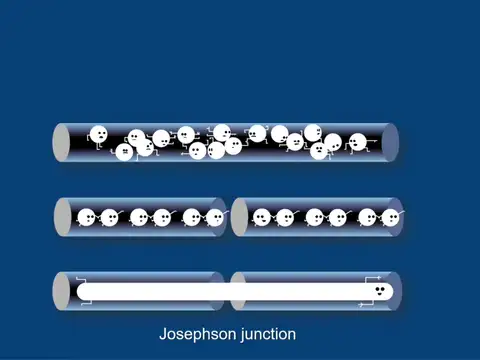
How the circuit makes this possible
Two superconductors were separated by a thin barrier to form a Josephson‑type element. At very low temperatures and with careful design, the entire circuit behaves like one “quantum object,” letting researchers watch tunnelling events and discrete energy levels directly in the lab.
Amazon Top Deals
POWERED BY

Crompton Ozone 75 Litres Desert Air Cooler for home | Large & Easy Clean Ice Chamber | 4-Way Air Deflection | High Density Honeycomb Pads | Everlast Pump | Auto Fill| 3 Year Brand Warranty
₹9,798Buy Now43%
OFF

LG 32 L Convection Microwave Oven (MC3286BRUM, Black, 360° Motorised Rotisserie for Bar-be-queing, 301 Auto Cook Menu, Stainless steel cavity, Indian Cuisine, Tandoor Se, Steam Clean & Diet Fry)
₹19,340Buy Now19%
OFF
4/6
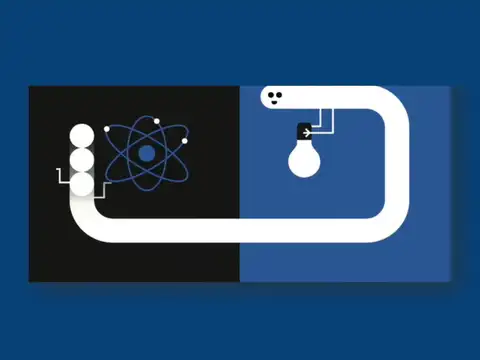
Why this is a big deal
Quantum behavior seen at a human scale opens doors for devices that measure tiny signals, store quantum information, or communicate securely. Making quantum effects robust in circuits is a foundation for quantum computers, quantum cryptography, and ultrasensitive sensors.
5/6
A quick mental picture
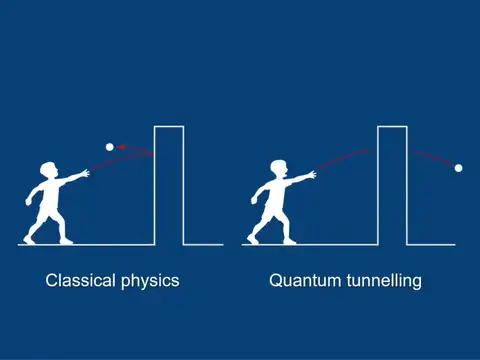
Imagine a ball stuck in a valley separated by a hill. Classically, it can’t cross without enough push. In the quantum world, the ball sometimes appears on the other side without climbing the hill—that’s tunnelling. Also, it can only climb to certain ledges—those are quantised energy levels.
6/6
From discovery to applications
These circuits helped inspire today’s superconducting qubits and quantum measurement tools. While modern systems are more advanced, they build on the same principles first demonstrated in these macroscopic experiments.