Export pessimism again: Trade policy of Modi government falls short on ambition and ideas
The reason is not far to seek. FTP, while being in the right direction, reflects business as usual and attempts only incremental change.
Updated:

By: Rajiv Kumar
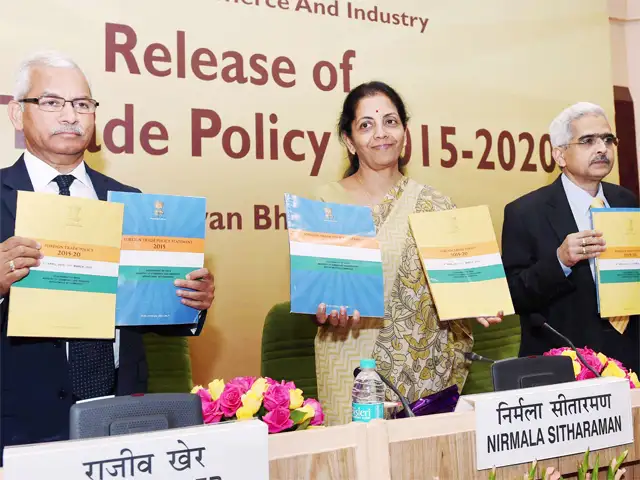
The Foreign Trade Policy (FTP) of the NDA government, announced by trade minister Nirmala Sitharaman earlier this month, is in two parts. It includes an FTP statement itself 66 pages long, accompanied by the actual policy that is another 159 pages! With all this commendable effort, it may still not achieve Sitharaman's stated objective that "it will enable India to respond to the challenges of external trade environment and take India to the next level in international trade".
The reason is not far to seek. FTP, while being in the right direction, reflects business as usual and attempts only incremental change rather than the bold new beginning that is needed if India is to "assume a position of leadership in the international trade discourse".
India cannot aspire to be a global leader with a mere 2% share in global trade. This may rise to 3.5% with FTP's target of raising total (merchandise plus services) exports from $465.9 billion in 2013-14 to $900 billion by 2020-21. Even this will not suffice to give us the status of a major export power or a legitimate seat on the global governance high table. We have to do better than achieving an annual export growth rate of 15% as assumed by FTP.
The assumed growth rate is inexplicably significantly lower than the 21% achieved by Indian exporters in the five years between 2005-06 and 2010-11. Between 2003 and 2010 Chinese exports increased from $438 billion to $1,578 billion at a compound annual growth rate of more than 30%. As a result, China's exports were $2.2 trillion in 2013 and accounted for 11.7% of global exports. At this level they are nearly five times India's total exports!
Clearly FTP has adopted a somewhat cautious target, which will not allow India to exploit the full potential of external demand for generating employment and expanding domestic manufacturing capacities.
FTP includes some steps for simplifying the system of rewards or incentives for exporters. First, it introduces the Merchandise Exports from India (MEIS) and Service Exports from India Schemes. These bring together a number of existing schemes under one head, makes these rewards payable in the form of duty credit scrip that are freely transferable and can be used to pay for customs and excise duties as well as service tax.
Second, these incentives are also made available to units operating from the Special Economic Zones (SEZs). Third, manufacturing exporters who are also status holders can now self-certify their goods as originating from India. Fourth, export units operating under four export promotion schemes will henceforth have access to fast track mechanisms, allowed to share infrastructure facilities and permitted to establish warehouses near their chosen ports. Other measures may well be hidden in the minutiae.
However, despite being nine months in the making, FTP leaves several well-known constraints unaddressed. SEZs continue to suffer from the minimum alternate tax. MEIS comes with a non-eligibility list of 19 criteria; MSME exporters will neither have any relief from the number of inspectors that plague them, nor be assured of better access to formal credit.
There is no special effort to attract export-oriented FDI and address infrastructure weaknesses, which are recognised to be two essential conditions for making Indian exporters a part of global value chains. FTP does not give a firm date for setting up the Directorate General of Trade Remedies.
It also does not give any details of the proposed Centre for Research in International Trade, which will hopefully be merged with the ministry's own Indian Institute of Foreign Trade. It might have been advisable to announce FTP after another three months during which these details would have been worked out and action completed on reducing cost and time in processing export and import applications.
The Foreign Trade Policy (FTP) of the NDA government, announced by trade minister Nirmala Sitharaman earlier this month, is in two parts. It includes an FTP statement itself 66 pages long, accompanied by the actual policy that is another 159 pages! With all this commendable effort, it may still not achieve Sitharaman's stated objective that "it will enable India to respond to the challenges of external trade environment and take India to the next level in international trade".
The reason is not far to seek. FTP, while being in the right direction, reflects business as usual and attempts only incremental change rather than the bold new beginning that is needed if India is to "assume a position of leadership in the international trade discourse".
India cannot aspire to be a global leader with a mere 2% share in global trade. This may rise to 3.5% with FTP's target of raising total (merchandise plus services) exports from $465.9 billion in 2013-14 to $900 billion by 2020-21. Even this will not suffice to give us the status of a major export power or a legitimate seat on the global governance high table. We have to do better than achieving an annual export growth rate of 15% as assumed by FTP.
The assumed growth rate is inexplicably significantly lower than the 21% achieved by Indian exporters in the five years between 2005-06 and 2010-11. Between 2003 and 2010 Chinese exports increased from $438 billion to $1,578 billion at a compound annual growth rate of more than 30%. As a result, China's exports were $2.2 trillion in 2013 and accounted for 11.7% of global exports. At this level they are nearly five times India's total exports!
Clearly FTP has adopted a somewhat cautious target, which will not allow India to exploit the full potential of external demand for generating employment and expanding domestic manufacturing capacities.
ADVERTISEMENT
FTP includes some steps for simplifying the system of rewards or incentives for exporters. First, it introduces the Merchandise Exports from India (MEIS) and Service Exports from India Schemes. These bring together a number of existing schemes under one head, makes these rewards payable in the form of duty credit scrip that are freely transferable and can be used to pay for customs and excise duties as well as service tax.
Second, these incentives are also made available to units operating from the Special Economic Zones (SEZs). Third, manufacturing exporters who are also status holders can now self-certify their goods as originating from India. Fourth, export units operating under four export promotion schemes will henceforth have access to fast track mechanisms, allowed to share infrastructure facilities and permitted to establish warehouses near their chosen ports. Other measures may well be hidden in the minutiae.
However, despite being nine months in the making, FTP leaves several well-known constraints unaddressed. SEZs continue to suffer from the minimum alternate tax. MEIS comes with a non-eligibility list of 19 criteria; MSME exporters will neither have any relief from the number of inspectors that plague them, nor be assured of better access to formal credit.
There is no special effort to attract export-oriented FDI and address infrastructure weaknesses, which are recognised to be two essential conditions for making Indian exporters a part of global value chains. FTP does not give a firm date for setting up the Directorate General of Trade Remedies.
ADVERTISEMENT
It also does not give any details of the proposed Centre for Research in International Trade, which will hopefully be merged with the ministry's own Indian Institute of Foreign Trade. It might have been advisable to announce FTP after another three months during which these details would have been worked out and action completed on reducing cost and time in processing export and import applications.
There are three major omissions. First, lack of a policy for ramping up foreign tourism in which India is truly a poor performer. With its meagre 7.5 million foreign tourist arrivals per year, India is losing out on a major employment expansion opportunity.
Second, the MSME sector – which produces 45% of manufacturing output and 40% of total exports – receives only cursory treatment without any tangible steps to make it a part of global value chains or improving access to needed technologies and markets. Third, FTP leaves the large panoply of export promotion and facilitation institutions virtually untouched, despite the majority of them not contributing effectively to the export effort.
The argument that tourism, manufacturing or MSMEs come under different ministries and consequently cannot be covered under FTP is contrary to FTP's own assertion that the document represents the effort of the ‘whole government' and tries to mainstream export activity. It would have been far better if FTP was accompanied by policy announcements for export expansion by other ministries like tourism, handicrafts, textiles, IT services and ministry of MSMEs.
Such a coordinated exercise, undertaken for the first time, would have shown a government working towards a common goal and inspired greater confidence. As it is, government has reinforced the impression that it is happy to tinker at the margins rather than go to the drawing board for designing a bold new policy approach.
Such incrementalism could disillusion investors who expected a new policy paradigm from the Modi government for tackling India's serious employment challenge.
ADVERTISEMENT
He is senior fellow, Centre for Policy Research, Delhi.Download
The Economic Times Business News App for the Latest News in Business, Sensex, Stock Market Updates & More.
The Economic Times Business News App for the Latest News in Business, Sensex, Stock Market Updates & More.
Download
The Economic Times News App for Quarterly Results, Latest News in ITR, Business, Share Market, Live Sensex News & More.
The Economic Times News App for Quarterly Results, Latest News in ITR, Business, Share Market, Live Sensex News & More.
Related Articles
 Seven-fold rise in funds under externally aided projects in northeast under Modi government: Nirmala Sitharaman2026-06-19T15:04:44Z
- Modi government has belittled India's global standing and sovereignty: Mallikarjun Kharge2026-06-14T13:32:05Z
- 12 years of Modi government strengthened India's health sector through accessibility and digital innovation: Amit Shah2026-06-14T09:25:25Z
Text: ET Bureau
With an aim to make India a significant partner in global trade by 2020, the government on Wednesday unveiled a new Foreign Trade Policy (FTP).
Talking about the new policy, which aims at boosting India's exports, Commerce Minister Nirmala Sitharaman said that PM Narendra Modi's pet projects, 'Make in India' and 'Digital India' will be integrated with the new Foreign Trade Policy.
The government is pitching India as a friendly destination for manufacturing and exporting goods, and the new policy is being seen as an important step towards realising that goal.
We take a look at some key features of the new Foreign Trade Policy:
Image: Minister of State for Commerce & Industry (Independent Charge), Nirmala Sitharaman with Revenue Secretary Shaktikanta Das and Commerce Secretary, Rajeev Kher releasing the “Foreign Trade Policy 2015-2020” in New Delhi on April 1, 2015.
With an aim to make India a significant partner in global trade by 2020, the government on Wednesday unveiled a new Foreign Trade Policy (FTP).
Talking about the new policy, which aims at boosting India's exports, Commerce Minister Nirmala Sitharaman said that PM Narendra Modi's pet projects, 'Make in India' and 'Digital India' will be integrated with the new Foreign Trade Policy.
The government is pitching India as a friendly destination for manufacturing and exporting goods, and the new policy is being seen as an important step towards realising that goal.
We take a look at some key features of the new Foreign Trade Policy:
Image: Minister of State for Commerce & Industry (Independent Charge), Nirmala Sitharaman with Revenue Secretary Shaktikanta Das and Commerce Secretary, Rajeev Kher releasing the “Foreign Trade Policy 2015-2020” in New Delhi on April 1, 2015.



ADVERTISEMENT


