Budget 2015: Why government should avoid public spending to speed up the economy
A stimulus mindset is the opposite of a tough reform mindset, and governments can rarely do both as the contrasting experience of the 1990s showed.
Updated:

By Ruchir Sharma
India’s economic elite has launched a distracting discussion about new public spending to speed up the economy, despite fresh and glaring evidence that this is a bad idea. Many big emerging nations including China, Russia and Brazil just tried a full-throttle experiment in stimulus spending, and it failed.
The average growth rate for emerging economies excluding China has fallen to 2.5% today, from more than 7% at the height of the spending campaign in 2010. That is the lowest growth rate in four decades, outside of a global recession. For leaders in these countries, stimulus is now a bad word.
Their experiment began in late 2008. As it became clear that falling Western demand was going to undermine growth in emerging economies, these nations embarked on a hurried campaign to fight the looming recession by ramping up public spending. In fact the stimulus campaign launched by emerging economies would dwarf its counterparts in the US and Europe. Among the G-20 – major emerging and developed economies – developed nations spent a sum equal to 4.2% of gross domestic product on stimulus in 2009 and 2010, based on data from the International Labour Organisation (ILO). Emerging ones spent more than half again as much, 6.9% of GDP.
Back then, emerging nations could actually afford to spend more than rich countries, ironically enough. Unlike governments of Europe, those of the emerging world went into the global financial crisis with little public debt, large reserves of foreign currency, and either budget surpluses or small deficits. They had money to burn and they burnt it, producing a brief flare of impressive growth. After bottoming at 3% in 2009, average GDP growth rate in big emerging economies more than doubled in 2010.
True believers in big spending let out a cheer. In 2011, ILO teamed up with European Union and others in lauding the contribution of heavy stimulus spending to a “spectacular” recovery in Asia, and a lesser one in Latin America. Alas, by that point, the flameout was already beginning.
China had ordered up the biggest stimulus – its spending would total 12% of GDP – but since 2010 its growth rate has fallen by a third and it is headed well below 7%. Brazil is in recession. Russia, which spent a staggering 10% of GDP on stimulus, was slowing sharply even before oil prices collapsed.
What happened? Emerging nations borrowed from the future to produce that flash of growth in 2010, and now they face the bills. Their government budgets have fallen into the red, from an aggregate EM surplus of 1% in 2007 to a deficit equal to around 3% of GDP in 2014, while key measures of productivity have declined sharply. Such deterioration helps explain why IMF and others are lowering forecasts for emerging-world GDP growth for the rest of this decade to 4% or less – a return to the pace of the crisis-ridden 1990s.
There is never a good time to rush into big spending programmes, but this is exactly the wrong time for India. The combined government deficit is 6.5% of GDP, one of the highest in the emerging world and government debt as a share of the economy is still at 60%, which is very high for a country with a per capita income of under $2,000.
India’s economic elite has launched a distracting discussion about new public spending to speed up the economy, despite fresh and glaring evidence that this is a bad idea. Many big emerging nations including China, Russia and Brazil just tried a full-throttle experiment in stimulus spending, and it failed.
The average growth rate for emerging economies excluding China has fallen to 2.5% today, from more than 7% at the height of the spending campaign in 2010. That is the lowest growth rate in four decades, outside of a global recession. For leaders in these countries, stimulus is now a bad word.
Their experiment began in late 2008. As it became clear that falling Western demand was going to undermine growth in emerging economies, these nations embarked on a hurried campaign to fight the looming recession by ramping up public spending. In fact the stimulus campaign launched by emerging economies would dwarf its counterparts in the US and Europe. Among the G-20 – major emerging and developed economies – developed nations spent a sum equal to 4.2% of gross domestic product on stimulus in 2009 and 2010, based on data from the International Labour Organisation (ILO). Emerging ones spent more than half again as much, 6.9% of GDP.
Back then, emerging nations could actually afford to spend more than rich countries, ironically enough. Unlike governments of Europe, those of the emerging world went into the global financial crisis with little public debt, large reserves of foreign currency, and either budget surpluses or small deficits. They had money to burn and they burnt it, producing a brief flare of impressive growth. After bottoming at 3% in 2009, average GDP growth rate in big emerging economies more than doubled in 2010.
True believers in big spending let out a cheer. In 2011, ILO teamed up with European Union and others in lauding the contribution of heavy stimulus spending to a “spectacular” recovery in Asia, and a lesser one in Latin America. Alas, by that point, the flameout was already beginning.
ADVERTISEMENT
China had ordered up the biggest stimulus – its spending would total 12% of GDP – but since 2010 its growth rate has fallen by a third and it is headed well below 7%. Brazil is in recession. Russia, which spent a staggering 10% of GDP on stimulus, was slowing sharply even before oil prices collapsed.
What happened? Emerging nations borrowed from the future to produce that flash of growth in 2010, and now they face the bills. Their government budgets have fallen into the red, from an aggregate EM surplus of 1% in 2007 to a deficit equal to around 3% of GDP in 2014, while key measures of productivity have declined sharply. Such deterioration helps explain why IMF and others are lowering forecasts for emerging-world GDP growth for the rest of this decade to 4% or less – a return to the pace of the crisis-ridden 1990s.
There is never a good time to rush into big spending programmes, but this is exactly the wrong time for India. The combined government deficit is 6.5% of GDP, one of the highest in the emerging world and government debt as a share of the economy is still at 60%, which is very high for a country with a per capita income of under $2,000.
A stimulus mindset is the opposite of a tough reform mindset, and governments can rarely do both as the contrasting experience of the 1990s showed. By the end of that decade, most emerging nations had no money to burn, no lenders they could turn to. They were forced instead to reform, cleaning up bad debts and pushing to make companies more competitive. Tough reform set up these economies to boom in the last decade.
After 2008, many of these same countries focussed on stimulus, largely ignoring reforms. As they ramped up stimulus spending, more and more of the money went to wasteful projects. This decay is symbolised by the half-empty malls and apartment complexes rising across China – many of which were hurriedly seeded in 2009. The message: When the state spends in haste, it will repent at leisure.
India is now again flirting with a path that many emerging world leaders just recently rejected. In May last year, Chinese Premier Li Keqiang warned that using stimulus to generate growth is “not sustainable” and “creates more problems”. Mexican central bank president Agustin Carstens recently told me that in the long run “fiscal and monetary policy cannot create growth”. Even former finance minister P Chidambaram has admitted that his government “lost control of the economy” because its long stimulus campaign led to higher deficits and inflation.
And at this early point in the administration, attempting a new round of public spending would only distract from the real job of reform.
(The author is Head of Emerging Markets Equity and Global Macro, Morgan Stanley.)
Download
The Economic Times Business News App for the Latest News in Business, Sensex, Stock Market Updates & More.
The Economic Times Business News App for the Latest News in Business, Sensex, Stock Market Updates & More.
Download
The Economic Times News App for Quarterly Results, Latest News in ITR, Business, Share Market, Live Sensex News & More.
The Economic Times News App for Quarterly Results, Latest News in ITR, Business, Share Market, Live Sensex News & More.
Text: ET Bureau
ET looks at the recent speeches of finance minister Arun Jaitley for clues to the budget for FY16. The budget is widely expected to lay down the agenda for the remaining four years of the Narendra Modi government.
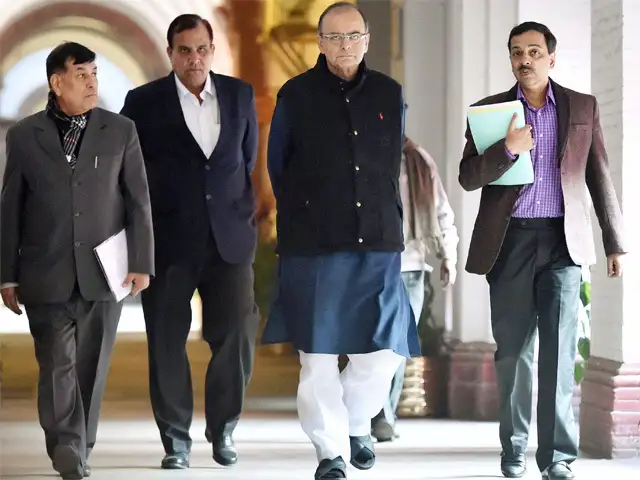
In Pic: Jaitley arrives at the Pre-Budget Consultation with the representatives of Trade Union, in New Delhi.
ET looks at the recent speeches of finance minister Arun Jaitley for clues to the budget for FY16. The budget is widely expected to lay down the agenda for the remaining four years of the Narendra Modi government.
In Pic: Jaitley arrives at the Pre-Budget Consultation with the representatives of Trade Union, in New Delhi.