Opinion: The new GDP data shouldn't cause euphoria
Most analysts think the economy will fare better in 2014-15 . The GDP data for the first two quarters — although based on the old definitions — does suggest acceleration.
Updated:

By Swaminathan S Anklesaria Aiyar
Most analysts have wailed and moaned about India's weak economic performance in the last three years. But suddenly, data revisions by the Central Statistical Organisation suggest that the economy has done pretty well, growing as fast as 6.9% in 2013-14 — against the original estimate of just 5%.
Most analysts think the economy will fare better in 2014-15 than last year. The GDP data for the first two quarters — although based on the old definitions — does suggest acceleration.
Going by the old data series, analysts expected GDP to rise from 4.9% last year to 5.5% this year. Assuming similar improvement in the new data for four quarters, growth will go up from 6.9% last year to perhaps 7.5% this year, well above the 7% benchmark of a tiger economy.
Optimists will cheer. But sceptics will say that revisions on paper can only produce paper tigers, not real ones. My immediate reaction is sceptical, though only time will tell.
There are many indicators in an economy apart from GDP. When they all point in the same direction, they buttress one another's credibility. Right now, other indicators do not buttress the upward GDP revision that paints India as a tiger.
CNBC data show that for 664 companies that till last week had declared their financial results for the third quarter, sales are up just 1.3% and net profits by just 3.4% on a year-onyear basis. On a quarter-on-quarter basis, sales are down 2.8% and net profits by 6.1%. These are disappointing figures, especially since falling commodity prices should have boosted demand and profit margins.
No sign of a tiger here. In the boom years, tax collections soared by up to 30% per year. There's no sign of that currently. Overall tax collections have risen at just half the budgeted rate of 19% during April-November, and excise duty collections — a critical measure of industrial buoyancy — are actually down 2.7%. That's truly dismal.
Loans Lie Low
Booming bank credit is a typical sign of tigerish growth. But the growth of bank credit since the beginning of the financial year has been only 6.6%, against 9.7% in the corresponding period the previous year. Yearon-year credit growth is 10.7% against 14.5% a year earlier. Remember, in the tiger years of the 2000s, credit growth rose by up to 30% per year.
The index of industrial production has long been criticised for sundry flaws, and has not been overhauled along with the national accounts. Still, it remains an important indicator, and currently looks pretty bad.
For the first eight months of the current fiscal year, industrial production is up only 2.2%. Electricity is the brightest spot, up 10.7%, but mining is up only 2.5% and manufacturing by a pathetic 1.1%.
Capital goods production is up 4.9%, against double-digit growth in the palmy 2000s. Consumer durables, a good measure of consumer strength and confidence, are down by as much as 15.9%. Mind you, these figures is a definite improvement on the more dismal performance the previous year. But they hardly inspire.
Exports have been a significant source of growth: merchandise exports grew at a compound rate of almost 20% in the boom years 2003-09. India's exports stagnated after 2011-12, along with the GDP slowdown. Export growth in the first half of 2014 suggested a revival, but the global economy slowed, so did our exports. They averaged only 4% growth during April-November. Global trade prospects keep getting bleaker: the IMF has reduced its projections once again.
To be sure, there are some positive trends too. The crash in oil and other commodity prices has slashed the current account deficit, which may be no more than 1.5% of GDP this year and even less next year.
Cheap oil has also helped reduce fiscal strains and inflation. Indeed, inflation has fallen faster than the RBI's glide path, and wholesale price inflation is close to zero. Yet, these have not produced tigerish trends in industrial production, bank credit, exports or tax collections.
Narendra Modi's assumption of power at the Centre and proposed reforms have enthused Indian and foreign investors. The latter poured $40 billion into India in 2014, more in portfolio than direct investment. Soaring stock markets have enabled the government and corporations to raise cash through capital markets.
Most analysts have wailed and moaned about India's weak economic performance in the last three years. But suddenly, data revisions by the Central Statistical Organisation suggest that the economy has done pretty well, growing as fast as 6.9% in 2013-14 — against the original estimate of just 5%.
Most analysts think the economy will fare better in 2014-15 than last year. The GDP data for the first two quarters — although based on the old definitions — does suggest acceleration.
Going by the old data series, analysts expected GDP to rise from 4.9% last year to 5.5% this year. Assuming similar improvement in the new data for four quarters, growth will go up from 6.9% last year to perhaps 7.5% this year, well above the 7% benchmark of a tiger economy.
Optimists will cheer. But sceptics will say that revisions on paper can only produce paper tigers, not real ones. My immediate reaction is sceptical, though only time will tell.
There are many indicators in an economy apart from GDP. When they all point in the same direction, they buttress one another's credibility. Right now, other indicators do not buttress the upward GDP revision that paints India as a tiger.
ADVERTISEMENT
CNBC data show that for 664 companies that till last week had declared their financial results for the third quarter, sales are up just 1.3% and net profits by just 3.4% on a year-onyear basis. On a quarter-on-quarter basis, sales are down 2.8% and net profits by 6.1%. These are disappointing figures, especially since falling commodity prices should have boosted demand and profit margins.
No sign of a tiger here. In the boom years, tax collections soared by up to 30% per year. There's no sign of that currently. Overall tax collections have risen at just half the budgeted rate of 19% during April-November, and excise duty collections — a critical measure of industrial buoyancy — are actually down 2.7%. That's truly dismal.
Loans Lie Low
Booming bank credit is a typical sign of tigerish growth. But the growth of bank credit since the beginning of the financial year has been only 6.6%, against 9.7% in the corresponding period the previous year. Yearon-year credit growth is 10.7% against 14.5% a year earlier. Remember, in the tiger years of the 2000s, credit growth rose by up to 30% per year.
ADVERTISEMENT
The index of industrial production has long been criticised for sundry flaws, and has not been overhauled along with the national accounts. Still, it remains an important indicator, and currently looks pretty bad.
For the first eight months of the current fiscal year, industrial production is up only 2.2%. Electricity is the brightest spot, up 10.7%, but mining is up only 2.5% and manufacturing by a pathetic 1.1%.
ADVERTISEMENT
Capital goods production is up 4.9%, against double-digit growth in the palmy 2000s. Consumer durables, a good measure of consumer strength and confidence, are down by as much as 15.9%. Mind you, these figures is a definite improvement on the more dismal performance the previous year. But they hardly inspire.
Exports have been a significant source of growth: merchandise exports grew at a compound rate of almost 20% in the boom years 2003-09. India's exports stagnated after 2011-12, along with the GDP slowdown. Export growth in the first half of 2014 suggested a revival, but the global economy slowed, so did our exports. They averaged only 4% growth during April-November. Global trade prospects keep getting bleaker: the IMF has reduced its projections once again.
To be sure, there are some positive trends too. The crash in oil and other commodity prices has slashed the current account deficit, which may be no more than 1.5% of GDP this year and even less next year.
Cheap oil has also helped reduce fiscal strains and inflation. Indeed, inflation has fallen faster than the RBI's glide path, and wholesale price inflation is close to zero. Yet, these have not produced tigerish trends in industrial production, bank credit, exports or tax collections.
Narendra Modi's assumption of power at the Centre and proposed reforms have enthused Indian and foreign investors. The latter poured $40 billion into India in 2014, more in portfolio than direct investment. Soaring stock markets have enabled the government and corporations to raise cash through capital markets.
The HSBC Purchasing Managers' Index, which was around 51% a year ago, has been rising steadily and touched 54.5% in December. The Centre for Monitoring Indian Economy gives estimates of new investment intentions of the public and private sectors. These rose by 176% year-onyear in the September-December quarter.
However, recent years have repeatedly seen high intentions that are not fulfilled. The UPA and then the Modi government have cleared over Rs 7 lakh crore of projects, but have not yet produced a boom in capital goods or construction.
Future prospects do indeed look better. But right now, key indicators show no sign of tigerish growth. Hence, the revision of GDP data should not cause euphoria. Some scepticism is in order.
(For a counterview, read ET's 'Economic Census: If there was a recovery in 2013-14, why did people miss it?' at goo.gl/NYSgBk)
Download
The Economic Times Business News App for the Latest News in Business, Sensex, Stock Market Updates & More.
The Economic Times Business News App for the Latest News in Business, Sensex, Stock Market Updates & More.
Download
The Economic Times News App for Quarterly Results, Latest News in ITR, Business, Share Market, Live Sensex News & More.
The Economic Times News App for Quarterly Results, Latest News in ITR, Business, Share Market, Live Sensex News & More.
Related Articles
 Parliamentary panel moots higher education spending, says NEP's 6% GDP target unmet2026-06-17T12:31:54Z
- Goldman Sachs cuts India's 2026 CAD forecast to 1.3% of GDP2026-06-15T19:10:09Z
- CEA defends India's GDP data, says country does not use methodology changes to inflate growth numbers2026-06-14T11:55:42Z
Text: ET Bureau
ET looks at the recent speeches of finance minister Arun Jaitley for clues to the budget for FY16. The budget is widely expected to lay down the agenda for the remaining four years of the Narendra Modi government.
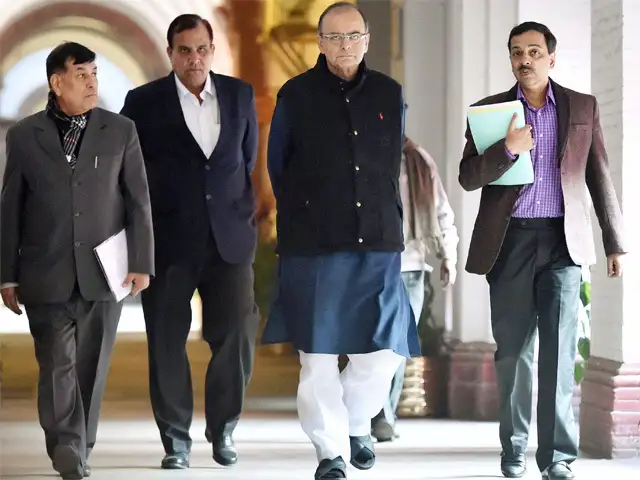
In Pic: Jaitley arrives at the Pre-Budget Consultation with the representatives of Trade Union, in New Delhi.
ET looks at the recent speeches of finance minister Arun Jaitley for clues to the budget for FY16. The budget is widely expected to lay down the agenda for the remaining four years of the Narendra Modi government.
In Pic: Jaitley arrives at the Pre-Budget Consultation with the representatives of Trade Union, in New Delhi.