Industrial production growth at three-month high of 5% in February
Growth for November was also revised to 5.2% from 3.9% estimated initially, pointing to an upward turn in the more frequent indicators of growth.
By ET Bureau | Updated:

NEW DELHI: A day after international ratings agency Moody’s updated its outlook on India’s credit rating, industrial production data provided more cheer on Friday, raising hopes that the economic growth is finally gathering some pace.
Industrial production growth accelerated to a three-month high of 5% in February compared with 2.6% in the previous month on the back of strong manufacturing, data released by the statistics office showed. Growth for November was also revised to 5.2% from 3.9% estimated initially, pointing to an upward turn in the more frequent indicators of growth, though still negative consumer durables production pointed to a weak buyer sentiment.
As per the revamped GDP methodology, the economy is expected to grow at 7.4% in the current fiscal, but most experts have questioned the numbers citing weak industrial production and anecdotal evidence. For 2015-16, the government has forecast GDP growth between 8.1 and 8.5%. The latest numbers partly address those concerns, although the February growth is magnified because of a strong base effect of negative 2% growth last year.
“I am hopeful of growth picking up in two areas, mining and power, due to the successful coal auction,” said DK Joshi, chief economist, Crisil, adding that he also expects consumer goods production to start picking up after two years of negative growth.
Soumya Kanti Ghosh, chief economic adviser at SBI, said that early indications point to a positive start to the new fiscal while adding, “However, I would not like to read too much into the February data.” Car sales growth slowed down to 2.6% in March, according to the data released by industry body Society of Indian Automobile Manufacturers, from 7% in February.
Though the Reserve Bank did not cut rates in its policy review earlier this week, its hard talk forced banks into cutting rates, a move that will also provide stimulus to demand. Growth between April 2014 and February 2015, as measured by the Index of Industrial Production ( IIP), is 2.8% compared with -0.1% in the corresponding period last year. Manufacturing sector, which contributes 75% to the index, grew 5.2% in the month, compared to a 3.9% contraction in the corresponding month last year.

The growth was led by robust performance of the capital goods and consumer non-durables segments, indicating a pick-up in investment activity in the economy. Capital goods production grew 8.8% in February, fourth successive month of rise. Only seven of the 22 manufacturing sub-sectors posted a negative growth in the month. Mobile phones were top contributor to the contraction, with output falling 51.7%, essentially due to the shutdown of Nokia’s Chennai plant.
Consumer non-durables production rose 10.7% but that of consumer durables declined 3.4%, adding up to a 13.3% contraction over April-February. “Notwithstanding the 27-month high growth of consumer goods output in February 2015, the outlook for consumer demand remains mixed,” said Aditi Nayar, senior economist at ICRA.
A rebound in mining growth to 2.5% from the previous month and 5.9% rise in electricity generation also pushed up the numbers.
Industrial production growth accelerated to a three-month high of 5% in February compared with 2.6% in the previous month on the back of strong manufacturing, data released by the statistics office showed. Growth for November was also revised to 5.2% from 3.9% estimated initially, pointing to an upward turn in the more frequent indicators of growth, though still negative consumer durables production pointed to a weak buyer sentiment.
As per the revamped GDP methodology, the economy is expected to grow at 7.4% in the current fiscal, but most experts have questioned the numbers citing weak industrial production and anecdotal evidence. For 2015-16, the government has forecast GDP growth between 8.1 and 8.5%. The latest numbers partly address those concerns, although the February growth is magnified because of a strong base effect of negative 2% growth last year.
“I am hopeful of growth picking up in two areas, mining and power, due to the successful coal auction,” said DK Joshi, chief economist, Crisil, adding that he also expects consumer goods production to start picking up after two years of negative growth.
Soumya Kanti Ghosh, chief economic adviser at SBI, said that early indications point to a positive start to the new fiscal while adding, “However, I would not like to read too much into the February data.” Car sales growth slowed down to 2.6% in March, according to the data released by industry body Society of Indian Automobile Manufacturers, from 7% in February.
Though the Reserve Bank did not cut rates in its policy review earlier this week, its hard talk forced banks into cutting rates, a move that will also provide stimulus to demand. Growth between April 2014 and February 2015, as measured by the Index of Industrial Production ( IIP), is 2.8% compared with -0.1% in the corresponding period last year. Manufacturing sector, which contributes 75% to the index, grew 5.2% in the month, compared to a 3.9% contraction in the corresponding month last year.
ADVERTISEMENT
The growth was led by robust performance of the capital goods and consumer non-durables segments, indicating a pick-up in investment activity in the economy. Capital goods production grew 8.8% in February, fourth successive month of rise. Only seven of the 22 manufacturing sub-sectors posted a negative growth in the month. Mobile phones were top contributor to the contraction, with output falling 51.7%, essentially due to the shutdown of Nokia’s Chennai plant.
Consumer non-durables production rose 10.7% but that of consumer durables declined 3.4%, adding up to a 13.3% contraction over April-February. “Notwithstanding the 27-month high growth of consumer goods output in February 2015, the outlook for consumer demand remains mixed,” said Aditi Nayar, senior economist at ICRA.
A rebound in mining growth to 2.5% from the previous month and 5.9% rise in electricity generation also pushed up the numbers.
Download
The Economic Times Business News App for the Latest News in Business, Sensex, Stock Market Updates & More.
The Economic Times Business News App for the Latest News in Business, Sensex, Stock Market Updates & More.
Download
The Economic Times News App for Quarterly Results, Latest News in ITR, Business, Share Market, Live Sensex News & More.
The Economic Times News App for Quarterly Results, Latest News in ITR, Business, Share Market, Live Sensex News & More.
Text: ET Bureau
With an aim to make India a significant partner in global trade by 2020, the government on Wednesday unveiled a new Foreign Trade Policy (FTP).
Talking about the new policy, which aims at boosting India's exports, Commerce Minister Nirmala Sitharaman said that PM Narendra Modi's pet projects, 'Make in India' and 'Digital India' will be integrated with the new Foreign Trade Policy.
The government is pitching India as a friendly destination for manufacturing and exporting goods, and the new policy is being seen as an important step towards realising that goal.
We take a look at some key features of the new Foreign Trade Policy:
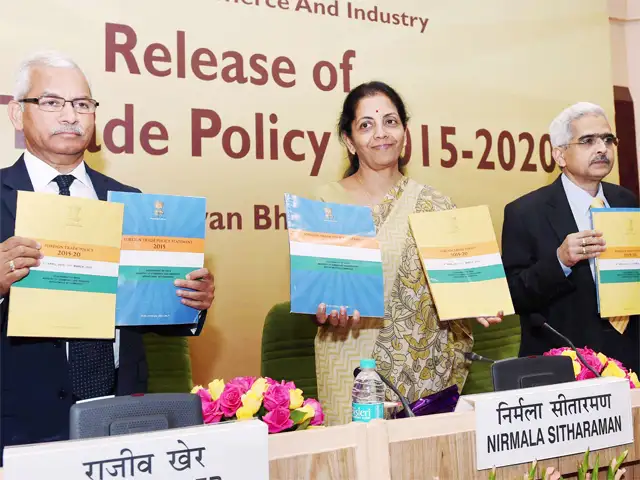
Image: Minister of State for Commerce & Industry (Independent Charge), Nirmala Sitharaman with Revenue Secretary Shaktikanta Das and Commerce Secretary, Rajeev Kher releasing the “Foreign Trade Policy 2015-2020” in New Delhi on April 1, 2015.
With an aim to make India a significant partner in global trade by 2020, the government on Wednesday unveiled a new Foreign Trade Policy (FTP).
Talking about the new policy, which aims at boosting India's exports, Commerce Minister Nirmala Sitharaman said that PM Narendra Modi's pet projects, 'Make in India' and 'Digital India' will be integrated with the new Foreign Trade Policy.
The government is pitching India as a friendly destination for manufacturing and exporting goods, and the new policy is being seen as an important step towards realising that goal.
We take a look at some key features of the new Foreign Trade Policy:
Image: Minister of State for Commerce & Industry (Independent Charge), Nirmala Sitharaman with Revenue Secretary Shaktikanta Das and Commerce Secretary, Rajeev Kher releasing the “Foreign Trade Policy 2015-2020” in New Delhi on April 1, 2015.





ADVERTISEMENT


