India’s path to become a $10 trillion economy
This goal should be achievable in about 15 years’s time as long as real GDP growth and inflation average 8% and 4% respectively over this period.
Updated:

By Chetan Ahya
Economic development is the centrepiece of this government’s social contract. A clear and ambitious plan will have to be articulated and delivered upon by policymakers in order to achieve this implied contract with voters. Since assuming office, policymakers have articulated the desire to lift per-capita income, improve social development indicators and harness the benefits of the demographic dividend by creating an environment in which businesses will thrive, invest and create jobs. Indeed, this approach is similar to the economic development experience of East Asian economies whereby the path towards a nation’s sustained prosperity lies in effectively mobilising both labour and non-labour resources. A reasonable initial goal would be to target lifting India’s GDP to $10 trillion (and per-capita income to about $7,500) from the current level of close to $2 trillion ($1,600). This goal should be achievable in about 15 years’s time as long as real GDP growth and inflation average 8% and 4% respectively over this period.
We believe this path to sustained prosperity entails two broad sets of reforms. In the initial phase, the focus of policy measures needs to be sustaining 6.5-7% growth with moderate and stable inflation. Indeed, policymakers have been judiciously fixing the root causes for the slippage in GDP growth to 5%, effectively reversing the distortions in the productivity dynamic. First, Centre plus states combined fiscal deficit, which has been painfully reduced from the peak of 9.9% in 2008-09 to an estimated 6.5% of GDP in 2014-15, will need to be further reduced to 5% of GDP. Second, the government needs to ensure that its policies do not intervene in the labour market to ensure that wage growth matches productivity growth. We believe high rural wage growth of about 18% during 2009-13 was a key factor behind the spike in inflation to 10% in that period.
Third, real interest rates need to be maintained in a positive territory to anchor inflation expectations and also to check the rise in property prices. Finally, ensuring a smooth functioning of the executive branch, faster implementation and increased transparency of government policies for investment approvals is needed to revive investment.

As the effects of the reforms that are currently being implemented begin to feed through to the economy in terms of improved productivity and macro stability, the economy will be on track to transition back to 6.5% GDP growth in the next 18 months. The goal of 8% sustainable growth needs a 15-year vision of mediumterm reforms — some of which are perceived to be politically-sensitive.
The list of these measures is long, but the government should prioritise reforms in the areas of land, labour, tax, infrastructure and overall ease of doing business. Indeed, the recent decisions taken by policymakers suggest that they are determined to accelerate the pace of implementation in each of these areas.
Since the implementation of the new Land Acquisition Act early last year, the process of land acquisition had come to a virtual standstill. To address this, in December 2014, the government promulgated an Ordinance that exempted five key categories of projects — which includes infrastructure and public-private partnership (PPP) projects where landownership is with the government —from consent and social impact assessment requirements. Converting this Ordinance to a law will be a critical starting point for kick-starting the investment cycle. In the area of labour laws, the government has made a series of important changes at a faster-than-expected pace. The most important step has been to reduce the discretionary powers of local labour inspectors, which has been a key bugbear of manufacturing companies. Moreover, select states have taken the lead to increase the flexibility of labour market regulations. Going forward, the government is considering a complete overhaul of the 44 labour laws into five uniform codes, which we think can be a pathbreaking reform if it can get Opposition support in Parliament.
Economic development is the centrepiece of this government’s social contract. A clear and ambitious plan will have to be articulated and delivered upon by policymakers in order to achieve this implied contract with voters. Since assuming office, policymakers have articulated the desire to lift per-capita income, improve social development indicators and harness the benefits of the demographic dividend by creating an environment in which businesses will thrive, invest and create jobs. Indeed, this approach is similar to the economic development experience of East Asian economies whereby the path towards a nation’s sustained prosperity lies in effectively mobilising both labour and non-labour resources. A reasonable initial goal would be to target lifting India’s GDP to $10 trillion (and per-capita income to about $7,500) from the current level of close to $2 trillion ($1,600). This goal should be achievable in about 15 years’s time as long as real GDP growth and inflation average 8% and 4% respectively over this period.
We believe this path to sustained prosperity entails two broad sets of reforms. In the initial phase, the focus of policy measures needs to be sustaining 6.5-7% growth with moderate and stable inflation. Indeed, policymakers have been judiciously fixing the root causes for the slippage in GDP growth to 5%, effectively reversing the distortions in the productivity dynamic. First, Centre plus states combined fiscal deficit, which has been painfully reduced from the peak of 9.9% in 2008-09 to an estimated 6.5% of GDP in 2014-15, will need to be further reduced to 5% of GDP. Second, the government needs to ensure that its policies do not intervene in the labour market to ensure that wage growth matches productivity growth. We believe high rural wage growth of about 18% during 2009-13 was a key factor behind the spike in inflation to 10% in that period.
Third, real interest rates need to be maintained in a positive territory to anchor inflation expectations and also to check the rise in property prices. Finally, ensuring a smooth functioning of the executive branch, faster implementation and increased transparency of government policies for investment approvals is needed to revive investment.
As the effects of the reforms that are currently being implemented begin to feed through to the economy in terms of improved productivity and macro stability, the economy will be on track to transition back to 6.5% GDP growth in the next 18 months. The goal of 8% sustainable growth needs a 15-year vision of mediumterm reforms — some of which are perceived to be politically-sensitive.
ADVERTISEMENT
The list of these measures is long, but the government should prioritise reforms in the areas of land, labour, tax, infrastructure and overall ease of doing business. Indeed, the recent decisions taken by policymakers suggest that they are determined to accelerate the pace of implementation in each of these areas.
Since the implementation of the new Land Acquisition Act early last year, the process of land acquisition had come to a virtual standstill. To address this, in December 2014, the government promulgated an Ordinance that exempted five key categories of projects — which includes infrastructure and public-private partnership (PPP) projects where landownership is with the government —from consent and social impact assessment requirements. Converting this Ordinance to a law will be a critical starting point for kick-starting the investment cycle. In the area of labour laws, the government has made a series of important changes at a faster-than-expected pace. The most important step has been to reduce the discretionary powers of local labour inspectors, which has been a key bugbear of manufacturing companies. Moreover, select states have taken the lead to increase the flexibility of labour market regulations. Going forward, the government is considering a complete overhaul of the 44 labour laws into five uniform codes, which we think can be a pathbreaking reform if it can get Opposition support in Parliament.
Finally, India is currently poorly ranked as 142nd out of 189 in the World Bank’s ease-of-doing-business index. While the recent streamlining of investment approvals has helped to expedite the process and improve sentiment, more steps are still needed. The critical step needed in this area is to take up a major training programme and change the incentive structure at the central and state government-levels to bring about change in the attitude of the field officers to welcome industrial development effort.
Taken together, these important changes in the macro environment, when fully implemented, should have a lasting impact on boosting economic development in India, and will go some way in achieving the ambition of creating a $10-trillion economy by 2030.
(The writer is chief Asia economist, Morgan Stanley, Hong Kong)
Download
The Economic Times Business News App for the Latest News in Business, Sensex, Stock Market Updates & More.
The Economic Times Business News App for the Latest News in Business, Sensex, Stock Market Updates & More.
Download
The Economic Times News App for Quarterly Results, Latest News in ITR, Business, Share Market, Live Sensex News & More.
The Economic Times News App for Quarterly Results, Latest News in ITR, Business, Share Market, Live Sensex News & More.
Related Articles
 Who gets faster Internet? India's net world may soon have first class and economy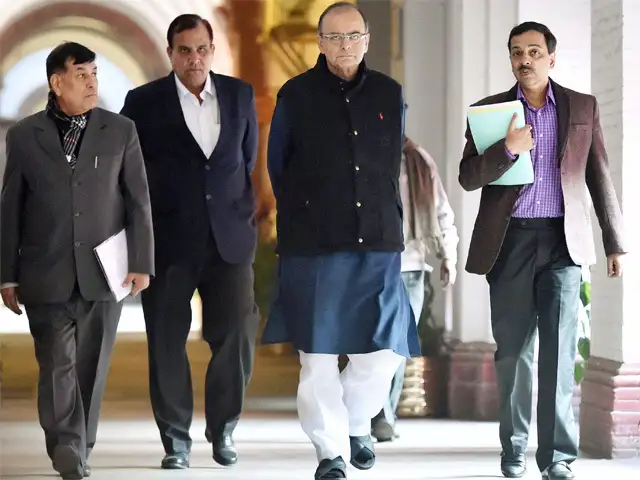
Text: ET Bureau
ET looks at the recent speeches of finance minister Arun Jaitley for clues to the budget for FY16. The budget is widely expected to lay down the agenda for the remaining four years of the Narendra Modi government.
In Pic: Jaitley arrives at the Pre-Budget Consultation with the representatives of Trade Union, in New Delhi.
ET looks at the recent speeches of finance minister Arun Jaitley for clues to the budget for FY16. The budget is widely expected to lay down the agenda for the remaining four years of the Narendra Modi government.
In Pic: Jaitley arrives at the Pre-Budget Consultation with the representatives of Trade Union, in New Delhi.