Budget 2015 may propose significant changes in income tax and corporate tax structures, boost savings
Personal income tax and corporate tax structures could see a significant revamp, leaving more money in the hands of individuals and with companies.
By Deepshikha Sikarwar, ET Bureau | Updated:

NEW DELHI: Direct tax rates may be in for a major overhaul in the budget. Among the most significant measures that finance minister Arun Jaitley is likely to announce in his much-anticipated budget on February 28 could be a recast of the direct tax structure, with the government looking to clean up levies on individuals and companies to create an investment-friendly regime and boost consumer sentiment.
Personal income tax and corporate tax structures could see a significant revamp, leaving more money in the hands of individuals and with companies.
“The idea is to spur investments and remove unnecessary hurdles,” said a government official, adding that deliberations were still going on.
 A revamp of tax slabs for individuals and incentives to encourage savings and investment in housing could be taken up as part of the package as the government is not just keen on giving some relief to the common man but also wants to provide a boost to financial savings.
Financial sector regulators including the Reserve Bank of India have also favoured increased incentives for household savings.
The revamped national numbers show that the savings rate fell to 30% of gross national disposable income (GNDI) in 2013-14 from 33% in the year before. The exact quantum of relief is not yet known.
There is limited scope for indirect tax reforms with the goods and services tax set to be imposed on April 1, 2016, compared with direct taxes, which have seen multiple changes over the past few years, rattling overall business sentiment.
The focus, another official said, will be on providing a healing touch by bringing clarity in some of the complicated tax provisions that have hurt the country’s image as an investment destination.
Industry views the upcoming budget as a make-or-break one and is looking to Jaitley’s effort to kick off an investment cycle. Companies want a stable and non-adversarial tax regime. Industry chambers including Ficci, CII and Assocham have also sought simplification of the tax structure.
Among the areas expected to be in focus are clarity in the minimum alternate tax (MAT) framework, an improvement in the dispute-settlement mechanism, tax clarity for real estate investment trusts and alternate investment funds in the form of tax pass through and cleaning up of provisions impacting infrastructure and manufacturing. The MAT rate is likely to be cut from the current 18.5%, if not for all companies, at least for those in special economic zones.
Personal income tax and corporate tax structures could see a significant revamp, leaving more money in the hands of individuals and with companies.
“The idea is to spur investments and remove unnecessary hurdles,” said a government official, adding that deliberations were still going on.
A revamp of tax slabs for individuals and incentives to encourage savings and investment in housing could be taken up as part of the package as the government is not just keen on giving some relief to the common man but also wants to provide a boost to financial savings.Financial sector regulators including the Reserve Bank of India have also favoured increased incentives for household savings.
The revamped national numbers show that the savings rate fell to 30% of gross national disposable income (GNDI) in 2013-14 from 33% in the year before. The exact quantum of relief is not yet known.
ADVERTISEMENT
In its first budget, the government had raised the exemption limit by Rs 50,000 but tax slabs were left unchanged. Similarly, the Section 80 C limit that offers tax rebates for investments and on home loan interest payments were raised by Rs 50,000 each.Though muted tax revenue growth and the need to set aside more funds for development leave little room, the government is keen to improve consumer sentiment, which is now being regarded as a quick way to revive the economy.There is limited scope for indirect tax reforms with the goods and services tax set to be imposed on April 1, 2016, compared with direct taxes, which have seen multiple changes over the past few years, rattling overall business sentiment.
The focus, another official said, will be on providing a healing touch by bringing clarity in some of the complicated tax provisions that have hurt the country’s image as an investment destination.
Industry views the upcoming budget as a make-or-break one and is looking to Jaitley’s effort to kick off an investment cycle. Companies want a stable and non-adversarial tax regime. Industry chambers including Ficci, CII and Assocham have also sought simplification of the tax structure.
ADVERTISEMENT
In focusAmong the areas expected to be in focus are clarity in the minimum alternate tax (MAT) framework, an improvement in the dispute-settlement mechanism, tax clarity for real estate investment trusts and alternate investment funds in the form of tax pass through and cleaning up of provisions impacting infrastructure and manufacturing. The MAT rate is likely to be cut from the current 18.5%, if not for all companies, at least for those in special economic zones.
ADVERTISEMENT
This group is of the view that the provision has done much to damage India’s reputation as an investment destination and clarity on this within the legislative framework would remove doubts in the minds of those looking to put their money to work in India.
Most industry bodies and foreign investors have strongly pitched for a change in this provision despite finance minister Jaitley’s repeated assurance that it would not be used.
The government has decided not to appeal the Shell and Vodafone judgments by the Bombay High Court, in line with its intent to be more investor friendly, but a decision on the retrospective amendment will be taken at the highest political level as there are a number of cases in litigation involving substantial revenue.
Sources said this could even be referred to the Cabinet for a decision. Tax experts said India is the most taxed economy in Asia and there is scope for further reforming the tax structure on the lines of customs duty. “There is a need for simplifying complicated tax policies,” said Rahul Garg, leader, direct tax practice, PwC.
The peak tax rate is 30% in India and a 2-10% surcharge is levied depending on profit. However, the effective tax rate, after factoring in all exemptions, is only just over 22%.
Download
The Economic Times Business News App for the Latest News in Business, Sensex, Stock Market Updates & More.
The Economic Times Business News App for the Latest News in Business, Sensex, Stock Market Updates & More.
Download
The Economic Times News App for Quarterly Results, Latest News in ITR, Business, Share Market, Live Sensex News & More.
The Economic Times News App for Quarterly Results, Latest News in ITR, Business, Share Market, Live Sensex News & More.
Text: ET Bureau
ET looks at the recent speeches of finance minister Arun Jaitley for clues to the budget for FY16. The budget is widely expected to lay down the agenda for the remaining four years of the Narendra Modi government.
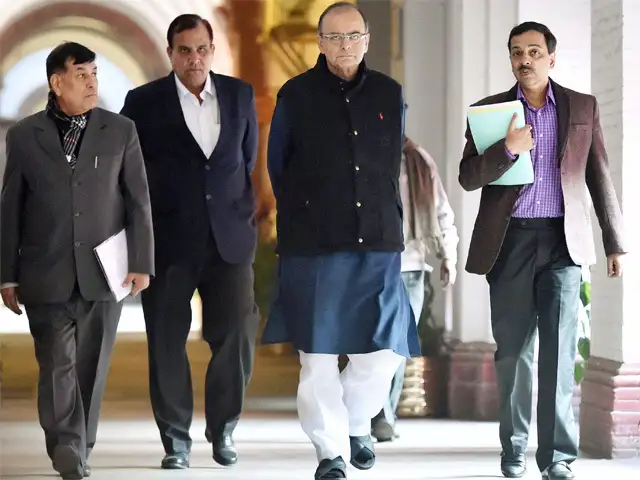
In Pic: Jaitley arrives at the Pre-Budget Consultation with the representatives of Trade Union, in New Delhi.
ET looks at the recent speeches of finance minister Arun Jaitley for clues to the budget for FY16. The budget is widely expected to lay down the agenda for the remaining four years of the Narendra Modi government.
In Pic: Jaitley arrives at the Pre-Budget Consultation with the representatives of Trade Union, in New Delhi.