Trucial States to crucial states: Why Modi has smelt great opportunity in UAE and Gulf countries
In Dubai and Sharjah and Abu Dhabi, or even Oman for that matter and among other members of the Gulf Cooperation Council, this made India a social and economic model.
Updated:

By Ashok Malik
In the days of the British Raj, the Arab tribal principalities that now comprise the United Arab Emirates were known as the Trucial States. The word “trucial” is a rarely-used adjective derived from "truce". Its use reflected the unique arrangement that British India had with the Persian Gulf sheikhdoms.
There was no direct rule, but an influence on those states was seen as necessary to maintain political stability in the broader west Asian region and in the Indian Ocean. In return, Calcutta and later New Delhi (the capitals of the Raj) provided a security umbrella.
It wasn’t just about security, though. Where the Trucial States really benefited was in capacity building. The origins of the armed forces and city polices of the modern-day UAE lie in training and knowledge sharing from British India. Gradually, the oasis of Dubai became a sort of western entrepôt to the Indian mainland, just as Singapore served the same purpose in the east.
In Dubai and Sharjah and Abu Dhabi, or even Oman for that matter and among other members of the Gulf Cooperation Council, this made India a social and economic model. Indeed, Bombay (today’s Mumbai) was as much a glamorous holiday destination for old residents of the UAE as Dubai is for contemporary Indians.
It is useful to keep this history in mind while assessing Prime Minister Narendra Modi’s visit to the UAE and the expansive joint statement that flowed from it. India doesn’t have the same military and political reach in Asia that the British Empire did; the equation is far, far from that. Nevertheless India’s emerging doctrine for the Indian Ocean and its near-neighbourhood does borrow elements from the strategic architecture of the Raj.
To what degree this can be done in a more equal world, with no overarching suzerain, and with the Emirates being flush with capital that India needs (rather than the other way round) will be a test for the coming period. Of course, here, as in several other foreign policy bets that Modi has taken, much depends on how quickly the Indian economy returns to a high-growth path.
It is easy to see what the UAE relationship holds for India, from potentially freezing Dawood Ibrahim’s assets in Dubai to getting UAE sovereign wealth funds to invest in Indian infrastructure. Yet, what does the UAE want? What is the long view from Abu Dhabi and Dubai?
The UAE and GCC states are faced with three major challenges. First, they realise the American military and security umbrella – which almost seamlessly replaced the British umbrella – is receding. America’s appetite for west Asian oil and its appetite for foreign wars have declined simultaneously; the former will probably never return.
Second, the threat from forces such as Islamic State is of a different order from earlier Islamist radical militias that were either easier to manipulate and control or fought infidels far away. This time it is closer home.
In the days of the British Raj, the Arab tribal principalities that now comprise the United Arab Emirates were known as the Trucial States. The word “trucial” is a rarely-used adjective derived from "truce". Its use reflected the unique arrangement that British India had with the Persian Gulf sheikhdoms.
There was no direct rule, but an influence on those states was seen as necessary to maintain political stability in the broader west Asian region and in the Indian Ocean. In return, Calcutta and later New Delhi (the capitals of the Raj) provided a security umbrella.
It wasn’t just about security, though. Where the Trucial States really benefited was in capacity building. The origins of the armed forces and city polices of the modern-day UAE lie in training and knowledge sharing from British India. Gradually, the oasis of Dubai became a sort of western entrepôt to the Indian mainland, just as Singapore served the same purpose in the east.
In Dubai and Sharjah and Abu Dhabi, or even Oman for that matter and among other members of the Gulf Cooperation Council, this made India a social and economic model. Indeed, Bombay (today’s Mumbai) was as much a glamorous holiday destination for old residents of the UAE as Dubai is for contemporary Indians.
It is useful to keep this history in mind while assessing Prime Minister Narendra Modi’s visit to the UAE and the expansive joint statement that flowed from it. India doesn’t have the same military and political reach in Asia that the British Empire did; the equation is far, far from that. Nevertheless India’s emerging doctrine for the Indian Ocean and its near-neighbourhood does borrow elements from the strategic architecture of the Raj.
ADVERTISEMENT
To what degree this can be done in a more equal world, with no overarching suzerain, and with the Emirates being flush with capital that India needs (rather than the other way round) will be a test for the coming period. Of course, here, as in several other foreign policy bets that Modi has taken, much depends on how quickly the Indian economy returns to a high-growth path.
It is easy to see what the UAE relationship holds for India, from potentially freezing Dawood Ibrahim’s assets in Dubai to getting UAE sovereign wealth funds to invest in Indian infrastructure. Yet, what does the UAE want? What is the long view from Abu Dhabi and Dubai?
The UAE and GCC states are faced with three major challenges. First, they realise the American military and security umbrella – which almost seamlessly replaced the British umbrella – is receding. America’s appetite for west Asian oil and its appetite for foreign wars have declined simultaneously; the former will probably never return.
Second, the threat from forces such as Islamic State is of a different order from earlier Islamist radical militias that were either easier to manipulate and control or fought infidels far away. This time it is closer home.
ADVERTISEMENT
Yet, this would require an upgrading of its justice and arbitration system; a clarifying of financial sources and of the reputation that UAE financial markets are just a gigantic money laundering mechanism; and investing the Gulf region’s impressive surpluses in productive assets (such as infrastructure and energy-intensive businesses in India) rather than simply more apartments in London and horse farms in Kentucky.
All three are pragmatic motivations: a response to changed circumstances. There is courage being displayed here as well as opportunities being offered that Modi has appreciated and grabbed. Each of the three drivers of new thinking in the UAE and its periphery opens up space for India.
For instance, the joint statement describes the UAE as "a multi-cultural society" and applauds India as a "nation of unparalleled diversity, religious pluralism and a composite culture". To the UAE and Gulf states India is a modern, non-western participative political phenomenon that remains deeply religious and traditional, without compromising its diversity. Once more, but in very different circumstances, India has become a model for the Emirates.
This is more pronounced when the joint statement embarks on a serious rejection of using religion as a cover to "sponsor terrorism" and achieve political goals, or when India and the UAE commit to "coordinate efforts to counter radicalisation". It is facile to see this as merely a snubbing of Pakistan; the implication is greater.
In the tectonic civil war in the Islamic world, UAE’s leadership has cast itself as a force for relative reform and moderation. Indeed, acceding to the demand for a Hindu temple in hitherto conservative Abu Dhabi and relaxing norms in Dubai that deny foreign investors the right to set up companies without the mandatory presence of a local partner are part of this process.
ADVERTISEMENT
There are other areas of congruence as well. The UAE/Arab-Chinese relationship is economically weighty but culturally a non-starter. Further, the building of a Chinese port in Gwadar poses a potential commercial threat to Dubai, and in that sense unites the UAE and India against a project that has acquired totemic status in Pakistan. In all this, and in the perfumes of Arabia, Modi has smelt a chance.
(The writer is a political commentator)
Download
The Economic Times Business News App for the Latest News in Business, Sensex, Stock Market Updates & More.
The Economic Times Business News App for the Latest News in Business, Sensex, Stock Market Updates & More.
Download
The Economic Times News App for Quarterly Results, Latest News in ITR, Business, Share Market, Live Sensex News & More.
The Economic Times News App for Quarterly Results, Latest News in ITR, Business, Share Market, Live Sensex News & More.
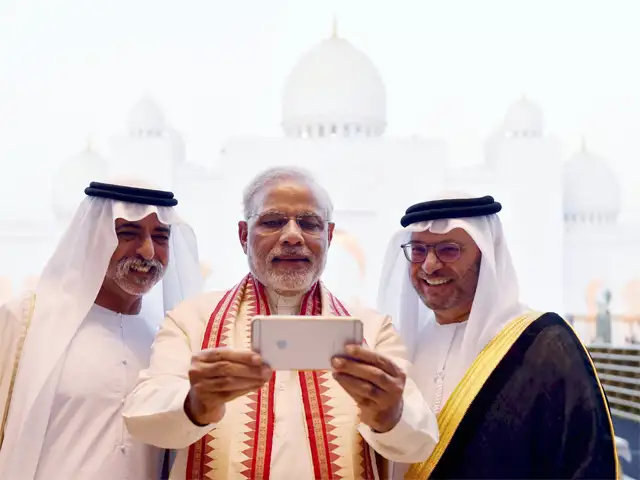
UAE government agreed to allot land for a Hindu temple in Abu Dhabi, which PM Modi called "a great step."
There is already one Hindu temple in nearby Dubai.
In pic: Prime Minister Narendra Modi takes a selfie with Sheikh Hamdan bin Mubarak Al Nahyan, UAE Minister of Higher Education and Scientific Research, during his visit to the Sheikh Zayed Grand Mosque, in Abu Dhabi, UAE.
There is already one Hindu temple in nearby Dubai.
In pic: Prime Minister Narendra Modi takes a selfie with Sheikh Hamdan bin Mubarak Al Nahyan, UAE Minister of Higher Education and Scientific Research, during his visit to the Sheikh Zayed Grand Mosque, in Abu Dhabi, UAE.

ADVERTISEMENT


