The politics of One Rank One Pension: Will Modi government bite the bullet?
The problem, as Modi wanted to know, is that 'one rank, one pension' is difficult to put into operation — that's the prevailing opinion within the bureaucracy.
By Manu Pubby, ET Bureau | Updated:

NEW DELHI: One of the biggest crises that the government faces today, ironically, began with a question that Narendra Modi asked a mega crowd in his first address after being declared the BJP's prime ministerial candidate.
"We have been hearing about 'one rank, one pension' for many years. What is the problem?" the leader asked a roaring gathering of exservicemen at Rewari in September 2013, with former army chief VK Singh by his side and his aides insisting it was an apolitical gathering of veterans.
Follow @ETDefence Twitter handle for comprehensive coverage on other buzzing Defence stories
The problem, as Modi wanted to know, is that 'one rank, one pension' (OROP) is difficult to put into operation — that's the prevailing opinion within the bureaucracy. Besides the fiscal and legal issues, there is concern that other services such as the para-military forces, the police and the railways will press for a similar pension structure.
"The plain fact is that OROP is just not implementable, and the sooner the government comes out with an open admission on this, and stops leading the defence forces down the garden path, the better," retired IAS officer Avay Shukla wrote in his blog, one of the rare on-record voices critical of the scheme.
"The basic premise of OROP is inherently flawed. One's pension is inextricably linked to one's salary at the time of retirement and not to the salary of the same post 20 years later. That is why Pay Commissions, every 10 years, do not link past pensions with current salaries but provide a percentage growth to those pensions. This is true of not just the armed forces (as some may think) but of the entire government structure," Shukla wrote. While Modi went on to sweep the polls, his government has been struggling for over a year to resolve the matter, which has now manifested in veterans anger spilling on to the streets.
While arguments can be made for and against OROP, it is clear that successive governments and political parties have played around with an emotive issue for the defence forces.
None of them, however, was as vocal as the BJP, which is now caught between the finance ministry warning of massive fiscal and legal hurdles and veterans and serving personnel in no mood to dilute their position. The BJP's public stand is that it is a long-standing issue that will take time to resolve, even as consultations are on at the highest level to hammer out an acceptable formula.
A Historic Issue
Veterans trace the OROP issue back to 1973, when the Congress government changed the pension rules, reducing the historic edge that they had over civilian counterparts in the government. While demands were made consistently by the services and veterans to hike pensions and "correct the wrong," they would invariably fade away.
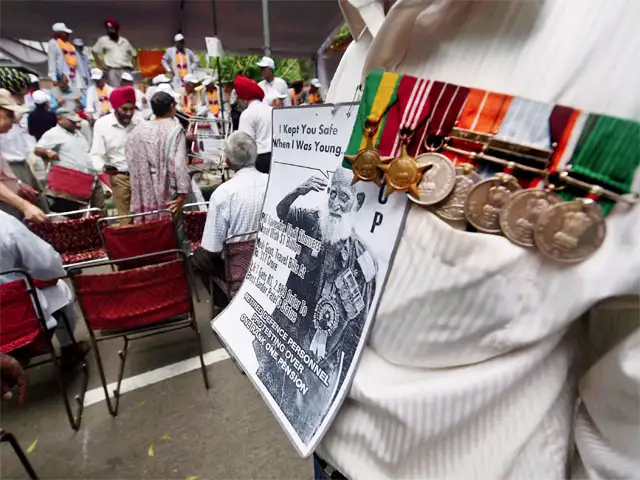
It is not as if protests on the issue have not occurred before – in 2009, ex-servicemen returned medals and conducted peaceful marches in the capital. Protests continued for the next two years, forcing the Congress to take some corrective steps but never fully committing to the OROP demand.
In November 2010, when public protests by veterans were at a peak, defence minister AK Antony clearly spelt out the government's view.
"Since the issue of 'one rank, one pension' was not accepted in the past and also, more recently, the Cabinet Secretary's committee set up on OROP and other related issues did not recommend the same, it has not been found feasible to accept the demand of 'one rank, one pension,'" he stated in a Rajya Sabha answer.
The government's approach then was to bridge the gap between the pensions of veterans. Measures taken in 2011 and 2012 did increase the pensions, tapering down the veterans' protests.
Electoral Politics
The issue took a political turn when Modi chose to bring it up in his September 2013 speech. Modi's impassioned statements had the potential of swinging over the influential fauji vote. The UPA government, then in its last months, stuck to its stand that measures had been taken and that this would be the closest possible formulation to an OROP.
A month after Modi's speech, Congress leader Rahul Gandhi stepped in on the issue, convinced it could be a game-changer with the elections coming up. Almost overnight, the UPA government reversed its long-standing position. The concept of 'almost parity' was junked and in February 2014, it was formally announced that OROP had been accepted and would be implemented.
This change stumped many observers and doubts were raised right then on the feasibility of the concept. However, with the heat of the elections and the BJP upsurge, the issue went on the backburner. The UPA sanctioned a token amount for OROP but did not go anywhere near implementing it.
"The BJP will implement one rank, one pension" was the one line in the 2014 BJP manifesto that hardened the belief that it could actually see the light of day.
Veterans Don't Forget
Unlike other such cases — the Lokpal Bill, for example — OROP had the determined push of the veteran community that is not known to back down. So, when Modi took over as prime minister, he faced the OROP question wherever he went.
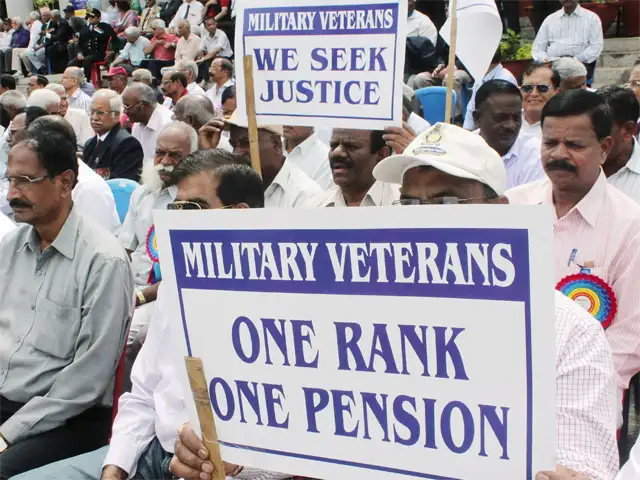
From on board an aircraft carrier in the Arabian Sea in June 2014, when he said that his government is "committed" to OROP to the Siachen glacier in October, where he told soldiers that "it was in my destiny that OROP has been fulfilled," the PM's words were noted carefully. However, a year after the government had committed to implementing the scheme and amid indications that the finance ministry had put a spanner in the works, a decision was taken to hit the streets. The sit-down protest at Jantar Mantar, will end only when the government delivers, the veterans said. The window for a resolution, however, is closing. Once the schedule for the Bihar elections are announced, possibly next week, the model code of conduct will come into force, preventing the government from making any major announcements.
The protests this time around are only as vocal as the BJP's commitment on the matter.
ET View: Not By OROP
OROP appeals to fairness and parity. But there are far better ways to approach this issue and solve the problem once and for all. Parity with the civil services would mean that recruits to the forces since 2004 should be part of the National Pension System, a defined contribution system. Or, at the least, the NPS should be the norm for those who join the armed forces from next April onwards. Britain has now introduced a defined contribution pension for its armed forces. Another reform to increase the tooth-to-tail ratio in defence spending is to retain soldiers only for six years or so and discharge them with scholarships to study whatever they want, not a pension.
"We have been hearing about 'one rank, one pension' for many years. What is the problem?" the leader asked a roaring gathering of exservicemen at Rewari in September 2013, with former army chief VK Singh by his side and his aides insisting it was an apolitical gathering of veterans.
Follow @ETDefence Twitter handle for comprehensive coverage on other buzzing Defence stories
The problem, as Modi wanted to know, is that 'one rank, one pension' (OROP) is difficult to put into operation — that's the prevailing opinion within the bureaucracy. Besides the fiscal and legal issues, there is concern that other services such as the para-military forces, the police and the railways will press for a similar pension structure.
"The plain fact is that OROP is just not implementable, and the sooner the government comes out with an open admission on this, and stops leading the defence forces down the garden path, the better," retired IAS officer Avay Shukla wrote in his blog, one of the rare on-record voices critical of the scheme.
"The basic premise of OROP is inherently flawed. One's pension is inextricably linked to one's salary at the time of retirement and not to the salary of the same post 20 years later. That is why Pay Commissions, every 10 years, do not link past pensions with current salaries but provide a percentage growth to those pensions. This is true of not just the armed forces (as some may think) but of the entire government structure," Shukla wrote. While Modi went on to sweep the polls, his government has been struggling for over a year to resolve the matter, which has now manifested in veterans anger spilling on to the streets.
ADVERTISEMENT
While arguments can be made for and against OROP, it is clear that successive governments and political parties have played around with an emotive issue for the defence forces.
None of them, however, was as vocal as the BJP, which is now caught between the finance ministry warning of massive fiscal and legal hurdles and veterans and serving personnel in no mood to dilute their position. The BJP's public stand is that it is a long-standing issue that will take time to resolve, even as consultations are on at the highest level to hammer out an acceptable formula.
A Historic Issue
Veterans trace the OROP issue back to 1973, when the Congress government changed the pension rules, reducing the historic edge that they had over civilian counterparts in the government. While demands were made consistently by the services and veterans to hike pensions and "correct the wrong," they would invariably fade away.
ADVERTISEMENT
It is not as if protests on the issue have not occurred before – in 2009, ex-servicemen returned medals and conducted peaceful marches in the capital. Protests continued for the next two years, forcing the Congress to take some corrective steps but never fully committing to the OROP demand.
In November 2010, when public protests by veterans were at a peak, defence minister AK Antony clearly spelt out the government's view.
ADVERTISEMENT
"Since the issue of 'one rank, one pension' was not accepted in the past and also, more recently, the Cabinet Secretary's committee set up on OROP and other related issues did not recommend the same, it has not been found feasible to accept the demand of 'one rank, one pension,'" he stated in a Rajya Sabha answer.
The government's approach then was to bridge the gap between the pensions of veterans. Measures taken in 2011 and 2012 did increase the pensions, tapering down the veterans' protests.
Electoral Politics
The issue took a political turn when Modi chose to bring it up in his September 2013 speech. Modi's impassioned statements had the potential of swinging over the influential fauji vote. The UPA government, then in its last months, stuck to its stand that measures had been taken and that this would be the closest possible formulation to an OROP.
A month after Modi's speech, Congress leader Rahul Gandhi stepped in on the issue, convinced it could be a game-changer with the elections coming up. Almost overnight, the UPA government reversed its long-standing position. The concept of 'almost parity' was junked and in February 2014, it was formally announced that OROP had been accepted and would be implemented.
This change stumped many observers and doubts were raised right then on the feasibility of the concept. However, with the heat of the elections and the BJP upsurge, the issue went on the backburner. The UPA sanctioned a token amount for OROP but did not go anywhere near implementing it.
"The BJP will implement one rank, one pension" was the one line in the 2014 BJP manifesto that hardened the belief that it could actually see the light of day.
Veterans Don't Forget
Unlike other such cases — the Lokpal Bill, for example — OROP had the determined push of the veteran community that is not known to back down. So, when Modi took over as prime minister, he faced the OROP question wherever he went.
From on board an aircraft carrier in the Arabian Sea in June 2014, when he said that his government is "committed" to OROP to the Siachen glacier in October, where he told soldiers that "it was in my destiny that OROP has been fulfilled," the PM's words were noted carefully. However, a year after the government had committed to implementing the scheme and amid indications that the finance ministry had put a spanner in the works, a decision was taken to hit the streets. The sit-down protest at Jantar Mantar, will end only when the government delivers, the veterans said. The window for a resolution, however, is closing. Once the schedule for the Bihar elections are announced, possibly next week, the model code of conduct will come into force, preventing the government from making any major announcements.
The protests this time around are only as vocal as the BJP's commitment on the matter.
ET View: Not By OROP
OROP appeals to fairness and parity. But there are far better ways to approach this issue and solve the problem once and for all. Parity with the civil services would mean that recruits to the forces since 2004 should be part of the National Pension System, a defined contribution system. Or, at the least, the NPS should be the norm for those who join the armed forces from next April onwards. Britain has now introduced a defined contribution pension for its armed forces. Another reform to increase the tooth-to-tail ratio in defence spending is to retain soldiers only for six years or so and discharge them with scholarships to study whatever they want, not a pension.
Download
The Economic Times Business News App for the Latest News in Business, Sensex, Stock Market Updates & More.
The Economic Times Business News App for the Latest News in Business, Sensex, Stock Market Updates & More.
Download
The Economic Times News App for Quarterly Results, Latest News in ITR, Business, Share Market, Live Sensex News & More.
The Economic Times News App for Quarterly Results, Latest News in ITR, Business, Share Market, Live Sensex News & More.
The finance ministry’s main argument is that the full OROP would prove to be a crushing burden on the economy.
But veterans argue that by the government’s own calculation the ORP bill would be Rs 8,600 crore a year, which is not that major an addition to the Rs 54,500-crore defence pensions expenditure estimated for this financial year.
But veterans argue that by the government’s own calculation the ORP bill would be Rs 8,600 crore a year, which is not that major an addition to the Rs 54,500-crore defence pensions expenditure estimated for this financial year.

ADVERTISEMENT


