One Rank One Pension: Veteran writes on possible resolution and the future
There have been number of discussions/debates on One Rank One Pension ever since the Veterans' Movement started close to seventy five days, at Jantar Mantar.
Updated:

By: Brigadier Vijay Raheja, Veteran
There have been number of discussions/debates on One Rank One Pension (OROP) ever since the Veterans' Movement started close to seventy five days, at Jantar Mantar. There have been counter views of runaway costs; increasing year after year. Before proceeding futher, it is important to highlight that out of a total defence pension burden civilian staff, who are out of purview of OROP, account for 60percent as against defence personnel, though larger in numbers, account for 40 percent; their pensions being lower due to early retirement.
Further, with aim of setting the record straight, decided to analyse the basic document, which has been in circulation in the form of a Draft Government of India Letter (DGL); for over a year. The fact that such a letter exists makes it amply clear that same came into being after due deliberations between Ministry of Defence and stake holders, ie Service Headquarters and representatives of Ex-Servicemen. Perusal of DGL brings to fore the intricate detailing and clear mindset aimed at resolving anomalies.
Present Imbroglio and Solutions
It is not my aim to reinvent the wheel and as such have no intention of starting with definition of OROP on which it is assumed that there is total clarity. Let me therefore come straight to cause(s) that have led to the predicament and then on to painstaking efforts on part of Ministry of Defence and Service Headquarters to resolve matters.
It is concomitant effect of 'bunching'; a concept followed by successive pay commissions that creates a divide in serving personnel, when people in same rank, having different number years of service are given a fixed starting salary. With subsequent promotions and years of service differential largely gets ironed out since every rank has a top of the scale - however few anomalies do arise. Typical example would be a person retiring on last day of the month, before increment due month as against his colleague, who has same number of years of service retiring a month later, but with an increment - such cases would be far and few.
Coming to pensioners the fixation is at the lowest end of the rank band, irrespective of years of service and hence the need of OROP and periodic review. A stage will come, as and when top of scale is reached for each rank there would be no change in pensions and therefore the misnomer of a 3% increase each year needs to be dispelled. Periodic review would be required to resolve anomalies, that may arise, with marginal financial impact.
Adequate safe guards have been inbuilt in DGL to ensure equitable treatment to one and all. Some note worthy measures are enumerated. To begin with calculation of service rendered for officers who have been promoted from ranks has been brought on an even keel; being different earlier for pre 1986 and pre 1967 commissioned officers. It is now total service from date of enrollment till date of retirement; thereby ensuring same pension to all retirees with number of years of service criteria.
Next it has been ensured that All Honorary Nb Sub, Modified Career Progression Scheme (MACP) Nb Sub and equivalents are granted pension of Nb Sub. Similarly any change/improvement in Hony Lt/Capt and equivalent shall be applicable to regular commissioned officers in ranks of Lt and Capt and equivalent ranks, if it is more beneficial.
As a consequence of introduction of time bound ranks (ie up to the rank of Colonel and equivalent), it is proposed that for past pensioners who retired before 16 Dec 2004 ie before time period for promotions was reduced, years of service will only be relevant and table for higher rank be taken into
Finally, a safety clause, to protect existing pensioners, has been included; wherein any changes in policy regarding pay or promotion which affect pay/pension of future pensioners, shall also be passed on to the past pensioners
Future
Hopefully, anomalous situation created due to bunching, as suggested by earlier Pay Commission Panels will change. Needless to say that painstaking efforts must have been put in by Service Headquarters to project what is best; as also point out anomalies created over the years to Seventh Pay Commission Panel. In addition, Panel Members have not only travelled over the country and interacted with veterans, but have visited far and remote areas to see working conditions of our troops. Add to this, as someone said, "Aborted Pensions of defence personnel as against Fully Matured Pensions of Civilians" am sure things are bound to change for the soldier.
There have been number of discussions/debates on One Rank One Pension (OROP) ever since the Veterans' Movement started close to seventy five days, at Jantar Mantar. There have been counter views of runaway costs; increasing year after year. Before proceeding futher, it is important to highlight that out of a total defence pension burden civilian staff, who are out of purview of OROP, account for 60percent as against defence personnel, though larger in numbers, account for 40 percent; their pensions being lower due to early retirement.
Further, with aim of setting the record straight, decided to analyse the basic document, which has been in circulation in the form of a Draft Government of India Letter (DGL); for over a year. The fact that such a letter exists makes it amply clear that same came into being after due deliberations between Ministry of Defence and stake holders, ie Service Headquarters and representatives of Ex-Servicemen. Perusal of DGL brings to fore the intricate detailing and clear mindset aimed at resolving anomalies.
Present Imbroglio and Solutions
It is not my aim to reinvent the wheel and as such have no intention of starting with definition of OROP on which it is assumed that there is total clarity. Let me therefore come straight to cause(s) that have led to the predicament and then on to painstaking efforts on part of Ministry of Defence and Service Headquarters to resolve matters.
It is concomitant effect of 'bunching'; a concept followed by successive pay commissions that creates a divide in serving personnel, when people in same rank, having different number years of service are given a fixed starting salary. With subsequent promotions and years of service differential largely gets ironed out since every rank has a top of the scale - however few anomalies do arise. Typical example would be a person retiring on last day of the month, before increment due month as against his colleague, who has same number of years of service retiring a month later, but with an increment - such cases would be far and few.
ADVERTISEMENT
Coming to pensioners the fixation is at the lowest end of the rank band, irrespective of years of service and hence the need of OROP and periodic review. A stage will come, as and when top of scale is reached for each rank there would be no change in pensions and therefore the misnomer of a 3% increase each year needs to be dispelled. Periodic review would be required to resolve anomalies, that may arise, with marginal financial impact.
Adequate safe guards have been inbuilt in DGL to ensure equitable treatment to one and all. Some note worthy measures are enumerated. To begin with calculation of service rendered for officers who have been promoted from ranks has been brought on an even keel; being different earlier for pre 1986 and pre 1967 commissioned officers. It is now total service from date of enrollment till date of retirement; thereby ensuring same pension to all retirees with number of years of service criteria.
Next it has been ensured that All Honorary Nb Sub, Modified Career Progression Scheme (MACP) Nb Sub and equivalents are granted pension of Nb Sub. Similarly any change/improvement in Hony Lt/Capt and equivalent shall be applicable to regular commissioned officers in ranks of Lt and Capt and equivalent ranks, if it is more beneficial.
As a consequence of introduction of time bound ranks (ie up to the rank of Colonel and equivalent), it is proposed that for past pensioners who retired before 16 Dec 2004 ie before time period for promotions was reduced, years of service will only be relevant and table for higher rank be taken into
ADVERTISEMENT
Finally, a safety clause, to protect existing pensioners, has been included; wherein any changes in policy regarding pay or promotion which affect pay/pension of future pensioners, shall also be passed on to the past pensioners
Future
ADVERTISEMENT
Hopefully, anomalous situation created due to bunching, as suggested by earlier Pay Commission Panels will change. Needless to say that painstaking efforts must have been put in by Service Headquarters to project what is best; as also point out anomalies created over the years to Seventh Pay Commission Panel. In addition, Panel Members have not only travelled over the country and interacted with veterans, but have visited far and remote areas to see working conditions of our troops. Add to this, as someone said, "Aborted Pensions of defence personnel as against Fully Matured Pensions of Civilians" am sure things are bound to change for the soldier.
Download
The Economic Times Business News App for the Latest News in Business, Sensex, Stock Market Updates & More.
The Economic Times Business News App for the Latest News in Business, Sensex, Stock Market Updates & More.
Download
The Economic Times News App for Quarterly Results, Latest News in ITR, Business, Share Market, Live Sensex News & More.
The Economic Times News App for Quarterly Results, Latest News in ITR, Business, Share Market, Live Sensex News & More.
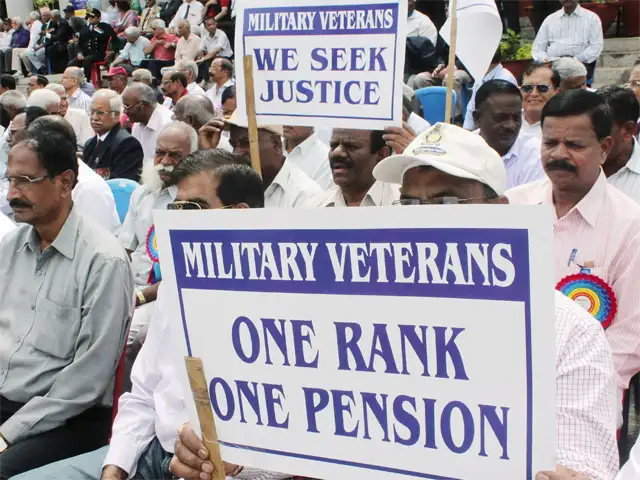
The finance ministry’s main argument is that the full OROP would prove to be a crushing burden on the economy.
But veterans argue that by the government’s own calculation the ORP bill would be Rs 8,600 crore a year, which is not that major an addition to the Rs 54,500-crore defence pensions expenditure estimated for this financial year.
But veterans argue that by the government’s own calculation the ORP bill would be Rs 8,600 crore a year, which is not that major an addition to the Rs 54,500-crore defence pensions expenditure estimated for this financial year.


ADVERTISEMENT


