
Trump vs. The Fed: The battle over central bank independence
1/10
The flashpoint
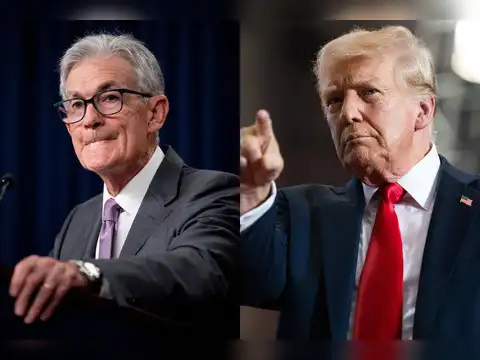
U.S. President Donald Trump has launched unprecedented attacks on the Federal Reserve. He has threatened to fire Fed governor Lisa Cook over alleged mortgage improprieties and has continued to pressure Fed Chair Jerome Powell to cut interest rates. These moves are testing the boundaries of presidential power over America’s central bank. (Source: Reuters)

2/10
Why independence matters
Central bank independence is widely regarded as a cornerstone of modern economies. It ensures that inflation is kept in check and that global financial stability is maintained. Since the 1980s, credibility and independence have been essential to preventing price instability.

3/10
Volcker's legacy
In the early 1980s, Fed Chair Paul Volcker raised interest rates to double digits to combat runaway inflation. His bold action tamed price growth and cemented the Federal Reserve’s reputation for independence from political pressure.
Amazon Top Deals
POWERED BY

Crompton Ozone 75 Litres Desert Air Cooler for home | Large & Easy Clean Ice Chamber | 4-Way Air Deflection | High Density Honeycomb Pads | Everlast Pump | Auto Fill| 3 Year Brand Warranty
₹9,798Buy Now43%
OFF

atomberg Studio Smart+ 1200mm BLDC Ceiling Fan with IoT & Remote | BEE 5 star Rated Energy Efficient Ceiling Fan | High Air Delivery with LED Indicators | 3 Year Warranty (Earth Brown)
₹5,903Buy Now36%
OFF

LG 32 L Convection Microwave Oven (MC3286BRUM, Black, 360° Motorised Rotisserie for Bar-be-queing, 301 Auto Cook Menu, Stainless steel cavity, Indian Cuisine, Tandoor Se, Steam Clean & Diet Fry)
₹19,340Buy Now19%
OFF

4/10
A global standard
Following the U.S. example, more than 100 central banks worldwide gained independence from their governments. Institutions like the European Central Bank and the Bank of England (since 1998) now operate autonomously, and this has been linked to lower and more stable inflation.

5/10
The results
Research shows that central banks with independence have achieved remarkable results. In rich countries, inflation fell by nearly 3.7 percentage points, while in developing nations the drop was over 10 points. Most notably, after the pandemic, independent central banks quickly brought inflation under control in just a few years.

6/10
The current threat
Trump’s push to influence the Fed risks politicizing monetary policy. Investors have already started demanding higher premiums on U.S. government bonds, reflecting concerns that the Fed’s credibility and independence may be compromised.

7/10
Lessons from crises
Central banks often step in during crises by printing money and working with governments to stabilize markets. This coordination was crucial during the 2008 financial crisis and again in 2012 when ECB President Mario Draghi’s pledge to do “whatever it takes” preserved the euro.

8/10
Independence under pressure
In the past decade, central banks bought trillions of dollars in assets to boost economies. While this helped recovery, it also raised concerns about inequality and showed how powerful these institutions have become. Such displays of power have made politicians more eager to challenge their independence.

9/10
Expert voices
Economist Jordi Galí notes that central banks handled the recent inflation surge effectively. Frederik Ducrozet warns that independence and credibility are their most valuable assets. Maurice Obstfeld highlights that central banks have revealed themselves as “mega powers,” raising questions about their legitimacy in political systems.

10/10
The bigger picture
Ultimately, central banks must balance inflation, growth, and credibility. Their independence allows them to maintain the trust of both the public and investors. If politicisation takes hold, decades of hard-won stability could be undone.
(Disclaimer: This slideshow has been sourced from Reuters)
(Disclaimer: This slideshow has been sourced from Reuters)