Top 5 things markets want FM Arun Jaitley to do this Budget
Markets are bullish on this budget and the numbers underline the optimism. FIIs have invested in excess of Rs 10,000 crore in Feb alone.
By ET Online | Updated:

MUMBAI: The markets are bullish on this budget and the numbers underline the optimism. The FIIs have invested in excess of Rs 10,000 crore in February alone.
The government has been making all the right noises in the run-up to the big event. And just like other industries, stock market participants have their own set of expectations from the Budget. Here's what they want:
Roll out the red carpet for retail investors: The government should look at various methods to increase individual savings. Retail investors should be encouraged to park savings in equity-linked instruments such as RGESS and infrastructure bonds.
The previous government had introduced Rajiv Gandhi Equity Savings Scheme (RGESS) for first-time investors, especially those who had stayed away from equities before November 23, 2012. If an investor exhausts the Rs 1-lakh limit under Section 80C, he can claim a further deduction of Rs 25,000 on taxable income.
"We also expect some alterations to the RGESS, which may be made more attractive for investments," said Kotak Securities Private Client Research report.
Brokers also want the government to allow Aadhaar instead of PAN card as a requisite to open demat accounts. This will enable more people to start investing in securities.
Lower taxation on securities: The market participants would want the government to make changes in tax rates on securities. At present, the dividend distribution tax is at 15 per cent, short-term capital gains tax on sale of shares is at 15 per cent. The government doesn’t levy tax on the sale of shares held for over a year.
STT is being levied on sale and purchase of securities on the stock exchanges since the last decade. Broking community is expecting withdrawal of STT or at least some reduction this budget.
"The high transaction cost is an important reason for lower participation of investors in the country… With low liquidity and higher cost in equity segment, investment has shifted to other assets classes. The most significant contributor to high cost of transaction is STT," the Association of National Exchanges Members of India told in a memorandum to the government.
Show fiscal prudence: Participants are building high hopes that FY16 Budget will be a different one with no populism. The government will walk tight rope in containing fiscal deficit.
The government "is likely to unleash expenditure reforms especially in subsidies, could selectively spend money on key infrastructure projects and continue on the path of fiscal consolidation. Of all these possibilities, we think the market's near-term attention will be on potential tax cuts and an absence of populist fervor,” said Morgan Stanley report.
"The market will certainly keep its eye on the quality and quantity of fiscal consolidation given how this may also affect monetary easing,” the report added.
GAAR: The market will be looking for clarity from the government on much-feared general anti-avoidance rules (GAAR).
"Industry would prefer GAAR to be scrapped, but international pledges mean it will have to take action on this front in two years, which is all the breathing time India has," said ET reprot.
"There have been discussions about removing impediments to investment ahead of the budget and deferral of GAAR has figured in these as the Narendra Modi government is keen to attract overseas flows to put the country on a highgrowth trajectory," the report added.
There are reports that GAAR may be deferred by about two years to boost business sentiment. A positive stance will act as a major booster to investor confidence and spike up the market as well.
GST: The implementation of important reforms like GST will be a priority and some announcement on the same is expected from the FM. The government is in discussions with state government to take them on board. It can lead to lower subsidies on fertilizer and cooking gas and help in direct cash transfer.
"We expect the FM to make some more announcements towards these. Thus, there may be some enabling measures which may be announced," said Kotak Securities Private Client Research report.
According to CARE Ratings, GST will reduce cascading effect on taxes and improved tax efficiencies can be passed on to the consumers.
The government has been making all the right noises in the run-up to the big event. And just like other industries, stock market participants have their own set of expectations from the Budget. Here's what they want:
Roll out the red carpet for retail investors: The government should look at various methods to increase individual savings. Retail investors should be encouraged to park savings in equity-linked instruments such as RGESS and infrastructure bonds.
The previous government had introduced Rajiv Gandhi Equity Savings Scheme (RGESS) for first-time investors, especially those who had stayed away from equities before November 23, 2012. If an investor exhausts the Rs 1-lakh limit under Section 80C, he can claim a further deduction of Rs 25,000 on taxable income.
"We also expect some alterations to the RGESS, which may be made more attractive for investments," said Kotak Securities Private Client Research report.
Brokers also want the government to allow Aadhaar instead of PAN card as a requisite to open demat accounts. This will enable more people to start investing in securities.
ADVERTISEMENT
Lower taxation on securities: The market participants would want the government to make changes in tax rates on securities. At present, the dividend distribution tax is at 15 per cent, short-term capital gains tax on sale of shares is at 15 per cent. The government doesn’t levy tax on the sale of shares held for over a year.
STT is being levied on sale and purchase of securities on the stock exchanges since the last decade. Broking community is expecting withdrawal of STT or at least some reduction this budget.
"The high transaction cost is an important reason for lower participation of investors in the country… With low liquidity and higher cost in equity segment, investment has shifted to other assets classes. The most significant contributor to high cost of transaction is STT," the Association of National Exchanges Members of India told in a memorandum to the government.
Show fiscal prudence: Participants are building high hopes that FY16 Budget will be a different one with no populism. The government will walk tight rope in containing fiscal deficit.
ADVERTISEMENT
The government "is likely to unleash expenditure reforms especially in subsidies, could selectively spend money on key infrastructure projects and continue on the path of fiscal consolidation. Of all these possibilities, we think the market's near-term attention will be on potential tax cuts and an absence of populist fervor,” said Morgan Stanley report.
"The market will certainly keep its eye on the quality and quantity of fiscal consolidation given how this may also affect monetary easing,” the report added.
ADVERTISEMENT
GAAR: The market will be looking for clarity from the government on much-feared general anti-avoidance rules (GAAR).
"Industry would prefer GAAR to be scrapped, but international pledges mean it will have to take action on this front in two years, which is all the breathing time India has," said ET reprot.
"There have been discussions about removing impediments to investment ahead of the budget and deferral of GAAR has figured in these as the Narendra Modi government is keen to attract overseas flows to put the country on a highgrowth trajectory," the report added.
There are reports that GAAR may be deferred by about two years to boost business sentiment. A positive stance will act as a major booster to investor confidence and spike up the market as well.
GST: The implementation of important reforms like GST will be a priority and some announcement on the same is expected from the FM. The government is in discussions with state government to take them on board. It can lead to lower subsidies on fertilizer and cooking gas and help in direct cash transfer.
"We expect the FM to make some more announcements towards these. Thus, there may be some enabling measures which may be announced," said Kotak Securities Private Client Research report.
According to CARE Ratings, GST will reduce cascading effect on taxes and improved tax efficiencies can be passed on to the consumers.
Too busy to trade in stocks? Invest in Mutual Funds with ET Money!
Bookmark or read stories offline -
Download ET Markets APP
Download ET Markets APP
Text: ET Bureau
ET looks at the recent speeches of finance minister Arun Jaitley for clues to the budget for FY16. The budget is widely expected to lay down the agenda for the remaining four years of the Narendra Modi government.
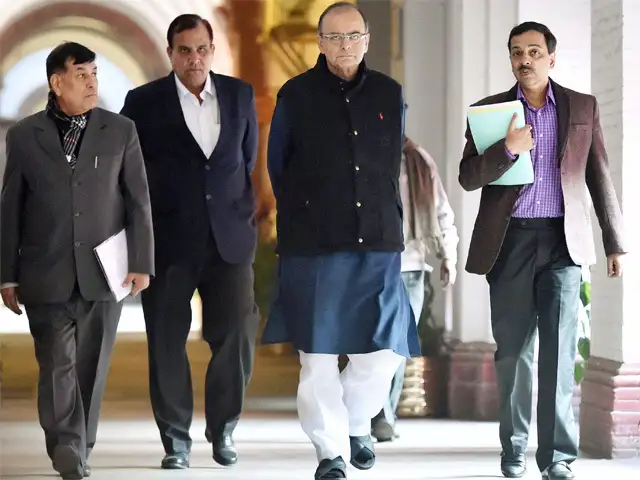
In Pic: Jaitley arrives at the Pre-Budget Consultation with the representatives of Trade Union, in New Delhi.
ET looks at the recent speeches of finance minister Arun Jaitley for clues to the budget for FY16. The budget is widely expected to lay down the agenda for the remaining four years of the Narendra Modi government.
In Pic: Jaitley arrives at the Pre-Budget Consultation with the representatives of Trade Union, in New Delhi.