The US dollar and gold, which typically move in opposite directions, are both on an upswing amid the search for safe havens.
The historical correlations between various asset classes look disrupted as investors are finding it difficult to price risk to global growth due to the Covid-19 epidemic. The impact of the SARS outbreak in 2003 may not serve as an effective proxy since China’s contribution to the global gross domestic product (GDP) has increased four-fold since then. As a result, investors are turning to safe haven assets to cover economic risks.
According to Bloomberg Economics calculations, China’s economy is running at 40-50 per cent of its capacity, and the first-quarter GDP growth may drop to 4.5 per cent, the lowest since 1992.
The US dollar and gold, which typically move in opposite directions, are both on an upswing amid the search for safe havens. This has resulted in the weakest negative correlation between these two asset classes in eight years. Gold is at a seven-year high of $1,600 per ounce. The dollar index, which tracks the performance of a basket of leading global currencies with respect to the US, has inched up to nearly 100 from 96.5 at the beginning of 2020. The dollar is strengthening with a flush of money moving towards US assets, both in fixed income and equities. The ratio of the MSCI US index to MSCI World index, excluding the US, rose to a record high of 1.6.
.#Dollar #DXY index traded this morning at its highest level for almost three years--not just confounding consensus… https://t.co/C8yQtYQ1Zy
— Mohamed A. El-Erian (@elerianm) 1582115383000
The bond and equity markets too are rising in tandem. The correlation between the US 10-year treasury yield and S&P 500 index has reached the highest level in a decade. Moderation in the global economy implies that global central banks may turn more accommodative. The probability of an interest rate cut by the US Fed during its meeting in the second-half of 2020 is more than 50 per cent.
The demand for the Japanese yen often increases amid rising risks to economic growth. This time around, however, bearish bets on the yen have risen the highest in 16 months on the expectation that the virus outbreak could put the Japanese economy in recession phase.
ADVERTISEMENT
Coronavirus attack: 5 stocks to gain from easing China competition
1/6
Coronavirus outbreak in China has hit supply chains across the world and India is no exception. Indian importers of raw materials too are facing problems as China factories remain shut for some time now. But the development has also brought some relief for domestic companies who competes with finished Chinese goods. Santosh Meena, Senior Analyst at TradingBells believes that electronic equipment, organic chemicals, fertilisers and plastics are top import sectors which may benefit from fall China imports.
Here are five likely beneficiaries of the reduced imports:
Coronavirus outbreak in China has hit supply chains across the world and India is no exception. Indian importers of raw materials too are facing problems as China factories remain shut for some time ..
Read More
Dixon Technologies is Trading Bells’ top pick in the electronic equipment segment. "Make in India" theme is the key reason for the stellar performance of Dixon Technologies. Synergy with marquee names like Samsung and Xiaomi is also a key factor for the vertical growth of the company. The cost of production is increasing in China resulting in companies moving from China to India and Dixon technologies is a major beneficiary of this phenomenon. The company has a strong order book for FY20-21. A cut in corporate tax is also boosting the bottom-line of the company.
Dixon Technologies is Trading Bells’ top pick in the electronic equipment segment. "Make in India" theme is the key reason for the stellar performance of Dixon Technologies. Synergy with marquee nam..
Read More
PI Industries is leading players in the agrochemicals space which is getting major benefits from falling imports from China of fertilizer and chemical products. PI Industries is ready for multi-year growth in the CSM segment because of its enhanced R&D and supply scarcity related issues in China. Recently, it has witnessed big product wins and a significant surge in the deal pipeline. The company is in the mode of capacity expansion as management sees decent growth opportunities in the future.
PI Industries is leading players in the agrochemicals space which is getting major benefits from falling imports from China of fertilizer and chemical products. PI Industries is ready for multi-year ..
Read More
Plastic products are the major beneficiaries of falling crude oil prices. Recently Supreme Industries has witnessed decent margin expansion amid a slow down in volume. The future growth outlook is bright as management expects volume to pick-up, led by a revival in demand from packaging and plastic piping segment. Pipes and fittings are likely to witness strong demand from the government’s ‘Nal se Jal’ Scheme. The company witnessed strong demand from that scheme in Bihar and Uttar Pradesh.
Plastic products are the major beneficiaries of falling crude oil prices. Recently Supreme Industries has witnessed decent margin expansion amid a slow down in volume. The future growth outlook is br..
Read More
API and chemical business is shifting from China to India after pollution control measures are taken by the Chinese government. A recent fall in imports from China due to Coronavirus will lead to further growth in revenue and margin for Indian companies where IOLCP is a perfect play for both specialty chemical and API business. It has a profit growth of 34% CAGR for the last 5 years with a ROE of 36%. It has footprints in 56 countries and regularly supplying its high-quality products to major pharmaceutical players.
API and chemical business is shifting from China to India after pollution control measures are taken by the Chinese government. A recent fall in imports from China due to Coronavirus will lead to fur..
Read More
Fertilizer is the fourth largest commodity that is imported from China to India and a recent fall in import due to Coronavirus is going to help domestic fertilizer players in a big way where UPL is the leader of this segment. The fallout from China disruption due to coronavirus on the CPC industry is uncertain and is still being weighed, according to UPL. Management sees this as an opportunity to seize market share and grab the space being vacated by Chinese chemical companies. Management believes that the opportunity for UPL to emerge as an alternative supply source offsets the potential negative impact on the overall demand for CPC as a result of the problems in China.
Fertilizer is the fourth largest commodity that is imported from China to India and a recent fall in import due to Coronavirus is going to help domestic fertilizer players in a big way where UPL is t..
Coronavirus: Pharma stocks that may gain or lose from China disruption
1/6
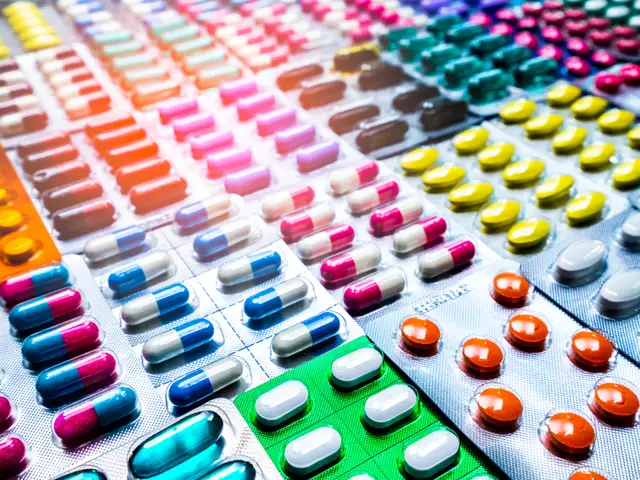
The Indian pharma industry is highly dependent on the Chinese pharmaceuticals industry for supplies of API, intermediates, and many organic chemicals. Total pharmaceutical and organic chemical imports from China are close to $10 billion of which bulk drug imports are more than $2.5 billion in value as per a report by Haitong Securities.
It is important to note that the total value of pharmaceutical production in India is more than $30 billion (for exports and consumption in India).
Here’s how the outbreak of coronavirus in China can impact the Indian pharma companies:
The Indian pharma industry is highly dependent on the Chinese pharmaceuticals industry for supplies of API, intermediates, and many organic chemicals. Total pharmaceutical and organic chemical import..
Read More
The ongoing Coronavirus crisis in China has forced pharmaceutical and chemical companies to shut their manufacturing units from mid-January. Most companies operating out of the affected regions have extended their shutdowns to mid-February. Fortunately, this healthcare crisis coincided with the Chinese New Year, due to which most API companies were well stocked in India. However, after speaking with industry experts, the brokerage believes that these supplies are likely to be exhausted by mid-March.
Here's a lowdown on key imported pharma products from China and the corresponding direct dependence of Indian companies.
The ongoing Coronavirus crisis in China has forced pharmaceutical and chemical companies to shut their manufacturing units from mid-January. Most companies operating out of the affected regions have ..
Read More
The key drug classes where APIs are imported in large quantities from Chinese suppliers are 1) Antibiotics, 2) NSAIDs, 3) ARVs, 4) Anti-epileptic, and 5) basic cancer products. The KSMs that are imported from China are 1) Acetic acid, 2) Para Amino Phenol, 3) 6 APA, 4) Adenine, and 5) Pen G. There are several solvents and non-active ingredients that are also imported from China.
The key drug classes where APIs are imported in large quantities from Chinese suppliers are 1) Antibiotics, 2) NSAIDs, 3) ARVs, 4) Anti-epileptic, and 5) basic cancer products. The KSMs that are impo..
Read More
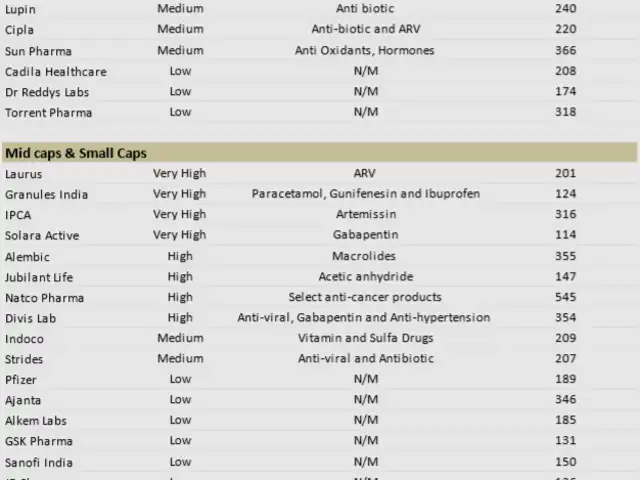
Among listed entities, API manufacturers have direct dependence on Chinese imports. Companies such as Laurus, Granules India, Solara Active Pharma are likely to have significant exposure.
Within formulation players, Aurobindo Pharma has one of the highest exposures to Chinese imports due to its antibiotic and ARV production while Alembic, IPCA, and Natco are likely to be heavily dependent on Chinese suppliers for their Macrolides, Anti-malarial, and anti-cancer products respectively.
Among listed entities, API manufacturers have direct dependence on Chinese imports. Companies such as Laurus, Granules India, Solara Active Pharma are likely to have significant exposure.
Within for..
Read More
Some players like Cadila, Dr. Reddy’s Lab and Torrent Pharma in large caps and Alkem Labs, Eris Life, Ajanta Pharma, Sanofi India, and Abbott India in mid- to small-cap categories do not have material direct dependence on Chinese imports. However, some of these players should be dependent on Chinese imports indirectly; for example Alkem Labs has high exposure to antibiotics and NSAIDs in India while Torrent Pharma sells many CNS products for which KSM could be generated out of Chinese factories. The industry is so intertwined that it is impossible to find a single player that would not be impacted by Chinese API/intermediate shortages, should these materialize from post mid-March.
Some players like Cadila, Dr. Reddy’s Lab and Torrent Pharma in large caps and Alkem Labs, Eris Life, Ajanta Pharma, Sanofi India, and Abbott India in mid- to small-cap categories do not have materia..
Read More
Should there be a crisis or supply disruption, API companies are likely to face severe earnings erosion due to their fixed long-term contracts, while formulation companies would be less impacted as they operate at higher gross margins and there is some leeway to pass cost increases on to prices. Specifically, companies that focus on low-volume and high-value products should be better off given their low dependence on China for such products and MNCs are also likely to be safer options given their direct imports.
Should there be a crisis or supply disruption, API companies are likely to face severe earnings erosion due to their fixed long-term contracts, while formulation companies would be less impacted as t..