World Breastfeeding Week: Nurse your newborn baby, it will help you burn extra calories
Breastfeeding also lowers the rate of postpartum depression in women.
By ET CONTRIBUTORS |
Getty Images
By Dr Garima Jain
India ranks the lowest in breastfeeding practices among South Asian countries including Sri Lanka, Afghanistan and Bangladesh, according to recent studies. Only 44% of women are able to breastfeed their newborns within an hour of birth and only 55% of all babies born in India receive breastmilk exclusively in the first six months.
Lack of support from a woman’s family, maternity protection measures and proper information are some factors contributing to the falling rates of breastfeeding in the country. Thus, despite a rise in the number of deliveries, breastfeeding rates are decreasing and more and more people are switching to breastmilk substitutes.
WHO recommends that colostrum — the milk produced by the mother right after her child is born — is the perfect food for the baby. It also says that children should be breastfed exclusively for at least six months and then along with other foods up to two years of age or beyond. BENEFITS FOR THE BABY Breast milk has all the ideal nutrients that a baby requires. It contains vitamins, fat and protein which help the baby grow, and it is in a form that is easier to digest, compared to infant formula.
Breast milk also contains antibodies that help the baby fight bacteria and viruses. It also lowers the risk of allergies and asthma in the baby, along with prevention of sudden infant death syndrome. Even those babies who are fed breastmilk only for six months are less prone to ear infections, diarr hoea and respiratory illnesses. Their visits to the doctor are also less frequent.
ADVERTISEMENT
Breastfed babies also tend to gain the right amount of weight as they grow up, which prevents cancer, diabetes and other diseases.
According to some studies, breastfeeding can significantly affect the baby's brain development in the long term.
Breastfeeding is beneficial from an emotional aspect as well because skinto-skin contact with the mother and the physical proximity of the baby to the mother secures their bond. PROTECTION FOR MOTHERS
ADVERTISEMENT
Breastfeeding has benefits for the mother also since it burns extra calories and thus, can help her lose weight. Breastfeeding also releases oxytocin which causes the uterus to shrink to its size before pregnancy. The risk of breast cancer is also reduced for women who breastfeed their babies as breast cells become more resistant to cancercausing mutations. Also, women who breastfeed tend to make certain lifestyle changes such as abstinence from alcohol and smoking, along with following a healthy diet. These lifestyle changes can also reduce the risk of breast cancer. Women who breastfeed also have less risk of osteoporosis compared to women who don't.
While women are breastfeeding, they have fewer menstrual cycles, which cause the level of estrogen to reduce and in turn, the risk of breast cancer decreases. Studies have shown that for each year that a woman breastfeeds her babies, the risk of breast cancer declines by 4%. The risk of breast cancer also decreases in women who have a family history of the disease by up to 60%, due to breastfeeding.
ADVERTISEMENT
The risk of ovarian cancer in women who have never breastfed is 1.5% more compared to women who have breastfed for 18 months, according to research. The reason breastfeeding helps prevent ovarian cancer is that it helps delay ovulation (release of an egg from one of a woman's ovaries).
Women who breastfeed for at least 12 months or more are at a lesser risk of developing high cholesterol, high blood pressure as well as cardiovascular diseases, compared to women who have never breastfed.
Breastfeeding may help prevent type-2 diabetes as it helps increase insulin sensitivity and boosts glucose metabolism. The longer a woman breastfeeds, the lesser the risk.
TIPS FOR NEW MOMS New mothers may take some time to get a hang of breastfeeding as it is a learning process, but a few tips can make it easier for you. Things may not go as smoothly as planned, but you should relax. The baby will learn gradually. You should also take a position that is comfortable for you as well as the baby when breastfeeding.
To keep the production of milk ongoing, nursing should be done consistently.
Production of milk varies from woman to woman; thus you shouldn't be worried that you are not lactating enough. Do not rely on supplements for increasing breast milk production.
Consult your doctor if you feel you are struggling with breastfeeding. Do not get discouraged as there are professionals who can teach mothers everything about breastfeeding.
Mothers can also use breast pumps once they get back to work or have to travel. This way, the baby can get breast milk even when you are not feeding and it wouldn't have to rely on breast milk substitutes.
When it comes to supporting women with maternity protection, a lot more needs to be done so that they can easily juggle between returning to work and breastfeeding.
(The writer is Senior Consultant-Gynaecology & Obstetrics at Apollo Cradle, Bengaluru)
World Milk Day: Know Nutritional Value Of Your Drink
1/7
There is a never-ending discussion about which milk is better and more nutritious than the other.
While animal milk (cow, buffalo, goat) contains more protein, fat and calcium, the absorption of plant milk is low in our body, and contains no cholesterol or lactose. Expert says that a person should alternate between different types of milk to get the most of the nutritional value.
On World Milk Day, Dr Seema Khanna, consultant nutritionist, shares the much-needed facts about the various milks available in the market.
There is a never-ending discussion about which milk is better and more nutritious than the other.While animal milk (cow, buffalo, goat) contains more protein, fat and calcium, the absorption of plant..
Read More
Cow's milk is the primary source of nutrition for children. Milk from early lactating cows contains antibiotics which helps in boosting immunity for cancer patients, and other life threatening diseases like HIV. Throughout the world, more than 6 billion people consume cow's milk and its milk products.
Cow's milk is the primary source of nutrition for children. Milk from early lactating cows contains antibiotics which helps in boosting immunity for cancer patients, and other life threatening diseas..
Read More
Glycemic index of rice milk is very high (86). Hence, it should be restricted by diabetic and polycystic ovarian syndrome patients.
Rice milk does not contain calcium, cholesterol and lactose. Rice milk is slightly foamy and appears similar to other forms of milk.
Rice milk is lighter (calorie-wise) than cow's milk, but less nutritious. It is the perfect option for people looking to reduce weight. It is easy to make at home, and inexpensive to prepare. The only drawback is that it may not contain many nutrients and has a short shelf life.
Method: Mix hot rice (preferably brown rice), raw cashews, hot water, salt and vanilla (optional) in a blender for 2 minutes. Strain the mixture in a cheesecloth. the creamy milk can last for at least 48 hours.
Glycemic index of rice milk is very high (86). Hence, it should be restricted by diabetic and polycystic ovarian syndrome patients.
Rice milk does not contain calcium, cholesterol and lactose. Rice ..
Read More
Goat milk is easy to digest as the fat molecules in the good milk are much smaller than the fat molecules in cow's milk. This milk is cheaper to process because it does not require homogenisation.
Goat milk is being used in treatment of dengue. It has fewer allergenic proteins, and causes less inflammation. It is high in calcium, fatty acids and low in cholesterol. It has good amount of protein, fat iron vitamin C and vitamin D with less of lactose content. It is good for patient having stomach ulcers.
Goat milk is easy to digest as the fat molecules in the good milk are much smaller than the fat molecules in cow's milk. This milk is cheaper to process because it does not require homogenisation.
G..
Read More
Almond milk contains neither lactose nor cholesterol. It is often consumed by lactose intolerants.
Unfortified almond milk has less nutrients, especially vitamin D. It is low in protein as compared to cow's milk.
Method: Soak almonds overnight. Blend almonds with the water (add dates if you want your milk to be sweet). Strain to remove the granules. Can be stored in the refrigerator for 3-4 days.
Almond milk contains neither lactose nor cholesterol. It is often consumed by lactose intolerants.
Unfortified almond milk has less nutrients, especially vitamin D. It is low in protein as compared ..
Read More
Buffalo milk contains more fats and solids. The emulsifying capacity of buffalo milk fat is better due to its higher proportion of butyric acid containing trglycerides compared to only 37% in cow's milk.
Buffalo milk contains more of saturated fats compared to cow's milk hence not recommended for heart disease patients and obese patients.
Buffalo milk contains more fats and solids. The emulsifying capacity of buffalo milk fat is better due to its higher proportion of butyric acid containing trglycerides compared to only 37% in cow's m..
Read More
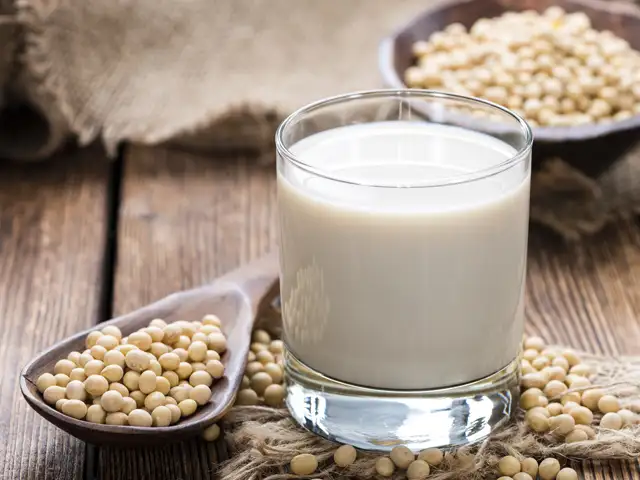
This plant-based drink is a stable emulsion of oil, water and protein. It is commonly used as a substitute for lactose intolerant patient and vegans.
Soy milk has a low glycemic index and can be consumed by diabetics and obese patients. However, it is not advisable during pregnancy.
It is good for people suffering with hypercholesteremia and hyperlipidemia as it contains omega-3 fatty acids. It has high content of isoflavons, proteins, vitamins and minerals with minimal amount of saturated fat. It can treat some of the leading health conditions like infertility.
Method: Add boiling water to split soybeans. Let it cool for 6-12 hours. Drain the beans, add cold water and mix in a blender for 3 minutes. Strain the mixture using a cheesecloth. Boil the soy milk for 10 minutes. Cool and store it for up to 3 days.
This plant-based drink is a stable emulsion of oil, water and protein. It is commonly used as a substitute for lactose intolerant patient and vegans.
Soy milk has a low glycemic index and can be con..
(Disclaimer: The opinions expressed in this column are that of the writer. The facts and opinions expressed here do not reflect the views of www.economictimes.com.)