When your mind lets you control a robotic arm, restore the sense of touch
Adding a sense of touch drastically improves the functionality of prosthetics for quadriplegics.
By AFP |
AFP
The world's first brain-computer interface allows a volunteer with paralysis, Nathan Copeland, from the chest down to accomplish this sensation.
WASHINGTON: Imagine being able to control a robotic arm from a distance, using only your mind. Now imagine being able to feel when its fingers grasp an object, as though it were your own hand.
US researchers published a study in the journal Science on Thursday about the world's first brain-computer interface that allowed a volunteer with paralysis from the chest down to accomplish this very feat.
The team say their work demonstrates that adding a sense of touch drastically improves the functionality of prosthetics for quadriplegics, compared to having them rely on visual cues alone.
"I am the first human in the world to have implants in the sensory cortex that they can use to stimulate my brain directly," Nathan Copeland, 34, told AFP.
"And then I feel as if a sensation is coming from my actual hand."
'Super cool'
ADVERTISEMENT
In 2004, Copeland was in a car accident that left him with a serious spinal cord injury and without the use of his hands or his legs.
He volunteered to participate in scientific research, and six years ago underwent a major operation to have tiny electrodes implanted in his brain.
Two sets of 88 electrodes the width of a strand of hair are arranged into "arrays" that resemble tiny hairbrushes and penetrate deep into the brain's motor cortex, which directs movement.
Fewer than 30 people in the world have these kinds of implants, the study's co-lead author Rob Gaunt, an assistant professor in the Department of Physical Medicine and Rehabilitation at the University of Pittsburgh, told AFP.
ADVERTISEMENT
What's unique about Copeland is an additional set of electrodes that are connected to his somatosensory cortex, which receives and processes sensations.
"When we're grabbing objects, we use this sense of touch very naturally to improve our ability to control," explained Gaunt.
ADVERTISEMENT
The team developed an interface that is "bi-directional" -- meaning not only can it "read" instructions from the brain and send them to the artificial limb, it can also "write" sensations from the device and transmit them back.
The idea of sending tactile feedback to the somatosensory cortex goes back decades, but doing so in a way that is controlled and is understandable by the circuitry of the brain was a challenge.
Nathan Copeland (right), 28, who is quadriplegic, controlling a robotic arm thanks to electrodes implanted in his brain, and Rob Gaunt (centre), assistant professor in the Department of Physical Medicine and Rehabilitation at the University of Pittsburgh, Pennsylvania. After operating on Copeland to install the electrodes, the team held their breath.
"No one knew what to expect because this had only been done in monkeys and you can't ask a monkey what something feels like," said Copeland.
Then came the moment of truth, when they tried sending their first touch signal.
"It was really faint," he recalled. He asked them to try again, to be sure it was real.
"Oh yeah, that's what that feels like, and it was just super cool," he said.
Twice as fast Before the interface could be put to work with the robotic arm, the scientists had to perform a series of tests with Copeland.
First, they needed to learn which electrodes caused what sensation when activated, and which fingers they were associated with, to set up the robotic hand correctly.
They also made him watch videos of the robotic arm moving left or right and recorded the electrodes that lit up when he was asked to "think" it was him controlling it.
Finally it was time to try it out.
Copeland sat next to the metallic black robotic arm and was asked to pick up a series of small objects like rocks, spheres, and place them on a box -- with either the tactile sensors switched on, or off.
He was able to complete each task on average twice as fast when the sensors were enabled, and was even able to achieve more complex tasks like picking up a glass and pouring its contents into another.
"The sensation gave me that assurance and confidence to know that I definitely had a good grab on the object and I could lift it up," said Copeland.
The team wants to further refine the prosthetics because "we don't want to just do science experiments in the lab, we want to actually build devices that are useful to people in their homes," added Gaunt.
Copeland got his brain-computer interface set up at home when the Covid pandemic shut down the university, and has used his downtime to learn how to draw on a tablet and even play video games.
He does this by using his mind to send signals directly to the computer, rather than using the arm to push buttons.
"It is just second nature to me now," he said.
New-Age Chef & Valet Robots To Make Your Life Easy
1/7
While the robotic revolution is making a splash around the world, here are a few that aim to make life easier, simulate human emotions and take us closer to the future. While the robotic revolution is making a splash around the world, here are a few that aim to make life easier, simulate human emotions and take us closer to the future.
While the robotic revolution is making a splash around the world, here are a few that aim to make life easier, simulate human emotions and take us closer to the future. While the robotic revolution i..
Read More
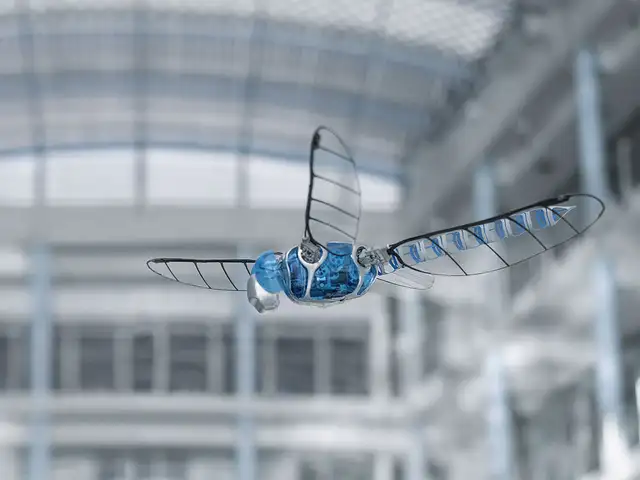
The BionicOpter was a talking point recently when Jeff Bezos tweeted a short video of himself playing with the robot dragonfly at his robotics conference MARS. The makers, Festo AG, say they have “technically mastered the highly complex flight characteristics of the dragonfly” — the robot can fly in all directions, hover in mid-air and glide without beating its wings. BionicOpter supports wireless real-time communication, a continuous exchange of information, and can identify complex events.
The BionicOpter was a talking point recently when Jeff Bezos tweeted a short video of himself playing with the robot dragonfly at his robotics conference MARS. The makers, Festo AG, say they have “t..
Read More
Motobot 2.0 is an autonomous motorcycle-riding robot that combines the latest in motorcycle and robotics technology to drive around a racetrack on a Yamaha YZF-R1M. The motorcycle dons a look of the classic modern aerodynamic racing two-wheeler, while the robot needs human operators only to specify how aggressively it should race. Motobot 2.0 can race at a speed of almost 200 kmph but it’s no match for Valentino Rossi yet.
Motobot 2.0 is an autonomous motorcycle-riding robot that combines the latest in motorcycle and robotics technology to drive around a racetrack on a Yamaha YZF-R1M. The motorcycle dons a look of the..
Read More
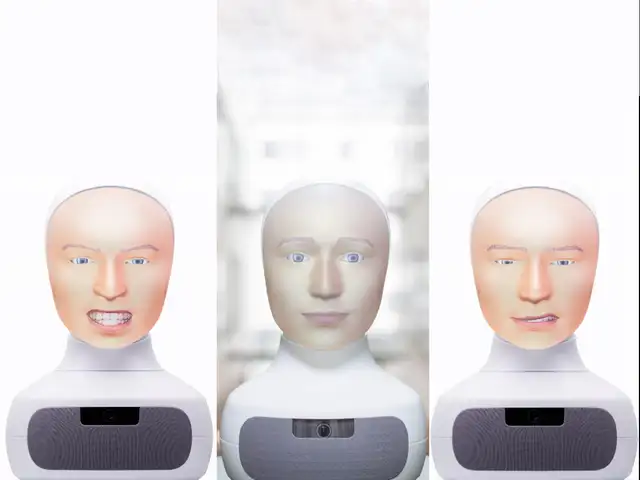
Tengai, a brainchild of Furhat Robotics, is the world’s first job interview robot that aims to take out unconscious human biases from the process. She sits on top of a table directly across the candidate she’s about to interview. Tengai has three degrees of movement freedom and can display complex expressions — blink and smile lightly as she poses her questions.
Tengai, a brainchild of Furhat Robotics, is the world’s first job interview robot that aims to take out unconscious human biases from the process. She sits on top of a table directly across the cand..
Read More
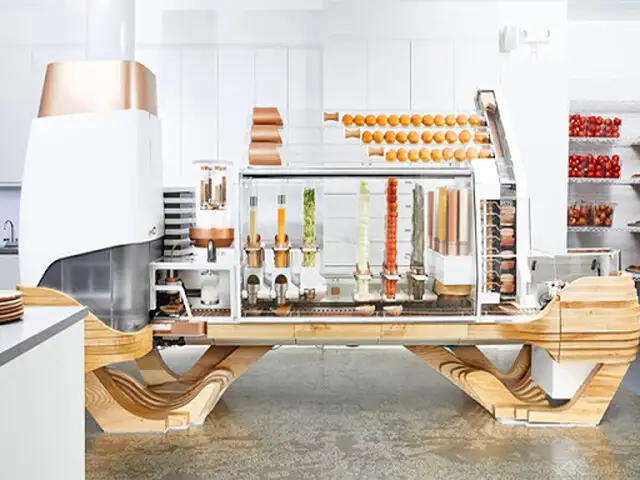
Creator, a burger restaurant that opened last year in San Francisco, is home to two sedansized robots each of which can churn out 120 burgers an hour. Each robot is reportedly equipped with 350 sensors, 50 actuators and 20 computers together which allow it to grind the meat, shape the burgers, slice the tomatoes, grate cheese and dispense mustard. The robots themselves are controlled by a machine learning algorithm.
Creator, a burger restaurant that opened last year in San Francisco, is home to two sedansized robots each of which can churn out 120 burgers an hour. Each robot is reportedly equipped with 350 sens..
Read More
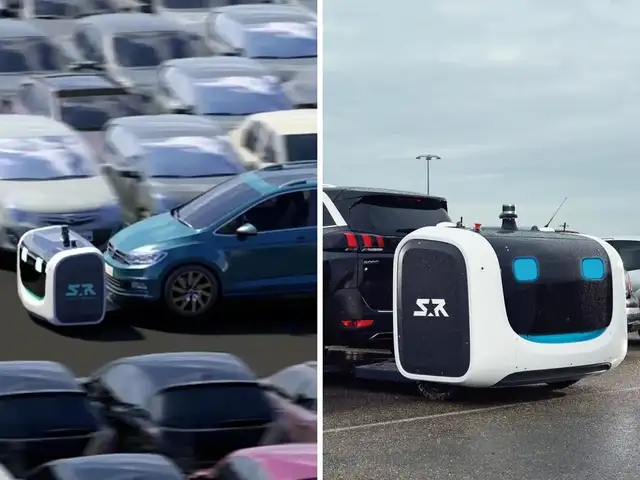
Robots are coming to take over valet parking tasks. London’s Gatwick Airport recently collaborated with Stanley Robotics to trial robots that valet park passengers’ cars. The trial will run from the second half of 2019 to early 2020 wherein passengers will have to leave their car at the airport’s ‘parking station’ without handing over keys. The robot will lift up the car and store it in a secure car park. The service will have access to users’ flight details so that the robot can bring back the car when the passenger returns.
Robots are coming to take over valet parking tasks. London’s Gatwick Airport recently collaborated with Stanley Robotics to trial robots that valet park passengers’ cars. The trial will run from the..
Read More
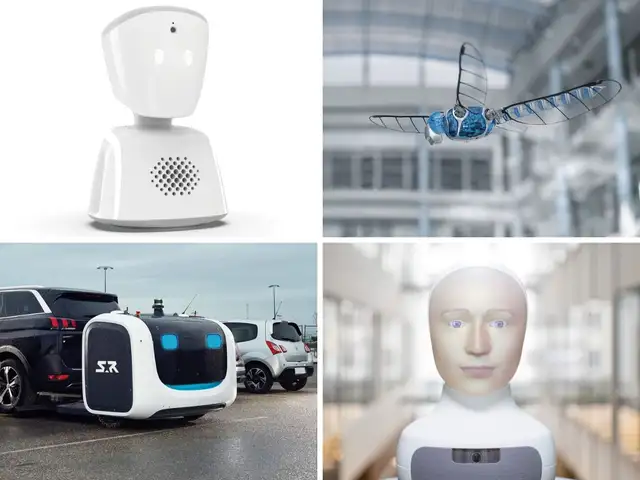
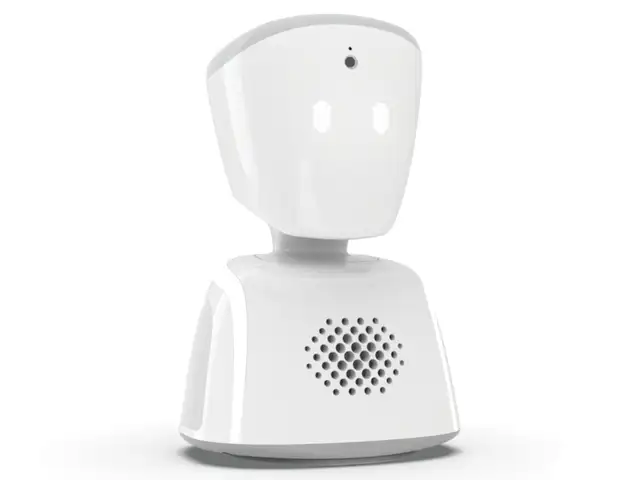
If you are unable to attend an important meeting at the office or your kid can’t be at school because of chronic illness, AV1 can be a competent proxy. Oslo-based start-up No Isolation’s AV1 is a cute-looking robot that can sit at a meeting room and live stream video and audio back to your mobile device remotely. It can help housebound sick children and elderly people keep in touch with friends and family, and thus combat loneliness.
If you are unable to attend an important meeting at the office or your kid can’t be at school because of chronic illness, AV1 can be a competent proxy. Oslo-based start-up No Isolation’s AV1 is a cu..