Facebook fears the WhatsApp privacy policy row may hurt its future
The flap threatens to erode trust in the service which is increasingly important to the social network's future.
By AFP | Updated:
WhatsApp policy update: Why is it alarming users
WASHINGTON: When WhatsApp users began to raise concerns about a new privacy policy being rolled out, members of a Washington pickup soccer group decided to switch their communications to rival messaging platform Signal, ditching the Facebook-owned service.
The shift was "about moving as many users away from the Facebook empire, which for my liking has become way too big and powerful," said Bernhard Fleck, one of the players.
The flap over WhatsApp's privacy policy -- described by Facebook as a misunderstanding about efforts to bring businesses onto the platform --threatens to erode trust in the service which is increasingly important to the leading social network's future. The California giant last month delayed implementation of a new policy which critics said could expand data collection from some two billion WhatsApp users around the world. Even with the delay in place, the policy caused an uproar and prompted a surge in interest in rival messaging services such as Signal and Telegram. A WhatsApp blog post cited "confusion" over the policy update and maintained that it "does not expand our ability to share data with Facebook."
The update concerns how merchants using WhatsApp to chat with customers can share data with Facebook, which could use the information for targeted ads, according to the social network. The policy will be reviewed and won't be implemented before May 15, according to the company. Ryan Calo, a privacy researcher with the University of Washington's Tech Policy Lab, said that even though many users misinterpreted the new policy, the backlash is understandable.
"The original sin was purchasing WhatsApp and folding it into the business model of Facebook which monetizes all the data they have," Calo said. "The changes aren't as dystopian as some people are thinking. But it is moving to a model that many people don't trust."
WhatsApp, acquired in 2014 for some $19 billion -- the largest sale of a venture-backed firm at the time -- is seen as a strategic asset for Facebook as it faces slowing growth for its core social network and looks to expand its offerings for connecting users and businesses. The controversy comes as Facebook seeks to integrate its "family" of applications with a common technology and provide more ways for people and businesses to connect, while US antitrust enforcers meanwhile press to "unwind" Facebook's acquisition of WhatsApp and Instagram.
ADVERTISEMENT
Merrill Lynch analyst Justin Post said in a recent research note that "we continue to see WhatsApp as an important driver of potential future Facebook stock value" and predicted that the social media giant would overcome these issues as it did with the Cambridge Analytica political scandal. With easy connections for voice and video calls, WhatsApp has a strong global user base but has not begun any meaningful monetization of the service, said Jasmine Enberg, senior analyst of global trends at the research firm eMarketer.
"It was only a matter of time before Facebook worked out a way to make it into a revenue stream," Enberg said. She added that since Facebook has apparently ruled out using WhatsApp for advertising, it is moving toward making it an e-commerce platform along the lines of China's WeChat with business tools for customer service and support. Privacy advocates point out that WhatsApp has in fact been sharing data with Facebook since it implemented a new policy in 2016, except from users who opted out at that time. Data from European Union users has also been excluded without affirmative consent under EU privacy laws. Indicating that WhatsApp users could no longer opt out last month, "was a little insulting to people's intelligence," said Gennie Gebhart, a privacy researcher with the Electronic Frontier Foundation.
"A lot of people joined WhatsApp to get away from Facebook, but now they are seeing they are sharing their data with that company," she said. But Gebhart said users have limited options now because of the so-called "network effect" -- with so many people on WhatsApp, it's difficult to move away from the free service. According to eMarketer data from last year, WhatsApp had more than 99 percent of mobile messaging app users in Brazil, 97 percent in India and 52 percent in the United States.
Enberg said the latest privacy dust-up is unlikely to slow momentum for WhatsApp and Facebook, especially since there is often a "disconnect" between what people say and what they do on privacy. "Sure, many people left and more may leave," she said, "But it's unlikely we will see a mass exodus. And WhatsApp's user base is already so large, it would take precisely that to make a significant dent."
ADVERTISEMENT
Telegram, Signal, Viber: All You Need To Know About The Top Alternatives To WhatsApp
1/6
WhatsApp's new update to its privacy policy and terms of service hasn't gone down well with users , several of whom are now looking for better alternatives to switch to. Last week, the instant messaging giant had launched a new privacy policy stating that it will be sharing user data with parent company Facebook, and those who do not accept the updated terms by February 8, will no longer have the access to their chats.
This notification, which users across India started receiving early last week, threw people, tech experts, and cybersecurity advocates into a frenzy. Several multinational companies also started advising their employees to avoid disclosing or sharing sensitive company-related data or information on WhatsApp. These companies warned their staff against making crucial business calls on the messaging platform.
On Thursday, the Tesla CEO and world’s richest man, Elon Musk in a tweet rooted for 'Signal', a messaging app.
Despite WhatsApp issuing a fresh clarification on Tuesday regarding it's changed policies, the debate on privacy continues to hover over it. Which leads us to the big question: Are there any good alternatives to WhatsApp? Well, there are several, and we’ve compiled a list of messaging services that come packed with interesting features.
WhatsApp's new update to its privacy policy and terms of service hasn't gone down well with users , several of whom are now looking for better alternatives to switch to. Last week, the instant messag..
Read More
This cross-platform, cloud-based instant messaging service is the closest match to WhatsApp. Telegram, which was initially launched for iOS and Android in late 2013 by two Russian brothers - Pavel Durov and Nikolai Durov, has impressively increased its reach in the last few months. It's a freeware service that offers video calling, VoIP, file sharing among other features. The instant messaging software can be used on both mobile platforms and desktops.
‘Secret Chat’ mode
One of the interesting features of Telegram is its 'Secret Chat' mode which is encrypted with its MTProto protocol. Messages sent within secret chat can only be accessed by the device through which the text was sent or received. Texts can be deleted at any time, and it can also optionally self-destruct. The secret chat can only be initiated through an invite, after which the 'encryption keys' for the session are exchanged between users.
Apart from this, users can also send texts, voice messages, images, documents, contacts, locations, music and many other things.
In 2020, Telegram reached over 400 million monthly active users and was the 8th most downloaded app in the world, as per the data shared by Apptopia.
This cross-platform, cloud-based instant messaging service is the closest match to WhatsApp. Telegram, which was initially launched for iOS and Android in late 2013 by two Russian brothers - Pavel Du..
Read More
This is another user-friendly app which is a cross-platform encrypted messaging service. If compared with other free instant messaging apps available in the market, Signal Messenger is believed to be the most secure one. Unlike WhatsApp and Telegram, Signal has a very simple and neat look, making the user experience for people in different age groups equally easy and friendly.
If this isn’t reason enough for you to give it a try, it is also recommended by Musk.
What is Signal?
In 2018, Moxie Marlinspike and WhatsApp co-founder Brian Acton, launched Signal Messenger, an open source application. In layman’s terms, it means that any security developer can test it to find bugs or flaws. The app offers end-to-end encryption, ensuring that nobody can access or store your private chats or media.
The messaging app also allows users to set a registration lock PIN. It provides a 'screen lock timeout' interval as an additional protection in case the user loses the phone. As far as privacy is concerned, Signal has said that it only stores the users’ phone numbers and nothing else. It also offers a feature that disables screenshots.
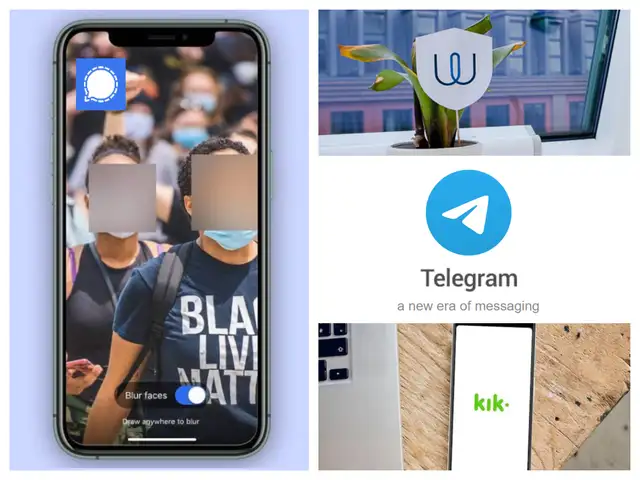
But the application's USP has to be the 'Sealed Sender' feature which hides the details of sender and receiver. Signal also has a feature where one can blur out faces of people in photos to protect their identities.
This is another user-friendly app which is a cross-platform encrypted messaging service. If compared with other free instant messaging apps available in the market, Signal Messenger is believed to be..
Read More
This is yet another instant messaging app that supports end-to-end encryption. Your messages, videos, photos, video and voice calls are protected. It is a cross-platform operated by Japanese firm MNC Rakuten, that lets you back-up your data from the app to your drive.
Just like Telegram, Viber, too, offers the disappearing messages feature. You can set a particular time and your text will disappear on its own. It also offers a ‘screenshot lock’ feature, similar to that of Signal. Viber can be accessed on iOS, Android and Windows.
How safe is your data with Viber?
Although Viber is a free app, you might see a few ads on the messaging platform. However, the company in a blog post clarified that the ads only help them keep the app free for all to use and no user data is actually shared with the advertising providers.
The messaging platform collects your device ID identifiers, location, phone number and user ID, in addition to product interaction, email ID, name and contacts.
This is yet another instant messaging app that supports end-to-end encryption. Your messages, videos, photos, video and voice calls are protected. It is a cross-platform operated by Japanese firm MNC..
Read More
It's a unique messenger app created by Wire Swiss that is protected by European data retention laws. The app supports end-to-end encrypted messaging, file-sharing, video and voice calls. It also has a feature called guest rooms for external communication, where users can chat with external parties without having them register on the app. The messaging service is available for mobile, desktop and web.
Different modes
Apart from Wire Personal, which is a secure messaging platform for personal use with end-to-end encryption, Wire offers three modes based on its security technology: Wire Pro, Wire Enterprise and Wire Red.
Wire Pro offers collaboration features for businesses, Wire Enterprise also comes with the same features as Pro but with additional services for large-scale business organisations, and then we have Wire Red, the on-demand crisis collaboration suite.
It's a unique messenger app created by Wire Swiss that is protected by European data retention laws. The app supports end-to-end encrypted messaging, file-sharing, video and voice calls. It also has ..
Read More
The instant messaging mobile app has a name for itself for the increased privacy and anonymity that it offers. To use Kik Messenger, you only need an email address to register as it does not ask for your mobile number. The app is mobile based and is available for iOS and Android operating systems.
However, Kik, product of Kik Interactive which was founded in 2009 by a group of students in Canada, doesn't offer end-to-end encryption.
How Ki(c)k-ing is Kik?
The most notable feature of the app is certainly the anonymity it offers. You can register by entering your first and last name, email address and birth date, which must prove that you are at least 13 years of age. Then you select a username and voila, your account is created. Unlike other messaging apps, Kik uses your device to store the data. Now this data storage feature has worked for the app and also against it as the data can't be retrieved in case you lose or switch your device.
The application doesn't have access to information such as photos, videos, chats among other things since the data is automatically deleted shortly after it is sent.
But despite these features, there are a lot of safety concerns when it comes to Kik as the messaging platform has a reputation of hosting illegal activities in the past, due to the anonymity it provides. Through Kik's anonymous chat option, you might find yourself talking to people you shouldn't be talking to.
The instant messaging mobile app has a name for itself for the increased privacy and anonymity that it offers. To use Kik Messenger, you only need an email address to register as it does not ask for ..