The milk goes in last! The correct way to drink tea like a Brit
Most Britons believe that milk should be poured in at the end, rather than the beginning.
By PTI |
Getty Images
LONDON: Although many cultural debates may be brewing in Britain, it appears that one age-old bone of contention has been settled: Should milk go in a cup of tea first or last? Drinking tea is considered one of Britain's favourite past-times, but its rituals have divided connoisseurs for centuries, and served as a social class marker.
The most contentious issue has been when to add milk, but a poll published today reveals that four times more Britons believe that it should be poured in at the end, rather than the beginning.
The YouGov Omnibus survey found that 79 per cent favoured adding milk last, with 20 per cent disagreeing.
The split was even more marked across the generations, with 96 per cent of 18-24 year-olds believing it should be added first, compared to 32 per cent of over 65-year-olds.
The issue was tackled by author George Orwell in his 1946 essay "A Nice Cup of Tea", where he wrote "indeed in every family in Britain there are probably two schools of thought on the subject".
ADVERTISEMENT
It was believed to have class connotations, with the aristocracy showing off their expensive china cups by adding boiling water first -- a practice that would reputedly shatter cheaper vessels.
But the latest poll indicates no preference according to class, with the middle and working classes both equally likely to add their milk in first.
World Milk Day: Know Nutritional Value Of Your Drink
1/7
There is a never-ending discussion about which milk is better and more nutritious than the other.
While animal milk (cow, buffalo, goat) contains more protein, fat and calcium, the absorption of plant milk is low in our body, and contains no cholesterol or lactose. Expert says that a person should alternate between different types of milk to get the most of the nutritional value.
On World Milk Day, Dr Seema Khanna, consultant nutritionist, shares the much-needed facts about the various milks available in the market.
There is a never-ending discussion about which milk is better and more nutritious than the other.While animal milk (cow, buffalo, goat) contains more protein, fat and calcium, the absorption of plant..
Read More
Cow's milk is the primary source of nutrition for children. Milk from early lactating cows contains antibiotics which helps in boosting immunity for cancer patients, and other life threatening diseases like HIV. Throughout the world, more than 6 billion people consume cow's milk and its milk products.
Cow's milk is the primary source of nutrition for children. Milk from early lactating cows contains antibiotics which helps in boosting immunity for cancer patients, and other life threatening diseas..
Read More
Glycemic index of rice milk is very high (86). Hence, it should be restricted by diabetic and polycystic ovarian syndrome patients.
Rice milk does not contain calcium, cholesterol and lactose. Rice milk is slightly foamy and appears similar to other forms of milk.
Rice milk is lighter (calorie-wise) than cow's milk, but less nutritious. It is the perfect option for people looking to reduce weight. It is easy to make at home, and inexpensive to prepare. The only drawback is that it may not contain many nutrients and has a short shelf life.
Method: Mix hot rice (preferably brown rice), raw cashews, hot water, salt and vanilla (optional) in a blender for 2 minutes. Strain the mixture in a cheesecloth. the creamy milk can last for at least 48 hours.
Glycemic index of rice milk is very high (86). Hence, it should be restricted by diabetic and polycystic ovarian syndrome patients.
Rice milk does not contain calcium, cholesterol and lactose. Rice ..
Read More
Goat milk is easy to digest as the fat molecules in the good milk are much smaller than the fat molecules in cow's milk. This milk is cheaper to process because it does not require homogenisation.
Goat milk is being used in treatment of dengue. It has fewer allergenic proteins, and causes less inflammation. It is high in calcium, fatty acids and low in cholesterol. It has good amount of protein, fat iron vitamin C and vitamin D with less of lactose content. It is good for patient having stomach ulcers.
Goat milk is easy to digest as the fat molecules in the good milk are much smaller than the fat molecules in cow's milk. This milk is cheaper to process because it does not require homogenisation.
G..
Read More
Almond milk contains neither lactose nor cholesterol. It is often consumed by lactose intolerants.
Unfortified almond milk has less nutrients, especially vitamin D. It is low in protein as compared to cow's milk.
Method: Soak almonds overnight. Blend almonds with the water (add dates if you want your milk to be sweet). Strain to remove the granules. Can be stored in the refrigerator for 3-4 days.
Almond milk contains neither lactose nor cholesterol. It is often consumed by lactose intolerants.
Unfortified almond milk has less nutrients, especially vitamin D. It is low in protein as compared ..
Read More
Buffalo milk contains more fats and solids. The emulsifying capacity of buffalo milk fat is better due to its higher proportion of butyric acid containing trglycerides compared to only 37% in cow's milk.
Buffalo milk contains more of saturated fats compared to cow's milk hence not recommended for heart disease patients and obese patients.
Buffalo milk contains more fats and solids. The emulsifying capacity of buffalo milk fat is better due to its higher proportion of butyric acid containing trglycerides compared to only 37% in cow's m..
Read More
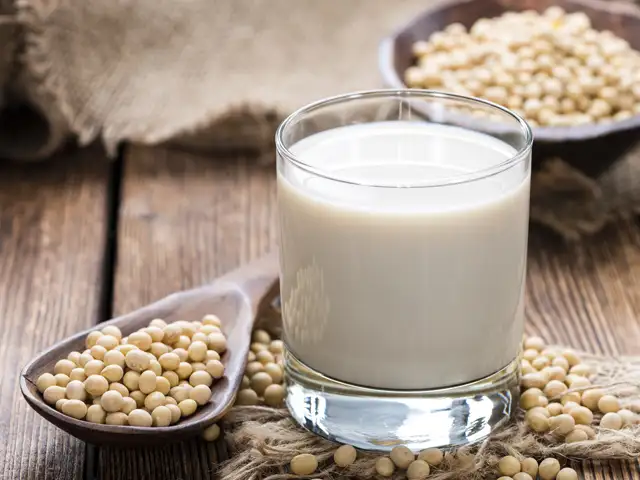
This plant-based drink is a stable emulsion of oil, water and protein. It is commonly used as a substitute for lactose intolerant patient and vegans.
Soy milk has a low glycemic index and can be consumed by diabetics and obese patients. However, it is not advisable during pregnancy.
It is good for people suffering with hypercholesteremia and hyperlipidemia as it contains omega-3 fatty acids. It has high content of isoflavons, proteins, vitamins and minerals with minimal amount of saturated fat. It can treat some of the leading health conditions like infertility.
Method: Add boiling water to split soybeans. Let it cool for 6-12 hours. Drain the beans, add cold water and mix in a blender for 3 minutes. Strain the mixture using a cheesecloth. Boil the soy milk for 10 minutes. Cool and store it for up to 3 days.
This plant-based drink is a stable emulsion of oil, water and protein. It is commonly used as a substitute for lactose intolerant patient and vegans.
Soy milk has a low glycemic index and can be con..