Psychology Test: Choose One Answer Without Overthinking. Your Answers Reveal Your Thinking Style

1/8
Psychology Test: Choose One Answer Without Overthinking. Your Answers Reveal Your Thinking Style
When you encounter a question, your brain can produce an answer almost instantly, sometimes before you consciously work through the information. Psychologists have studied this tendency through cognitive reflection, which involves pausing to examine an initial response instead of automatically accepting it. For the five situations ahead, don't try to find the “smartest” answer. Pick the option that genuinely comes to mind first and keep track of your choices.

2/8
You find a wallet on the street. What do you do first?
A. Look for an ID to find the owner
B. Hand it to the nearest authority
C. Look around to see if someone appears to be searching for it
D. Take it home and figure out what to do later
Your first response can reveal what information your mind prioritises when there isn't an obvious solution. A suggests an evidence-first approach, where you seek concrete information before deciding. B prioritises an established procedure, while C relies more on reading the surrounding situation and other people's behaviour. D reflects a tendency to postpone the decision when the available information feels insufficient.
This isn't claiming A = “logical personality.” It's testing what your mind does first when information is incomplete.
B. Hand it to the nearest authority
C. Look around to see if someone appears to be searching for it
D. Take it home and figure out what to do later
Your first response can reveal what information your mind prioritises when there isn't an obvious solution. A suggests an evidence-first approach, where you seek concrete information before deciding. B prioritises an established procedure, while C relies more on reading the surrounding situation and other people's behaviour. D reflects a tendency to postpone the decision when the available information feels insufficient.
This isn't claiming A = “logical personality.” It's testing what your mind does first when information is incomplete.

3/8
A bat and ball together cost ₹110. The bat costs ₹100 more than the ball. How much does the ball cost?
A. ₹10
B. ₹5
C. ₹15
D. ₹20
If ₹10 immediately jumped out at you, you encountered the kind of intuitive response studied in the Cognitive Reflection Test. The answer feels obvious, but checking the calculation reveals that the ball costs ₹5. If you immediately questioned ₹10 and worked through the calculation, you engaged in the reflective process the test was designed to examine.
B. ₹5
C. ₹15
D. ₹20
If ₹10 immediately jumped out at you, you encountered the kind of intuitive response studied in the Cognitive Reflection Test. The answer feels obvious, but checking the calculation reveals that the ball costs ₹5. If you immediately questioned ₹10 and worked through the calculation, you engaged in the reflective process the test was designed to examine.
Amazon Top Deals
POWERED BY

Crompton Ozone 75 Litres Desert Air Cooler for home | Large & Easy Clean Ice Chamber | 4-Way Air Deflection | High Density Honeycomb Pads | Everlast Pump | Auto Fill| 3 Year Brand Warranty
₹9,798Buy Now43%
OFF

LG 32 L Convection Microwave Oven (MC3286BRUM, Black, 360° Motorised Rotisserie for Bar-be-queing, 301 Auto Cook Menu, Stainless steel cavity, Indian Cuisine, Tandoor Se, Steam Clean & Diet Fry)
₹19,090Buy Now20%
OFF

4/8
You meet someone who seems extremely confident. What's your first thought?
A. They probably know what they're talking about
B. Confidence doesn't tell me much
C. I'd want to hear their reasoning first
D. My impression would depend on the situation
Our minds constantly make rapid judgements using limited information. Choosing A suggests you are more comfortable allowing an immediate impression to guide your judgement, while B and C involve withholding judgement until more information is available. D reflects a more context-dependent approach. The important point is that an intuitive first impression isn't automatically wrong — the question is whether you can recognise when it needs checking.
B. Confidence doesn't tell me much
C. I'd want to hear their reasoning first
D. My impression would depend on the situation
Our minds constantly make rapid judgements using limited information. Choosing A suggests you are more comfortable allowing an immediate impression to guide your judgement, while B and C involve withholding judgement until more information is available. D reflects a more context-dependent approach. The important point is that an intuitive first impression isn't automatically wrong — the question is whether you can recognise when it needs checking.
5/8
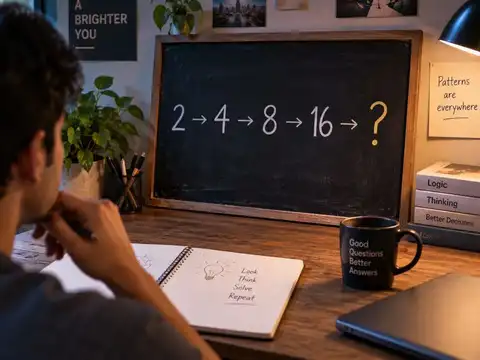
Which number comes next?
2 — 4 — 8 — 16 — ?
A. 20
B. 24
C. 32
D. 36
If 32 immediately appeared in your mind, your brain rapidly detected the doubling pattern. This time, the intuitive answer happens to be correct. That's important because intuition isn't simply the opposite of good reasoning. Humans can use experience and pattern recognition to arrive at useful answers quickly. Cognitive reflection becomes especially relevant when that first pattern or impression conflicts with other information.
A. 20
B. 24
C. 32
D. 36
If 32 immediately appeared in your mind, your brain rapidly detected the doubling pattern. This time, the intuitive answer happens to be correct. That's important because intuition isn't simply the opposite of good reasoning. Humans can use experience and pattern recognition to arrive at useful answers quickly. Cognitive reflection becomes especially relevant when that first pattern or impression conflicts with other information.

6/8
A friend recommends a restaurant they loved. The reviews are terrible. What do you trust first?
A. My friend's recommendation
B. The reviews
C. I'd investigate further
D. I'd probably go with my gut
This choice introduces a different kind of information conflict: personal experience versus external evidence. Choosing A or D suggests greater willingness to rely on a trusted personal impression, while B gives more weight to aggregated evidence. C reflects a tendency to seek additional information before committing. Your response isn't a measure of intelligence; it shows which source your mind is inclined to prioritise first.
B. The reviews
C. I'd investigate further
D. I'd probably go with my gut
This choice introduces a different kind of information conflict: personal experience versus external evidence. Choosing A or D suggests greater willingness to rely on a trusted personal impression, while B gives more weight to aggregated evidence. C reflects a tendency to seek additional information before committing. Your response isn't a measure of intelligence; it shows which source your mind is inclined to prioritise first.

7/8
Result: So, what does your pattern of answers say?
If you repeatedly chose options based on what immediately felt convincing, you may have a stronger tendency to rely on intuitive responses. If you frequently chose options that involved checking evidence or delaying judgement, you may lean more toward reflective processing. A mixture suggests that you switch approaches depending on the situation. Researchers caution, however, that cognitive-reflection tasks also involve numeracy, reasoning ability and other cognitive skills, so this should be viewed as a fun indication of your thinking tendencies rather than a diagnosis.
8/8
The Psychology Behind Your Choices
The real test is what happens after the first thought
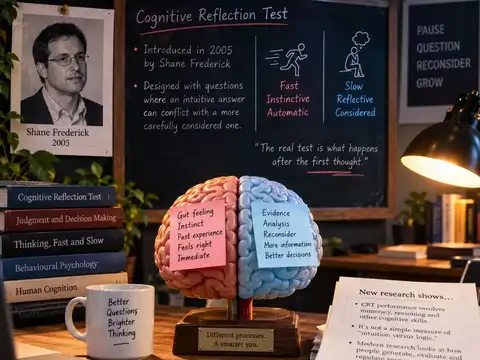
The Cognitive Reflection Test, introduced by psychologist Shane Frederick in 2005, was designed around questions where an intuitive answer can conflict with a more carefully considered one. Later research has complicated the picture, showing that CRT performance cannot be reduced to a simple measure of “intuition versus logic.” Modern work instead examines how people generate, evaluate and regulate responses. In other words, the interesting psychological ability isn't never trusting your instincts — it's being able to stop and reconsider them when necessary.
The Cognitive Reflection Test, introduced by psychologist Shane Frederick in 2005, was designed around questions where an intuitive answer can conflict with a more carefully considered one. Later research has complicated the picture, showing that CRT performance cannot be reduced to a simple measure of “intuition versus logic.” Modern work instead examines how people generate, evaluate and regulate responses. In other words, the interesting psychological ability isn't never trusting your instincts — it's being able to stop and reconsider them when necessary.