Over-flowing inboxes? No problem! Gen Z may free the world from never-ending e-mails
A 2020 study found that email is among the top tools used for collaboration by people above 30.
By New York Times |
iStock
Inbox stress is not unique to people born after the 1998 rom-com 'You’ve Got Mail' or who entered kindergarten at the dawn of the Gmail era (2004).
Despite the reasonable qualms of older generations, Generation Z — generally defined as people born between 1997 and 2012 — is pioneering the return of chaotic trends like low-rise jeans, pop-punk and Ed Hardy.
But members of Gen Z do seem to agree with their elders on one thing: Email. Ugh. And, if we’re lucky, maybe they can one day save everyone from overflowing inboxes.
According to a 2020 study from the consulting firm Creative Strategies, there’s a generational gap in primary work tools. The survey found that for those 30 and above, email was among the top tools they used for collaboration. For those under 30, Google Docs was the app workers associated most with collaboration, followed by Zoom and iMessage.
Adam Simmons, 24, prefers to communicate using “literally anything but email.” Simmons, who is based in Los Angeles, started a video production company after graduating from the University of Oregon in 2019. He primarily communicates with his eight employees and his clients, which are mostly sports teams, over text, Instagram and Zoom.
“Email is all your stressors in one area, which makes the burnout thing so much harder,” he said. “You look at your email and have work stuff, which is the priority, and then rent’s due from your landlord and then Netflix bills. And I think that’s a really negative way to live your life.”
The turning point for Simmons was when a work email from the Seattle Mariners got lost in his spam folder.
ADVERTISEMENT
“It’s actually crazy how outdated it is,” he said of email, becoming increasingly animated during the interview that we set up over text. He noted that messages show up in spam that aren’t spam and that he has to upload video clips elsewhere before emailing them. “It’s painful to use Google Drive.”
“Part of the whole reason I don’t want to work for someone else is because I don’t want to constantly check my email and make sure my boss didn’t email me,” Simmons said. “That’s the most stressful thing.”
For some people, adding texting can complicate communication, introducing multiple ways to be expected to get in touch with someone. Inbox stress is, of course, not unique to people born after the email rom-com “You’ve Got Mail” hit theaters (’98) or who were entering kindergarten at the dawn of the Gmail era (2004).
ADVERTISEMENT
In April, in response to a reader callout on pandemic burnout, The New York Times received dozens of messages specifically about email, or what one reader described as “the eternal chore.” Another said: “It has, on the worst days, brought me to tears.”
Others put it more bluntly: “Every time I get an email, it is like getting stabbed. Another thing for me to do,” a student wrote.
ADVERTISEMENT
The shortcomings of email have only been exacerbated by the pandemic. Decisions that were once made by stopping by a co-worker’s desk have been relegated to inbox Ping-Pong. Some people wrote about feeling a sense of guilt for not being able to reply faster or for adding emails to their colleagues’ inboxes. Others described how responding to a barrage of emails caused them to lose track of other tasks, creating a cycle that’s at best unproductive and at worse infuriating.
“After the email is sent, I have to think hard about where I was and what I was doing. It’s the digital equivalent of walking into a room only to forget why you went there,” wrote Vishakha Apte, 46, an architect in New York.
Some have been trying to get rid of email for years. Writers like Cal Newport, whose book “A World Without Email: Reimagining Work in an Age of Communication Overload” was published in March, has long argued that the “tyranny of the inbox” causes us to lose our ability to concentrate. Switching rapidly between email, Slack and other tasks creates a pileup in our brains.
“We also feel frustrated. We feel tired. We feel anxious. Because the human brain can’t do it,” Newport told the Times’ Ezra Klein in March. He has been singing this same song since at least 2016. The shortcomings of email have only been exacerbated by the pandemic. In 2017, a study found that the average inbox had 199 unread emails. And here, almost 16 months into remote work for many white-collar employees, inboxes have only become more bloated.
But younger workers, who were disproportionately hard-hit by the instability of the pandemic, appear to be reassessing their professional priorities. And maybe they will really be able to do what the work of Newport — who at 39 is on the elder cusp of millennial — has not been able to do.
Harrison Stevens, 23, started a vintage clothing company while at the University of Oregon and opened a location after graduating in 2020. He started giving clients his personal number and has them text or call him, which he says helps alleviate the load but introduces a new problem of not having clear work-life balance.
Emailing is “almost like a social anxiety people have,” Stevens said. “I think a lot of people find it easier and more convenient to send a text than compose an email. It almost feels like there are other eyes looking, like, I have to be so professional in this setting and make sure everything is perfect,” he says, noting that there’s something less formal about using your fingers and thumbs on a phone keyboard, rather than a computer keyboard.
For some people, adding texting can complicate communication, introducing multiple ways to be expected to get in touch with someone.
Aurora Biggers, 22, a journalist who recently graduated from George Fox University, said she used to give out her number but was getting so many texts that it was infringing on personal time. She thinks her generation is less inclined to use email as their main form of communication. While she likes the work-home boundaries that email offers, she said what she finds most difficult is that there isn’t one standard form of communication. The main problem with email then is not necessarily that there is too much of it, but too much competition.
“It’s impossible to expect email to be the main form of communication because so many people aren’t working office jobs or are sitting in an office with an email notification coming through,” she said. “I don’t think it’s the most relevant way to expect people to communicate with you.”
Tired Of Never-Ending Working From Home Shift? 4 Tips To Maintain A Work-Life Balance
1/6
Working from home has become the new normal as companies try to minimise disruptions and keep operations running as close to normal as possible. But with most of us working from home, the lines between "work" and "home" could become quickly blurred.
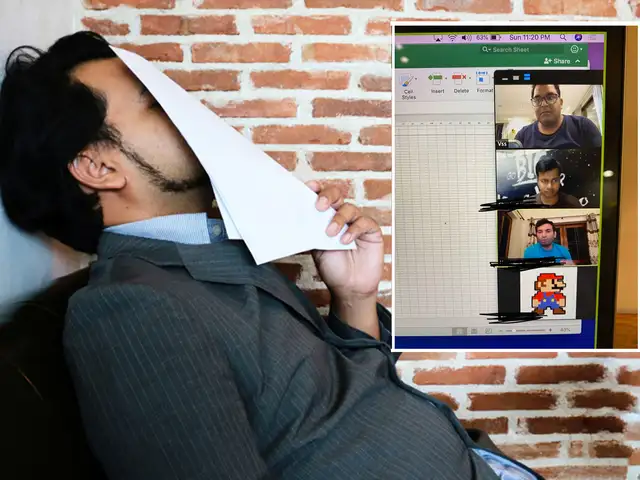
A few weeks ago, Paytm founder Vijay Shekhar Sharma took to Twitter to announce that he had been so wrapped up in Zoom meetings (inset from Sharma's Twitter account) that he forgot it was Sunday. And that seems to be the case with most entrepreneurs who are dealing with investor pressure and the stress of a looming economic slowdown.
Working from home has become the new normal as companies try to minimise disruptions and keep operations running as close to normal as possible. But with most of us working from home, the lines betwe..
Read More
In a recent media interview, Zerodha CEO Nithin Kamath (L) confessed, “I start work around 8.30 am and work till I sleep. I am definitely overworking, so are a few of my colleagues.”
“I had assumed that there would be more family time than before (but) the opposite has happened. Maybe I am spending lesser time than before because the boundary between work and personal time has disappeared. That said, daily I work out with my wife and play music with my son, and enjoy a drink with my brother and father once in a few days.”
If you find yourself in a similar situation as Kamath or Paytm's Vijay Shekhar Sharma (R), here are a few practical ways you can quickly establish boundaries.
In a recent media interview, Zerodha CEO Nithin Kamath (L) confessed, “I start work around 8.30 am and work till I sleep. I am definitely overworking, so are a few of my colleagues.”“I had assumed t..
Read More
Working from home can be invasive to your personal life. Without scheduled work hours, work can creep into your home life and just as personal errands can creep into work hours. To avoid this, start and end your workday at the same time every day. Don’t mix household chores into work hours and vice-versa.
Working from home can be invasive to your personal life. Without scheduled work hours, work can creep into your home life and just as personal errands can creep into work hours. To avoid this, start ..
Read More
Studies have shown that having a designated workspace helps put your brain into work mode and enhances productivity. If you can’t set aside a designated workspace (due to a space crunch), try to create barriers in other ways. For example, use your laptop for work calls/meetings and use your phone to check social media or chat with friends. Having different devices for different purposes will help your brain switch from work to play mode.
Studies have shown that having a designated workspace helps put your brain into work mode and enhances productivity. If you can’t set aside a designated workspace (due to a space crunch), try to crea..
Read More
A shutdown ritual is a set routine of actions that you perform at the end of each workday to finalize your day and signify that your workday is done. Cal Newport, the author of Deep Work, initiated it as a New Years’ resolution to get the most of his relaxation time.
“It has worked better than I imagined. I’ve basically eliminated stressful work-related thoughts from my evenings and weekends. This has really improved my ability to relax and focus on other things,” he wrote on his website.
Some activities you can include in your shutdown ritual are preparing a to-do list for the next day, going for a walk, signing up for an evening fitness class among others. The goal isn’t what you do but that you do something to replace and simulate your commute, which is a built-in shutdown ritual.
A shutdown ritual is a set routine of actions that you perform at the end of each workday to finalize your day and signify that your workday is done. Cal Newport, the author of Deep Work, initiated i..
Read More
One way to ensure that you’re not blurring the lines between work and home is to create a no-work zone for at least an hour before you go to bed and after you wake up. This will keep your mind ample time to properly recharge.
Research shows that what you do before you go to sleep has an impact on the quality of sleep, and your engagement, your ability to focus, the next day. Passive leisure activities, like watching TV or reading a book, were associated with better sleep than doing something like answering work emails.
One way to ensure that you’re not blurring the lines between work and home is to create a no-work zone for at least an hour before you go to bed and after you wake up. This will keep your mind ample ..