Myth busted: Playing Sudoku may not prevent age-related cognitive decline
It can boost mental abilities over a lifetime.
By PTI |
Getty Images
Previous studies have suggested that mental ability can be maintained or improved by exercising the mind in brain teasers such as Sudoku.
LONDON: Playing Sudoku and crosswords may not offset age-related mental decline, but can boost mental ability over a lifetime, a study claims.
Researchers from the University of Aberdeen in the UK found that regularly doing problem solving throughout your lifetime does not prevent mental decline in later life.
The study, published in The BMJ, suggests that regularly engaging in intellectual activities boosts mental ability throughout life and provides a "higher cognitive point" from which to decline.
Previous studies have suggested that mental ability can be maintained or improved by exercising the mind in brain teasers such as Sudoku and crossword puzzles. Regularly engaging in intellectual activities boosts mental ability. They also suggest that reading from an early age, playing board games and playing musical instruments at least twice a week is linked with significantly reducing the risk for dementia, researchers said.
However, there is a lack of historical childhood mental ability data, and the effect of practice on improving test scores has often been overlooked in mental ageing studies, they said.
ADVERTISEMENT
The study involved 498 participants who were all born in 1936 and had all taken part in a group intelligence test at the age of 11.
They were around 64 years old at the start of the study.
The researchers found that engaging in intellectually stimulating activities on a regular basis was linked to the level of mental ability in old age, having the largest association with improving cognitive performance during the course of life.
Next Horizon Of Science: AI To Diagnose Brain Haemorrhage, Spacecraft For Intergalactic Travel
1/6
From AI that can diagnose stroke to scientists taking antimatter for a truck ride, here’s everything exciting about technologies that are going to shape our future. (Text: Rajarshi Bhattacharjee)
From AI that can diagnose stroke to scientists taking antimatter for a truck ride, here’s everything exciting about technologies that are going to shape our future. (Text: Rajarshi Bhattacharjee)
Hate carbon dioxide for heating up the planet? Switzerland has a giant machine that sucks carbon dioxide from air and performs better than plants. In essence, it’s a gigantic artificial tree. Zurichbased Climeworks AG is the world’s first ever commercial plant that can capture CO2 from the air on an industrial level. The amount (900 tonnes) of carbon dioxide the plant draws annually is approximately the same as the amount emitted by 200 cars in the same time.
(Image: www.climeworks.com)
Hate carbon dioxide for heating up the planet? Switzerland has a giant machine that sucks carbon dioxide from air and performs better than plants. In essence, it’s a gigantic artificial tree. Zurich..
Read More
Scientists at the Icahn School of Medicine at Mount Sinai in US have developed an artificial intelligence platform that can identify disease in brain CT scans in 1.2 seconds, and diagnose a range of acute neurological illnesses, such as stroke, and haemorrhage. The study shows that the system was faster than human diagnosis. This is the first study to utilise AI for detecting acute neurologic events and demonstrate a direct clinical application.
Scientists at the Icahn School of Medicine at Mount Sinai in US have developed an artificial intelligence platform that can identify disease in brain CT scans in 1.2 seconds, and diagnose a range of..
Read More
Remember the pursuit craft driven by Valerian (Dane DeHaan) in the 2017 movie Valerian and the City of a Thousand Planets? US design and technology company Lexus has a concept of the futuristic single-seat craft called Skyjet that will take the future humans on intergalactic trips. Powered by a compact fuel-cell capsule, the Skyjet will fly on clean, renewable energy for space travel, sometime around 2740.
(Image: www.lexus.co.uk)
Remember the pursuit craft driven by Valerian (Dane DeHaan) in the 2017 movie Valerian and the City of a Thousand Planets? US design and technology company Lexus has a concept of the futuristic sing..
Read More
The most dense, solidstate memory in history is here. It could soon exceed the capabilities of current hard drives by 1,000 times. Scientists at the University of Alberta in Edmonton, Canada say they can use hydrogen atoms to boost storage capacity. They were able to reach a storage density of 128TB per square inch. That’s much ahead of current 10TB hard disks which have approximately 512GB per square inch.
(Image: www.ualberta.ca)
The most dense, solidstate memory in history is here. It could soon exceed the capabilities of current hard drives by 1,000 times. Scientists at the University of Alberta in Edmonton, Canada say the..
Read More
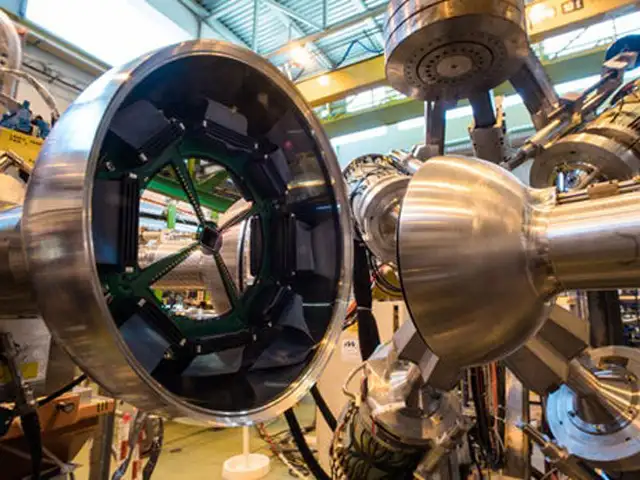
We know antimatter is highly volatile — when it comes into contact with matter, the two annihilate each other. However, physicists at CERN in Switzerland have learned to control it so well that they are now preparing to transport antimatter by truck and then use it to study the strange behaviour of rare radioactive nuclei.
(Image: Julien Marius Ordan-CERN - https://home.cern)
We know antimatter is highly volatile — when it comes into contact with matter, the two annihilate each other. However, physicists at CERN in Switzerland have learned to control it so well that they..
However, such activities had no effect on the rate of mental decline associated with ageing.
ADVERTISEMENT
While those who regularly engage in problem solving could potentially enhance their mental ability, this does not "protect an individual from decline but imparts a higher starting point from which decline is observed," researchers said.