Isaac Newton's first-edition of laws of motion 1687 copy found in Corsican library
The rare copy of the 17th-century work was found hidden in one of the upper shelves.
By PTI |

iStock
AJACCIO (FRANCE): A first-edition copy of Isaac Newton's groundbreaking book laying out his three laws of motion, which became the foundation for modern physics, has been found at a library on the French island of Corsica. Vannina Schirinsky-Schikhmatoff, director of conservation at the Fesch public heritage library in Ajaccio, said she discovered the copy of the 17th-century work while studying an index from the library's founder Lucien Bonaparte - one of Napoleon's brothers.
"I found the Holy Grail in the main room, hidden in the upper shelves," she told AFP this week.
"The cover has a little damage but inside it's in excellent condition -- this is the cornerstone of modern mathematics," she said.
The Latin text, "Philosophiae Naturalis Principia Mathematica" (Mathematical Principles of Natural Philosophy) was first published by Newton in 1687.
The renowned physicist was famously inspired by seeing an apple fall from a tree in his garden in Grantham, England, which sparked his elaborations of the classical laws of gravity, motion and optics.
English translations were published later, but the original editions remain prized by collectors.
"A Latin edition sold for $3.7 million at an auction held by Christie's a few years ago, and that's the one at the Ajaccio library," Schirinsky-Schikhmatoff said, referring to a December 2016 sale in New York to an undisclosed buyer.
It is not the first rare find at the Fesch library since an in-depth review of its holdings began a few years ago.
In 2018, Schirinsky-Schikhmatoff unveiled a "Thesaurum Hyeroglyphicorum" study of Egyptian hieroglyphics dating from 1610 -- some 200 years before France's Jean-Francois Champollion deciphered parts of the Rosetta Stone.
"I found the Holy Grail in the main room, hidden in the upper shelves," she told AFP this week.
"The cover has a little damage but inside it's in excellent condition -- this is the cornerstone of modern mathematics," she said.
The Latin text, "Philosophiae Naturalis Principia Mathematica" (Mathematical Principles of Natural Philosophy) was first published by Newton in 1687.
The renowned physicist was famously inspired by seeing an apple fall from a tree in his garden in Grantham, England, which sparked his elaborations of the classical laws of gravity, motion and optics.
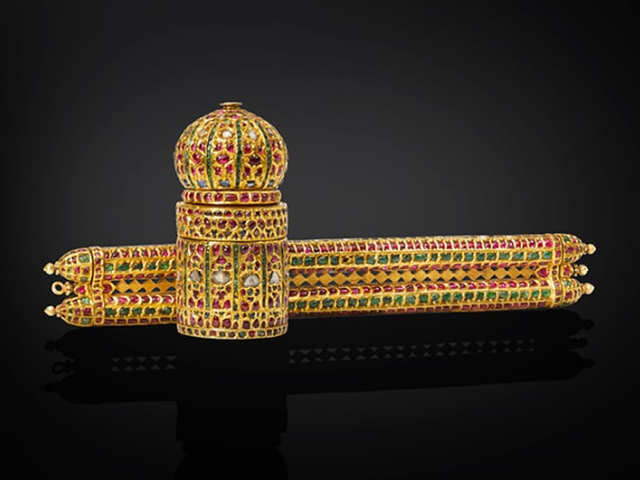
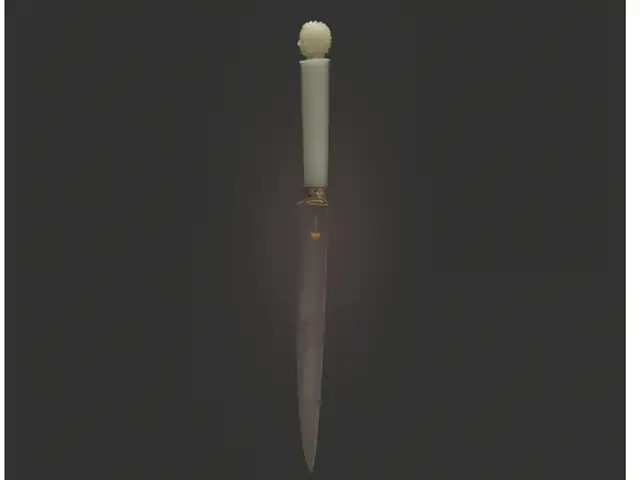
A dagger of an emperor, an ornate pen case and a 17th century necklace of the Nizam. These are among the 400 pieces of ancient Indian treasures and Mughal jewels set to go under the hammer in New York on June 19.
It is a known fact that during the reign of the Mughal dynasty, jewelled pen case and inkwell sets were presented to persons of utmost distinction. This emerald, ruby and diamond-set pen case and inkwell has the engraving of a sacred swan or hamsa under the inkwell. It is dated back to the late 16th century and is said to have originated in the Deccan region.





English translations were published later, but the original editions remain prized by collectors.
ADVERTISEMENT
"A Latin edition sold for $3.7 million at an auction held by Christie's a few years ago, and that's the one at the Ajaccio library," Schirinsky-Schikhmatoff said, referring to a December 2016 sale in New York to an undisclosed buyer.
It is not the first rare find at the Fesch library since an in-depth review of its holdings began a few years ago.
In 2018, Schirinsky-Schikhmatoff unveiled a "Thesaurum Hyeroglyphicorum" study of Egyptian hieroglyphics dating from 1610 -- some 200 years before France's Jean-Francois Champollion deciphered parts of the Rosetta Stone.
ADVERTISEMENT
Download
The Economic Times Business News App for the Latest News in Business, Sensex, Stock Market Updates & More.
The Economic Times Business News App for the Latest News in Business, Sensex, Stock Market Updates & More.
ADVERTISEMENT


