Serendipitous Rajasthan meteorite need not be satellite debris or space dust.
By ET Bureau |
iStock
The rare metallic meteorite could just as well be an exploratory projectile from a faraway civilisation.
No sooner does a study published in the Astrophysical Journal posit that there could be 36 civilisations like ours right in our own galaxy that a 2.8 kg lump of metal from space serendipitously lands in a Rajasthan village this week.
While initial reports say that it may be a rare metallic meteorite, others aver it is merely a molten bit of space trash; but it could just as well be an exploratory projectile from a faraway civilisation.
#RajasthanMeteorite like object falls in Sanchor area in Jalore district at 7 AM on Friday , (June 19 , 2020 )T… https://t.co/XscVjBXZgE
Although close encounters of the third kind happen only in the US according to Hollywood, extraterrestrials need not stick to that script.
The Star Trek series has claimed ‘First Contact’ and China has built the world’s largest single-dish radio telescope to achieve that same goal, but India is just as good a place as any to receive a more ‘solid’ signal, especially since Krrish proved Bollywood is no stranger to alien life forms too.
Update on #Meteorite��The object is lying with Sanchore policeThe area where it fell has been cordoned off The… https://t.co/IGqTjWQ9E8
The study is based on the assumption that it takes five billion years and a star (sun) of a certain size for intelligent life to form because that is how it happened on Earth. But we could be the slowpokes in the evolutionary stakes.
ADVERTISEMENT
Hopefully, the meteorite is not a vindication of Chinese science fiction writer Liu Cixin’s postscript in Remembrance of Earth’s Past — ‘perhaps tomorrow we’ll wake up and find an alien spaceship the size of the Moon parked in orbit’.
Apophis Can Wipe Out A Country: A Look At Every Massive Asteroid That Has Hit Earth
1/5
A monster asteroid - named Apophis after the Egyptian 'God of Chaos' - is likely to swoosh past Earth, but there is a slight chance that it may hit the planet.
The bigger-than-Eiffel Tower asteroid, weighing around 27 billion-kg, could leave a crater impact of 1.6 km wide in diameter and 518 metre deep. It has the capacity of an 880 million tonne TNT explosion that can wipe out large cities or even an entire country.
First spotted in August 2006, the ‘hazardous’ asteroid was initially named 2006 QQ23.
Meanwhile, the European Space Agency recently released a 'risk list' of 878 asteroids that are likely to cause a massive impact on Earth in the next 100 years.
Here's a look at all the asteroids Earth has braved.
A monster asteroid - named Apophis after the Egyptian 'God of Chaos' - is likely to swoosh past Earth, but there is a slight chance that it may hit the planet.The bigger-than-Eiffel Tower asteroid, w..
Read More
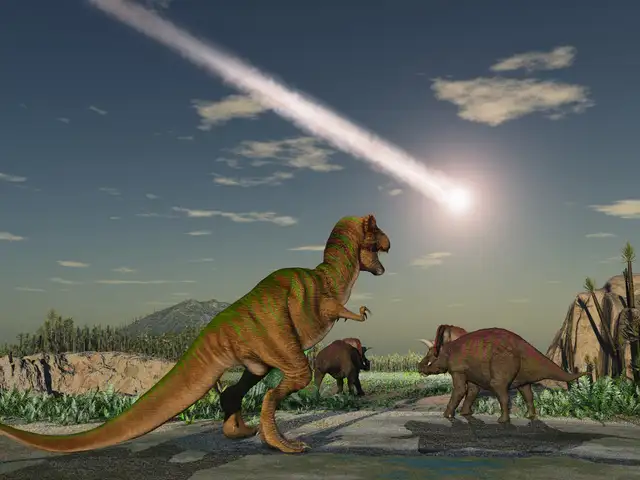
This is the famous asteroid impact that hit Earth approximately 66 million years ago in the present-day town of Chicxulub in Mexico's Yucatan Peninsula state, during the end of the Cretaceous period.
The asteroid was between 11-81 km in diameter. Its impact caused a 180 kilometre wide crater, making it one of biggest known impactors on Earth. The asteroid heated organic matter in rocks and ejected it into the atmosphere, forming soot in the stratosphere. Soot is a strong, light-absorbing aerosol that caused global climate changes that triggered the mass extinction of dinosaurs, ammonites, and other animals, and led to the macroevolution of mammals and the appearance of humans.
The Apophis asteroid is relatively smaller in size compared to this one.
This is the famous asteroid impact that hit Earth approximately 66 million years ago in the present-day town of Chicxulub in Mexico's Yucatan Peninsula state, during the end of the Cretaceous period...
Read More
In March or April of 1490, China's Qingyang city experienced the Ch'ing-yang air burst. The meteor shower may have occurred because it got disintegrated from an asteroid after entering the atmosphere. While there hasn't been any confirmation, it is believed that the meteor shower may have caused a large number of casualties.
In March or April of 1490, China's Qingyang city experienced the Ch'ing-yang air burst. The meteor shower may have occurred because it got disintegrated from an asteroid after entering the atmosphere..
Read More
On June 1908, Russia's Podkamennaya Tunguska River in Yeniseysk Governorate, which is now now Krasnoyarsk Krai, saw a large explosion. With three casualties and an impact stretch of over 2,000 sq km, the carter - the circular, bowl-shaped depression on the surface of the Earth - was never found.
The researchers believe that the object was disintegrated about 5-10 km before hitting the surface. Considered as Earth's largest impact event, its size was estimated somewhere between 50 metre and 190 metre, depending on the speed at which it travelled. Its energy was estimated to be 1,000 times greater than the Hiroshima atomic bomb attack, knocking down around 80 million trees due to the shock wave, which was capable of wiping out a metropolitan city.
On June 1908, Russia's Podkamennaya Tunguska River in Yeniseysk Governorate, which is now now Krasnoyarsk Krai, saw a large explosion. With three casualties and an impact stretch of over 2,000 sq km,..
Read More
This superbolide (a meteor brighter than the moon that radiate energy due to friction or pressure, and exploded after entering the atmosphere) entered our planet's atmosphere on February 2013 over southern Ural region in Russia's Chelyabinsk Oblast. An approximately 20-metre asteroid turned into a fireball, emitting light brighter than the Sun that was visible from a distance of up to 100 km.
While the atmosphere absorbed most of the object's energy, it resulted in major shock waves that shattered glass, damaged buildings and even caused 1,500 injuries. If the energy wasn't absorbed, the impact could have been 26-33 times greater than the nuclear blast at Hiroshima.
With over 12,000K – 13,000K kg heavier than France's Eiffel Tower, this is the biggest natural object that entered the atmosphere ever since the 1908 Tunguska impact.
This superbolide (a meteor brighter than the moon that radiate energy due to friction or pressure, and exploded after entering the atmosphere) entered our planet's atmosphere on February 2013 over ..