Cloudy with a chance of metal: Ultra-hot exoplanet where it rains iron observed
The giant exoplanet WASP-76b has a day side where temperatures climb above 2400 degrees Celsius - high enough to vaporise metals.
By PTI |
iStock
The planet also has distinct day-night chemistry, according to the scientists. (Representative image)
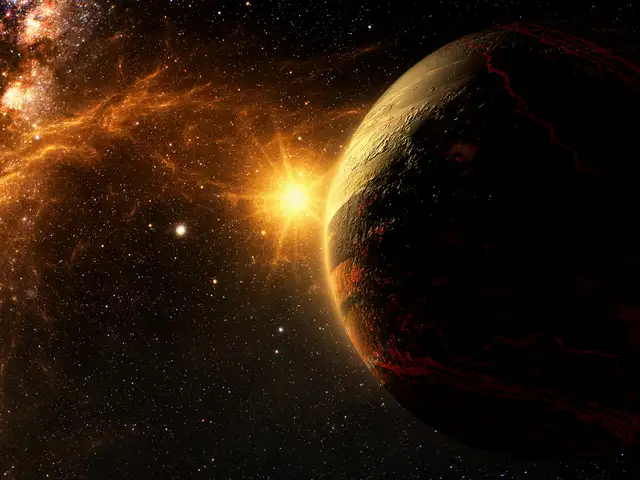
LONDON: Astronomers have observed an ultra-hot giant planet in the constellation of Pisces where they suspect it rains iron, a finding that may lead to better ways of studying the climate of the most extreme planets outside the Solar System.
According to the researchers, including those from the University of Geneva in Switzerland, the giant exoplanet WASP-76b is at a distance that would take even light 640 years to reach the Earth, and has a day side where temperatures climb above 2400 degrees Celsius - high enough to vaporise metals.
The study, published in the journal Nature, noted that strong winds carry iron vapour to the cooler night side where it may be condensing into iron droplets.
"One could say that this planet gets rainy in the evening, except it rains iron," said study co-author David Ehrenreich, a professor at the University of Geneva in Switzerland.
Apophis Can Wipe Out A Country: A Look At Every Massive Asteroid That Has Hit Earth
1/5
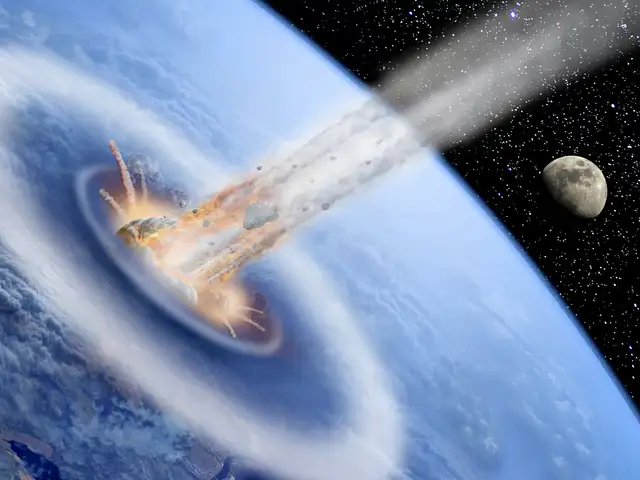
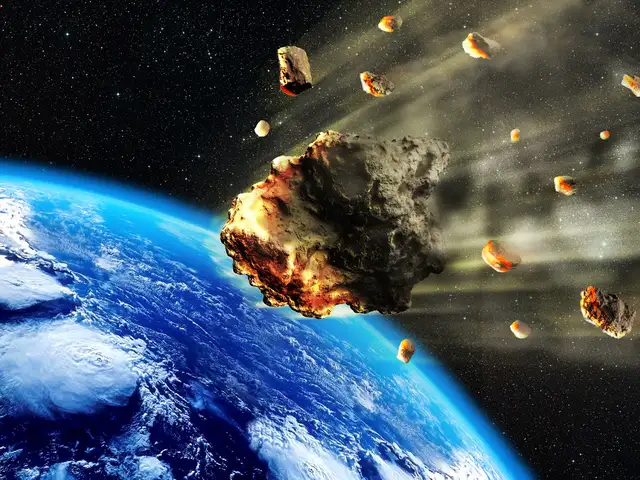
A monster asteroid - named Apophis after the Egyptian 'God of Chaos' - is likely to swoosh past Earth, but there is a slight chance that it may hit the planet.
The bigger-than-Eiffel Tower asteroid, weighing around 27 billion-kg, could leave a crater impact of 1.6 km wide in diameter and 518 metre deep. It has the capacity of an 880 million tonne TNT explosion that can wipe out large cities or even an entire country.
First spotted in August 2006, the ‘hazardous’ asteroid was initially named 2006 QQ23.
Meanwhile, the European Space Agency recently released a 'risk list' of 878 asteroids that are likely to cause a massive impact on Earth in the next 100 years.
Here's a look at all the asteroids Earth has braved.
A monster asteroid - named Apophis after the Egyptian 'God of Chaos' - is likely to swoosh past Earth, but there is a slight chance that it may hit the planet.The bigger-than-Eiffel Tower asteroid, w..
Read More
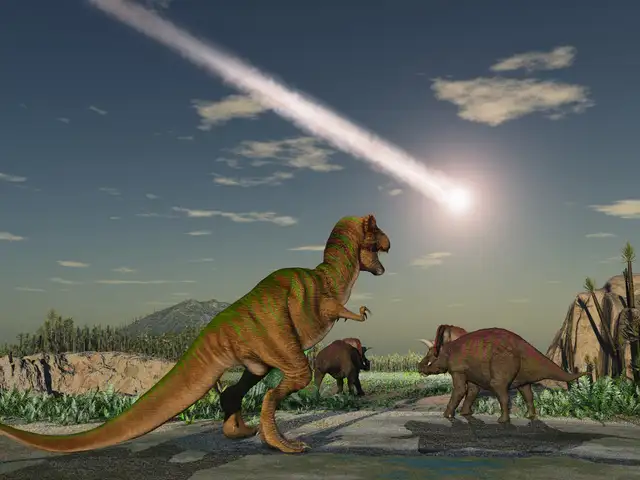
This is the famous asteroid impact that hit Earth approximately 66 million years ago in the present-day town of Chicxulub in Mexico's Yucatan Peninsula state, during the end of the Cretaceous period.
The asteroid was between 11-81 km in diameter. Its impact caused a 180 kilometre wide crater, making it one of biggest known impactors on Earth. The asteroid heated organic matter in rocks and ejected it into the atmosphere, forming soot in the stratosphere. Soot is a strong, light-absorbing aerosol that caused global climate changes that triggered the mass extinction of dinosaurs, ammonites, and other animals, and led to the macroevolution of mammals and the appearance of humans.
The Apophis asteroid is relatively smaller in size compared to this one.
This is the famous asteroid impact that hit Earth approximately 66 million years ago in the present-day town of Chicxulub in Mexico's Yucatan Peninsula state, during the end of the Cretaceous period...
Read More
In March or April of 1490, China's Qingyang city experienced the Ch'ing-yang air burst. The meteor shower may have occurred because it got disintegrated from an asteroid after entering the atmosphere. While there hasn't been any confirmation, it is believed that the meteor shower may have caused a large number of casualties.
In March or April of 1490, China's Qingyang city experienced the Ch'ing-yang air burst. The meteor shower may have occurred because it got disintegrated from an asteroid after entering the atmosphere..
Read More
On June 1908, Russia's Podkamennaya Tunguska River in Yeniseysk Governorate, which is now now Krasnoyarsk Krai, saw a large explosion. With three casualties and an impact stretch of over 2,000 sq km, the carter - the circular, bowl-shaped depression on the surface of the Earth - was never found.
The researchers believe that the object was disintegrated about 5-10 km before hitting the surface. Considered as Earth's largest impact event, its size was estimated somewhere between 50 metre and 190 metre, depending on the speed at which it travelled. Its energy was estimated to be 1,000 times greater than the Hiroshima atomic bomb attack, knocking down around 80 million trees due to the shock wave, which was capable of wiping out a metropolitan city.
On June 1908, Russia's Podkamennaya Tunguska River in Yeniseysk Governorate, which is now now Krasnoyarsk Krai, saw a large explosion. With three casualties and an impact stretch of over 2,000 sq km,..
Read More
This superbolide (a meteor brighter than the moon that radiate energy due to friction or pressure, and exploded after entering the atmosphere) entered our planet's atmosphere on February 2013 over southern Ural region in Russia's Chelyabinsk Oblast. An approximately 20-metre asteroid turned into a fireball, emitting light brighter than the Sun that was visible from a distance of up to 100 km.
While the atmosphere absorbed most of the object's energy, it resulted in major shock waves that shattered glass, damaged buildings and even caused 1,500 injuries. If the energy wasn't absorbed, the impact could have been 26-33 times greater than the nuclear blast at Hiroshima.
With over 12,000K – 13,000K kg heavier than France's Eiffel Tower, this is the biggest natural object that entered the atmosphere ever since the 1908 Tunguska impact.
This superbolide (a meteor brighter than the moon that radiate energy due to friction or pressure, and exploded after entering the atmosphere) entered our planet's atmosphere on February 2013 over ..
The researchers said this phenomenon happens because the 'iron rain' planet only ever shows one face - its day side - to its parent star, while its cooler night side remains in perpetual darkness.
ADVERTISEMENT
They explained that like the Earth's Moon, WASP-76b is 'tidally locked', meaning it takes as long to rotate around its axis as it does to go around the star.
On its day side, the study noted, it receives thousands of times more radiation from its parent star than the Earth does from the Sun.
The planet is also so close to its star it takes just 43 hours to complete one revolution, the researchers reported in the study.
According to the scientists, this side is so hot that molecules separate into atoms, and metals like iron evaporate into the atmosphere.
ADVERTISEMENT
This extreme temperature difference between the day and night sides results in vigorous winds that bring the iron vapour from the ultra-hot day side to the cooler night side, where temperatures decrease to around 1500 degrees Celsius, the study noted.
The planet also has distinct day-night chemistry, according to the scientists.
ADVERTISEMENT
While they detected the trace of iron vapour at the division between the daytime and the night-time sector of the planet, they did not see any traces of the element in the exoplanet's dark side, the study noted.
"No signal arises from the nightside close to the morning terminator, showing that atomic iron is not absorbing starlight there. Iron must thus condense during its journey across the nightside," the scientists noted in the study, marking the first time chemical variations have been detected in a giant ultra-hot planet.
"However, suprisingly we do not see this iron vapour at dawn. The only explanation possible for this phenomenon is that it rains iron on the dark side of this exoplanet with extreme conditions" Ehrenreich said.
The astronomers made this first-of-its-kind discovery using the European Southern Observatory's (ESO) high resolution spectrograph, ESPRESSO, in the Chilean Atacama Desert.
Tech Advances Prepared To Defend Earth From Asteroids, 3D Print Hearts
1/8
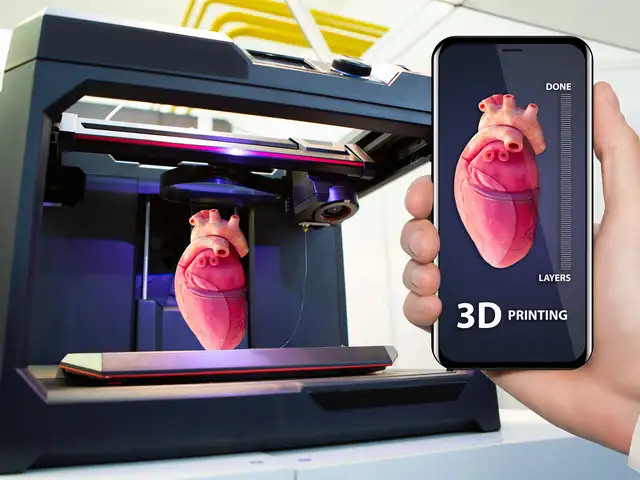
Emergence of a 3D printed heart, thermal tracking of asteroids, algorithms to forecast disruptions in nuclear fusion and more are turning science fiction into reality.
Emergence of a 3D printed heart, thermal tracking of asteroids, algorithms to forecast disruptions in nuclear fusion and more are turning science fiction into reality.
Scientists have found an ingenious way to spot tiny near-Earth objects (NEOs) early as they hurtle towards the planet. Instead of using visible light to spot incoming NEOs, researchers at NASA’s Jet Propulsion Laboratory used a characteristic of NEOs — their heat. Asteroids and comets are warmed by the sun and so glow brightly at thermal wavelengths, making them easier to spot with the Near-Earth Object Wide-field Infrared Survey Explorer (NEOWISE) telescope.
Scientists have found an ingenious way to spot tiny near-Earth objects (NEOs) early as they hurtle towards the planet. Instead of using visible light to spot incoming NEOs, researchers at NASA’s Jet ..
Read More
Scientists at the Tel Aviv University achieved a breakthrough by 3D printing a heart using the patient’s own cells. The scientists used personalised non-supplemented materials as bio-inks for 3D printing. The bio-inks do not provoke an immune response, thereby minimising complications. Scientists extracted fatty tissue from the patient and processed them to form personalised bio-inks to 3D print the heart, complete with cells, blood vessels, ventricles and chambers.
Scientists at the Tel Aviv University achieved a breakthrough by 3D printing a heart using the patient’s own cells. The scientists used personalised non-supplemented materials as bio-inks for 3D prin..
Read More
Scientists have developed a cost-effective method to allow self-driving cars to ‘see’ 3D objects in their path. Scientists from Cornell University in the US have dis-covered that a simpler method, using two inexpensive cameras on either side of the windshield can detect objects with nearly LiDAR’s (Light Detection and Ranging) accuracy and at a fraction of the cost.
Scientists have developed a cost-effective method to allow self-driving cars to ‘see’ 3D objects in their path. Scientists from Cornell University in the US have dis-covered that a simpler method, us..
Read More
Artificial Intelligence (AI) can speed up the development of clean and limitless fusion energy for generating electricity, claim researchers. A team of scientists at the US Department of Energy and Princeton University are applying deep learning to forecast sudden disruptions that can halt fusion reactions and damage the reactions. Accomplishing this feat are neural networks, layers of interconnected nodes — mathematical algorithms — that are weighed by the programme to shape the desired output.
Artificial Intelligence (AI) can speed up the development of clean and limitless fusion energy for generating electricity, claim researchers. A team of scientists at the US Department of Energy and P..
Read More
Technology that can help people suffering from dementia stay at home as long as possible could be available in the next five years. Scientists and doctors at the Imperial College London are developing an ear device that records brain activity and uses radar technology to track people’s movements at home. Sensors are also being created to remotely monitor heart rate, sleep cycles and blood pressure.
Technology that can help people suffering from dementia stay at home as long as possible could be available in the next five years. Scientists and doctors at the Imperial College London are developin..
Read More
A nasal spray of ‘love hormone’ oxytocin may help treat alcohol use disorder, according to a study. The study found that oxytocin blocks enhanced drinking in alcohol-dependent test rats. Targeting the oxytocin system may provide novel pharmaceutical interventions for the treatment of alcohol-use disorder, said researchers from the National Institutes of Health and The Scripps Research Institute in the US.
A nasal spray of ‘love hormone’ oxytocin may help treat alcohol use disorder, according to a study. The study found that oxytocin blocks enhanced drinking in alcohol-dependent test rats. Targeting th..
Read More
Researchers have developed a protein-based sensor that can detect lanthanides, the rare earth metals used in smartphones and other gadgets, in an efficient and cost-effective way. The sensor changes its fluorescence when it binds to these metals, according to a study published in the Journal of the American Chemical Society. Extracting rare-earths from the environment or from industrial samples is generally challenging and expensive.
(All images are for representative purposes only)
Researchers have developed a protein-based sensor that can detect lanthanides, the rare earth metals used in smartphones and other gadgets, in an efficient and cost-effective way. The sensor changes ..
"The observations show that iron vapour is abundant in the atmosphere of the hot day side of WASP-76b," said María Rosa Zapatero Osorio, another co-author of the study from the Centre for Astrobiology in Spain.
"A fraction of this iron is injected into the night side owing to the planet's rotation and atmospheric winds. There, the iron encounters much cooler environments, condenses and rains down," Osorio added.
The scientists noted in a statement that ESPRESSO - the Echelle SPectrograph for Rocky Exoplanets and Stable Spectroscopic Observations - was originally designed to hunt for Earth-like planets around Sun-like stars.
"We soon realised that the remarkable collecting power of the VLT and the extreme stability of ESPRESSO made it a prime machine to study exoplanet atmospheres," said Pedro Figueira, another study co-author and ESPRESSO instrument scientist at ESO.
"What we have now is a whole new way to trace the climate of the most extreme exoplanets," Ehrenreich said.