About five years ago, Senapathy ‘Kris’ Gopalakrishnan, co-founder of Infosys, made large philanthropic donations towards the niche area of brain research and has continued since to drive interest in this field. One of his latest efforts involved a 30-minute presentation at IIT Bombay’s annual entrepreneurship summit.
Gopalakrishnan explained that there is the clinical aspect of brain research that would help find a cure for or at least arrest the advance of neurodegenerative diseases like Alzheimer’s, Parkinson’s and dementia. And then there is the need to find a better computation model by understanding the brain better.
Nature, the best teacher
“Human history is about mimicking nature. [It is about] wondering why does nature do something and how can we replicate that? Flying is a wonderful example of this. And over time, humans become far better than nature, more capable than nature and also more wasteful than nature,” Gopalakrishnan said during the presentation.
Except, we don’t strictly copy nature, he added. We tend to do things differently. We throw computing power at it. “Brute force,” he called it. “It’s a black box. We can’t explain now how things happen. There are areas that we need to work on,” he said.
Infosys co-founder Senapathy ‘Kris’ Gopalakrishnan According to Gopalakrishnan, most countries today recognise that the marvels of the brain and its workings are the last unknown. ‘What is consciousness?’ is a question we don’t have an answer for yet. “There is a huge opportunity to understand the brain and come out with a better model of computing. We are drowning in software. [Currently,] 70 per cent of budgets are going in maintaining the systems rather than creating new ones. Soon, we will have an explosion of data, and we won’t know what to do with it. That’s why we need a better model of computing,” Gopalakrishnan said.
ADVERTISEMENT
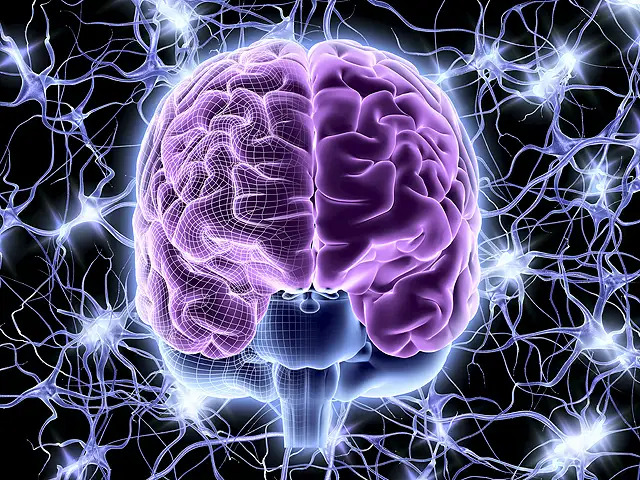
To make his point, he gave some facts about this powerful organ: “A brain weighs two kilograms and consumes 20 watts of power. A computer with similar power will have 300 megawatts of consumption of power and will probably be a large system, definitely more than two kilograms. That’s why I said that when we want to replicate it [nature], we will throw power at it. And we waste resources,” he said.
Try this to better understand waste of resources. Each time you ask your digital assistant about the weather for the day, large supercomputers are utilised to respond to this seemingly simple query. “If it was done in your home, you may need a grid to just power that computer,” Gopalakrishnan said. George Boole and John von Neumann, the two fathers of computer science, wondered about the brain. “One person [Boole] said that the brain thinks in binary and Boolean logic. Another person said that the brain has separate areas for processing, storing and registering. Interestingly, we created this whole field of computer science based on these ideas. Surprisingly or not surprisingly, both of them were wrong. The brain is not a digital binary machine. It is analogue,” he said, going back to the history of how the field of computer science evolved, largely by wondering about the brain.
“The new paradigm of computing is you don’t tell the computer how a problem should be solved. You train or teach the computer. You have labelled data. Why do you require it? You need to know what that data pertains to, what it implies, and using this labelled data you train the computer and specify what outcomes are desirable. And the computer then figures out how to go from input to output,” he said, adding that in the new paradigm, you don’t need to know how to solve a problem. If you have input data, you know what desirable outputs are, the machine will figure it out.
ADVERTISEMENT
Infosys co-founder Senapathy ‘Kris’ Gopalakrishnan Take face recognition, for instance. Where a human can remember 300-400 faces, the machine can remember infinite ones. “Pattern recognition is a problem that people have been trying to solve using finite state automata [where you understand a problem, develop an algorithm, translate that algorithm into your computer program, feed that into a computer, hopefully there are no bugs, the program runs, and solves the problem]. And they were failing because we don’t know how our brain processes patterns,’ Gopalakrishnan said, adding, “Now, machines are even better than humans at recognising faces. You throw computing power at the problem and if you have infinite memory, infinite processing power and a lot of training data, you are able to solve this problem.”
ADVERTISEMENT
This is what is enabling a new generation of problems to be solved using AI machine learning etc. And that is what is exciting.
And the better we understand the brain, the more efficiently we’ll build the computing systems of tomorrow.
Next Horizon Of Science: AI To Diagnose Brain Haemorrhage, Spacecraft For Intergalactic Travel
1/6
From AI that can diagnose stroke to scientists taking antimatter for a truck ride, here’s everything exciting about technologies that are going to shape our future. (Text: Rajarshi Bhattacharjee)
From AI that can diagnose stroke to scientists taking antimatter for a truck ride, here’s everything exciting about technologies that are going to shape our future. (Text: Rajarshi Bhattacharjee)
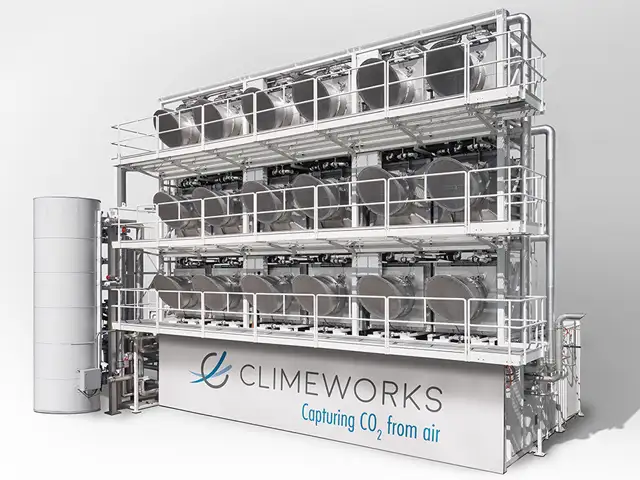
Hate carbon dioxide for heating up the planet? Switzerland has a giant machine that sucks carbon dioxide from air and performs better than plants. In essence, it’s a gigantic artificial tree. Zurichbased Climeworks AG is the world’s first ever commercial plant that can capture CO2 from the air on an industrial level. The amount (900 tonnes) of carbon dioxide the plant draws annually is approximately the same as the amount emitted by 200 cars in the same time.
(Image: www.climeworks.com)
Hate carbon dioxide for heating up the planet? Switzerland has a giant machine that sucks carbon dioxide from air and performs better than plants. In essence, it’s a gigantic artificial tree. Zurich..
Read More
Scientists at the Icahn School of Medicine at Mount Sinai in US have developed an artificial intelligence platform that can identify disease in brain CT scans in 1.2 seconds, and diagnose a range of acute neurological illnesses, such as stroke, and haemorrhage. The study shows that the system was faster than human diagnosis. This is the first study to utilise AI for detecting acute neurologic events and demonstrate a direct clinical application.
Scientists at the Icahn School of Medicine at Mount Sinai in US have developed an artificial intelligence platform that can identify disease in brain CT scans in 1.2 seconds, and diagnose a range of..
Read More
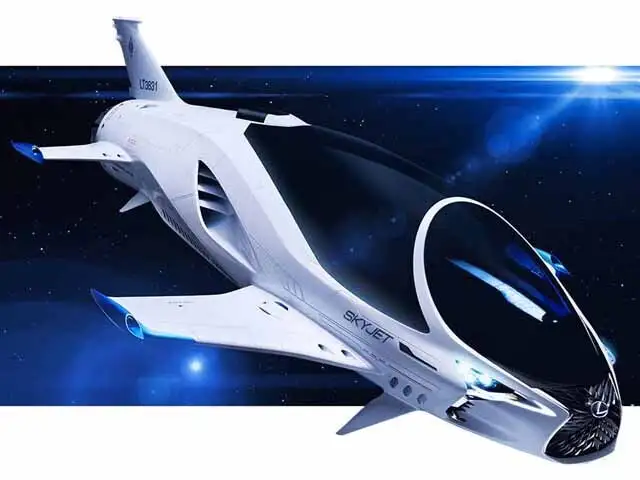
Remember the pursuit craft driven by Valerian (Dane DeHaan) in the 2017 movie Valerian and the City of a Thousand Planets? US design and technology company Lexus has a concept of the futuristic single-seat craft called Skyjet that will take the future humans on intergalactic trips. Powered by a compact fuel-cell capsule, the Skyjet will fly on clean, renewable energy for space travel, sometime around 2740.
(Image: www.lexus.co.uk)
Remember the pursuit craft driven by Valerian (Dane DeHaan) in the 2017 movie Valerian and the City of a Thousand Planets? US design and technology company Lexus has a concept of the futuristic sing..
Read More
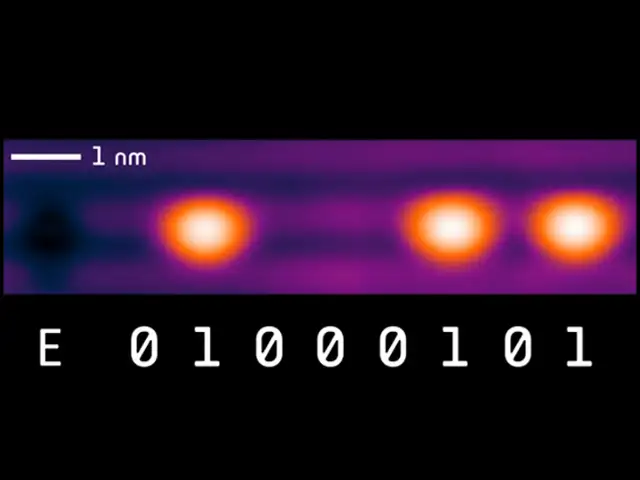
The most dense, solidstate memory in history is here. It could soon exceed the capabilities of current hard drives by 1,000 times. Scientists at the University of Alberta in Edmonton, Canada say they can use hydrogen atoms to boost storage capacity. They were able to reach a storage density of 128TB per square inch. That’s much ahead of current 10TB hard disks which have approximately 512GB per square inch.
(Image: www.ualberta.ca)
The most dense, solidstate memory in history is here. It could soon exceed the capabilities of current hard drives by 1,000 times. Scientists at the University of Alberta in Edmonton, Canada say the..
Read More
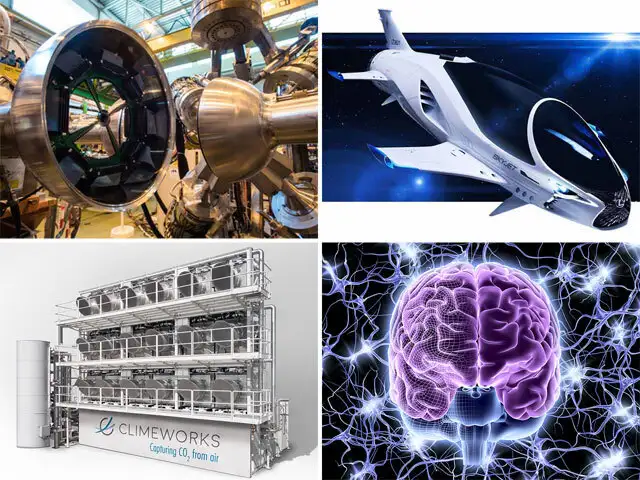
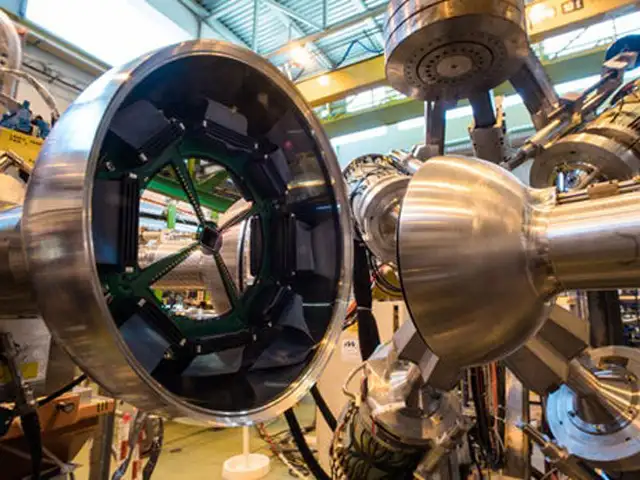
We know antimatter is highly volatile — when it comes into contact with matter, the two annihilate each other. However, physicists at CERN in Switzerland have learned to control it so well that they are now preparing to transport antimatter by truck and then use it to study the strange behaviour of rare radioactive nuclei.
(Image: Julien Marius Ordan-CERN - https://home.cern)
We know antimatter is highly volatile — when it comes into contact with matter, the two annihilate each other. However, physicists at CERN in Switzerland have learned to control it so well that they..
Business News › Magazines › Panache › Brain not a digital binary machine, understanding its complex functioning can develop better computing model: Kris GopalakrishnanText Size:AAA