Stars usually have a life of around 9 million years. Betelgeuse is 8 million-plus years old but may still be thousands of years away from its end. There is another problem.
Here's why Betegeuse, the star, is making headlines:
You mean, Betelgeuse the star? You know about it already?
What did you expect? Err… just that I will be able to throw some light on the subject.
Throw light on the 11th brightest star in our skies? Not on the star but on the fact that it has been dimming.
ADVERTISEMENT
Betelgeuse is dimming? Aha! So you do not know the latest. May I?
Okay, you have my permission to illuminate… I mean throw light on it. Betelgeuse is part of the Orion constellation of stars. But it is also a bit of a rogue.
A rogue star? It moves around freely, constantly grows brighter and redder. But now scientists have noted a reduction in its brightness.
ADVERTISEMENT
And do they know why?
ADVERTISEMENT
The popular explanation is that Betelgeuse is nearing the end of its life, and may be headed for a supernova explosion.
A supernova? That would be something. Yes. They say it would be like a second moon in our skies when that happens.
Oh wow? So what’s the timeline? It is complicated. Stars usually have a life of around 9 million years. Betelgeuse is 8 million-plus years old but may still be thousands of years away from its end. There is another problem.
That light years separate earth and Betelgeuse? Yes. It is 640 light years away. So it will take 640 years for light from Betelgeuse to reach us.
That means, even if the supernova happens, we won’t know in a hurry. Or maybe it has already happened.
And we have no clue. Or I should say we are totally in the dark.
Apophis Can Wipe Out A Country: A Look At Every Massive Asteroid That Has Hit Earth
1/5
A monster asteroid - named Apophis after the Egyptian 'God of Chaos' - is likely to swoosh past Earth, but there is a slight chance that it may hit the planet.
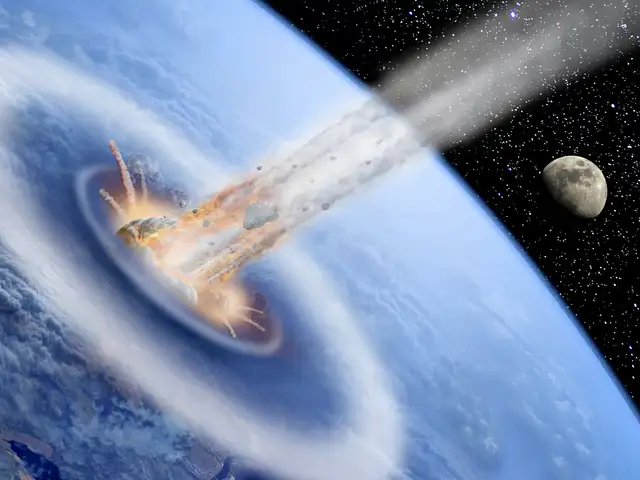
The bigger-than-Eiffel Tower asteroid, weighing around 27 billion-kg, could leave a crater impact of 1.6 km wide in diameter and 518 metre deep. It has the capacity of an 880 million tonne TNT explosion that can wipe out large cities or even an entire country.
First spotted in August 2006, the ‘hazardous’ asteroid was initially named 2006 QQ23.
Meanwhile, the European Space Agency recently released a 'risk list' of 878 asteroids that are likely to cause a massive impact on Earth in the next 100 years.
Here's a look at all the asteroids Earth has braved.
A monster asteroid - named Apophis after the Egyptian 'God of Chaos' - is likely to swoosh past Earth, but there is a slight chance that it may hit the planet.The bigger-than-Eiffel Tower asteroid, w..
Read More
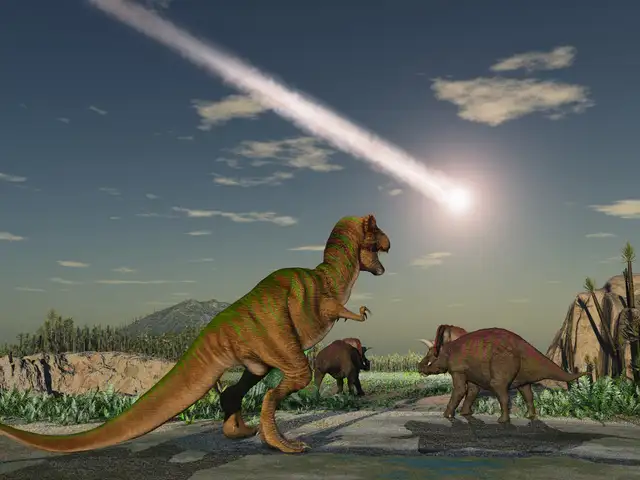
This is the famous asteroid impact that hit Earth approximately 66 million years ago in the present-day town of Chicxulub in Mexico's Yucatan Peninsula state, during the end of the Cretaceous period.
The asteroid was between 11-81 km in diameter. Its impact caused a 180 kilometre wide crater, making it one of biggest known impactors on Earth. The asteroid heated organic matter in rocks and ejected it into the atmosphere, forming soot in the stratosphere. Soot is a strong, light-absorbing aerosol that caused global climate changes that triggered the mass extinction of dinosaurs, ammonites, and other animals, and led to the macroevolution of mammals and the appearance of humans.
The Apophis asteroid is relatively smaller in size compared to this one.
This is the famous asteroid impact that hit Earth approximately 66 million years ago in the present-day town of Chicxulub in Mexico's Yucatan Peninsula state, during the end of the Cretaceous period...
Read More
In March or April of 1490, China's Qingyang city experienced the Ch'ing-yang air burst. The meteor shower may have occurred because it got disintegrated from an asteroid after entering the atmosphere. While there hasn't been any confirmation, it is believed that the meteor shower may have caused a large number of casualties.
In March or April of 1490, China's Qingyang city experienced the Ch'ing-yang air burst. The meteor shower may have occurred because it got disintegrated from an asteroid after entering the atmosphere..
Read More
On June 1908, Russia's Podkamennaya Tunguska River in Yeniseysk Governorate, which is now now Krasnoyarsk Krai, saw a large explosion. With three casualties and an impact stretch of over 2,000 sq km, the carter - the circular, bowl-shaped depression on the surface of the Earth - was never found.
The researchers believe that the object was disintegrated about 5-10 km before hitting the surface. Considered as Earth's largest impact event, its size was estimated somewhere between 50 metre and 190 metre, depending on the speed at which it travelled. Its energy was estimated to be 1,000 times greater than the Hiroshima atomic bomb attack, knocking down around 80 million trees due to the shock wave, which was capable of wiping out a metropolitan city.
On June 1908, Russia's Podkamennaya Tunguska River in Yeniseysk Governorate, which is now now Krasnoyarsk Krai, saw a large explosion. With three casualties and an impact stretch of over 2,000 sq km,..
Read More
This superbolide (a meteor brighter than the moon that radiate energy due to friction or pressure, and exploded after entering the atmosphere) entered our planet's atmosphere on February 2013 over southern Ural region in Russia's Chelyabinsk Oblast. An approximately 20-metre asteroid turned into a fireball, emitting light brighter than the Sun that was visible from a distance of up to 100 km.
While the atmosphere absorbed most of the object's energy, it resulted in major shock waves that shattered glass, damaged buildings and even caused 1,500 injuries. If the energy wasn't absorbed, the impact could have been 26-33 times greater than the nuclear blast at Hiroshima.
With over 12,000K – 13,000K kg heavier than France's Eiffel Tower, this is the biggest natural object that entered the atmosphere ever since the 1908 Tunguska impact.
This superbolide (a meteor brighter than the moon that radiate energy due to friction or pressure, and exploded after entering the atmosphere) entered our planet's atmosphere on February 2013 over ..