Basic homemade masks can stop Covid-19 patients from spreading coronavirus
Homemade mask should only be considered as a last resort to prevent droplet transmission from infected individuals.
By PTI |
iStock
Most people don't know how to wear or remove the mask properly.
PARIS: Is a homemade mask better than nothing at all? With an unknown number of asymptomatic virus carriers, some experts are advising people to fashion their own face coverings to prevent them spreading the disease.
As health workers across the world struggle to get protective equipment and stocks dwindle, health organisations have stressed that there is little scientific evidence to show that masks are effective at preventing healthy people catching COVID-19.
But some experts say they could be useful as a barrier to stop those infected -- particularly those without symptoms -- from contaminating others through the tiny respiratory droplets emitted when they cough, sneeze, talk or even breathe.
"It only works if everyone wears (them), and if everyone does, you only need a very basic mask, because a piece of tissue can block it," said KK Cheng, director of the Institute of Applied Health Research at Birmingham University. "It's not perfect, but that's much better than nothing."
There is scant evidence on the effectiveness of do-it-yourself face coverings, however.
"It's not clear whether homemade masks would reduce transmission, there has been very little scientific research on this topic," Benjamin Cowling, epidemiologist at the University of Hong Kong, told AFP.
ADVERTISEMENT
One 2013 Cambridge University study looked at a scenario of an influenza pandemic and subsequent shortage of surgical masks.
Belgian fashion designer and sewing teacher Audrey Jacques displays one of the homemade protective face masks during the coronavirus lockdown, imposed by the Belgian government in an attempt to slow down the spread of COVID-19, in Brussels. Volunteers were tasked with making their own masks from cotton t-shirts for the research, which found that improvised masks might reduce the likelihood of infection -- but not eliminate the risk.
"Our findings suggest that a homemade mask should only be considered as a last resort to prevent droplet transmission from infected individuals, but it would be better than no protection," the study said.
ADVERTISEMENT
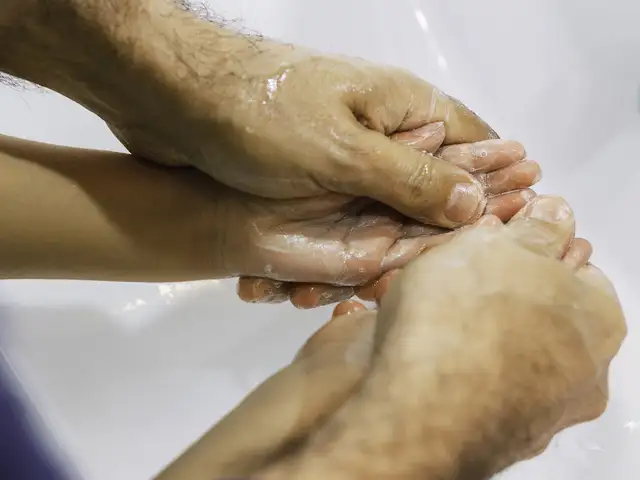
Even the doctors who recommend the use of masks, insist they should not be seen as an alternative to the most crucial prevention measures, such as hand washing and social distancing.
Since the start of the coronavirus epidemic, many western countries have stressed that the widespread use of masks is not necessary. This position has surprised many in parts of Asia, where mask-wearing is a common practice.
ADVERTISEMENT
"The big mistake in the US and Europe, in my opinion, is that people aren't wearing masks," said Gao Fu, the head of the Chinese Center for Disease Control and Prevention in an interview with Science magazine last week.
Cheng said that mask wearing was not in "Western culture". But he added that the authorities may also have wanted to dissuade panic buying of protective equipment that would leave shortages for key health workers.
World Health Organisation guidelines say that only those who are sick and the people caring for them need to wear masks.
"There is no specific evidence to suggest that the wearing of masks by the mass population has any particular benefit," said Mike Ryan, executive director of the WHO's emergencies programme, in a briefing on Monday.
"In fact there is some evidence to suggest the opposite," he said, adding people often did not know how to wear or remove the mask properly.
Ryan said there was also a "massive global shortage" of protective equipment. "Right now the people most at risk from this virus are frontline health workers who are exposed to the virus every second of every day. The thought of them not having masks is horrific," he said.
Mask made by Belgian fashion designer and sewing teacher Audrey Jacques. In recent days, several European countries have updated their position on mask wearing, with the Czech Republic, Slovenia, and Austria announcing new rules to compel people to cover their faces in places like supermarkets.
Pulmonologist Nicolas Hutt, who works in Alsace, one of the French regions most affected by the epidemic, said people should wear "alternative masks" not produced for medical purposes.
These would act as a barrier in "areas where distancing measures are not properly followed, like shops".
Online tutorials for making your own masks have circulated widely.
While French authorities have stuck to the WHO guidance that healthy people do not need masks, the industry ministry's standardisation board posted a manufacturing blueprint on Friday.
Prime Minister Edouard Philippe has also said that textile and paper firms would now be encouraged to make masks.
These would not be for medical personnel but for those who would see a mask as a good way of equipping themselves and "reassuring themselves, protecting themselves and fighting against the epidemic".
Some could even be luxury branded. At the weekend, fashion house Chanel said it was mobilising dozens of its dressmakers to produce masks and gowns and would "start production as soon as the prototypes and raw materials have been approved".
Coronavirus Can Get Children Worried: Here's How To Have The Talk
1/7
In the wake of coronavirus, several schools and colleges have been shut in many parts of the world to contain the spread of COVID-19. As public awareness and conversations around the novel virus increase, the situation can get the children anxious and worried for their family members and friends.
Parents, family members, teachers, healthcare professionals and trusted adults play a significant role in helping children make sense of what they hear in a way that is honest, accurate and minimise their fear or anxiety.
Dr Sreenath Manikanti, Senior Consultant Neonatologist & HOD Fortis La Femme Hospital, Richmond Road, Bangalore shares a few tips to help make the corona conversation easier around children.
In the wake of coronavirus, several schools and colleges have been shut in many parts of the world to contain the spread of COVID-19. As public awareness and conversations around the novel virus incr..
Read More
- Remember that children react to how and what things are said
- Children pick up cues from conversations you have with them and others
- Patiently listen to what they say, and allow them to ask questions
- Avoid using words that might blame others and lead to stigma
- Remember that the virus can make anyone sick. Avoid making assumptions about who might have COVID-19
- Pay attention to what children see, hear or read on television, radio or online
- Reduce the amount of screen time for children focused on COVID-19. Too much information on any one topic can lead to anxiety and worry
- Provide information to kids that is honest and accurate. Give information that is truthful and appropriate for the age and developmental level of the child
- Talk to children about how some stories on COVID-19 on the internet and social media may be based on rumours and inaccurate information
- Teach chilren everyday actions to reduce the spread of germs
- Stay calm and keep information simple
- Reassure children that health and school authorities are working very hard to keep everyone safe and healthy
- Teach dos and don'ts at home, schools and play areas
- Remember that children react to how and what things are said
- Children pick up cues from conversations you have with them and others
- Patiently listen to what they say, and allow them to ask qu..
Read More
- Stay 6 feet away from people who are coughing or sneezing or sick
- Cough or sneeze into a tissue or your elbow, and then throw the tissue into a closed bin
- Wash hands with soap and water for at least 20 seconds, especially after blowing nose, coughing or sneezing, after using restroom, and before eating or learning to prepare food
- If soap and water are not available, teach children to use hand sanitiser
- Stay 6 feet away from people who are coughing or sneezing or sick
- Cough or sneeze into a tissue or your elbow, and then throw the tissue into a closed bin
- Wash hands with soap and water for a..
Read More
- Avoid touching mouth, nose, eyes and face with unclean hands
- Avoid coughing or sneezing into hands
- Avoid crowded places
- Avoid touching surfaces in public places and play areas unnecessarily
- Avoid touching mouth, nose, eyes and face with unclean hands
- Avoid coughing or sneezing into hands
- Avoid crowded places
- Avoid touching surfaces in public places and play areas unnecessaril..
Read More
What is COVID-19?
- COVID-19 is the short name for 'coronavirus disease 2019'
- It is a new virus. Doctors are still learning more about it
- Recently, this virus has made a lot of people sick
- Doctors and scientists think that most people will be alright, especially kids, but some people might get very sick
- Doctors and experts are working hard to help people stay healthy
What is COVID-19?
- COVID-19 is the short name for 'coronavirus disease 2019'
- It is a new virus. Doctors are still learning more about it
- Recently, this virus has made a lot of people sick
- ..
Read More
- Practice healthy habits at home, school and play to help protect against the spread of COVID-19
- Cough or sneeze into a tissue or your elbow. If you sneeze or cough into a tissue, throw it in the dustbin right away
- Keep your hands out of your mouth, nose and eyes. This will help keep germs out of your body
- Wash your hands with soap and water for at least 20 seconds. If you don’t have soap and water, use hand sanitiser to clean the germs
- Keep things clean and hygienic
- If you have cough & fever, stay home. Just like you don’t want to get other people’s germs in your body, other people don’t want to get your germs either
- If you are old enough, you can help adults at home and school clean the things we touch the most like desks, doorknobs, light switches and remote controls
- Practice healthy habits at home, school and play to help protect against the spread of COVID-19
- Cough or sneeze into a tissue or your elbow. If you sneeze or cough into a tissue, throw it in the..
Read More
- COVID-19 can look different in different people. From what doctors have seen so far, most kids don’t seem to get very sick
- Being sick with COVID-19 would be a little bit like having the flu. Children may get a fever, cough or have a hard time taking deep breaths
- Most people who have contracted COVID-19 don't get very sick. Only a small group of people who get it have had more serious problems
- If you suspect your child may have COVID-19, call Government of India helpline +91-11-23978046 or contact nearest healthcare facility to let them know before you bring your child in to see them
- COVID-19 can look different in different people. From what doctors have seen so far, most kids don’t seem to get very sick
- Being sick with COVID-19 would be a little bit like having the flu. Chi..