Rs one lakh crore for railway safety fund: Arun Jaitley

He also said that Railways will get Rs 1,31,000 crore for capex and development expenditure in 2017-18.

NEW DELHI: With railways plagued by repeated derailments, government today proposed setting up of a special safety fund of Rs 1 lakh crore that will cover upgradation of tracks and signalling besides elimination of unmanned level crossings.

The Railway Budget, merged with General Budget 2017-18, also provides for commissioning of new railway lines of 3,500 km will against 2,800 kms in 2016-17.

Finance Minister Arun Jaitley announced the Plan size for the next fiscal for the Railways at Rs 1,31,000 crore as against Rs 1.21 lakh crore last year.

He proposed creation of 'Rashtriya Rail Sanraksha Kosh' (National Rail Safety Fund) with a corpus of Rs 1 lakh crore.

Emphasising on safety, the Budget proposed elimination of all unmanned level crossings on the broad gauge network by 2020.

Addressing concerns of the differently-abled persons, Jaitley announced that 500 stations would be made disbaled friendly.
ADVERTISEMENT

The Budget also promised to equip all coaches with bio toilets and announced "Clean my coach' App for passengers.

In order to encourage E-ticketing, Jaitley announced withdrawal of service charges from tickets booked through IRCTC.

Railway PSUs IRCTC, IRFC and Concor are to be listed on various stock exchanges.
If Budget sounds Greek to you, this could help
1/9
The Union Budget can sound all greek for some. If you are one of them, this could help.

Here's a guide to the India's most important financial statement.

The Union Budget can sound all greek for some. If you are one of them, this could help. Here's a guide to the India's most important financial statement.
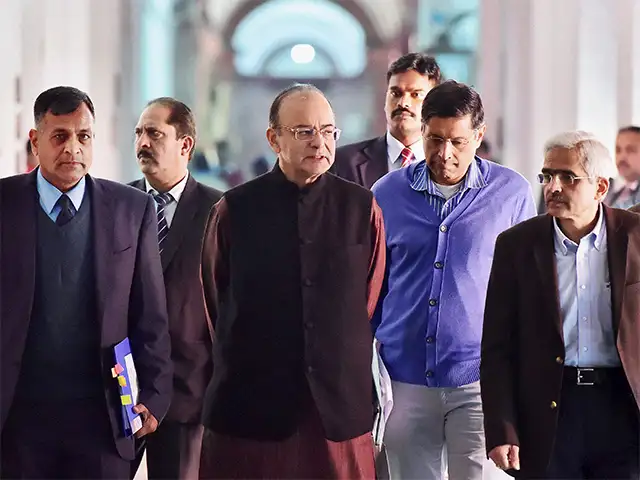
According to Article 112 of the Constitution of India, the Union Budget of a year is a statement of the estimated receipts and expenditure of the government for that particular year.
Budget is made through a consultative process involving ministry of finance, NITI Aayog and spending ministries.

Finance ministry issues guidelines to spending based on which ministries present their demands.

The Budget Division of the Department of Economic Affairs in the finance ministry is the nodal body responsible for producing the Budget.
Budget is made through a consultative process involving ministry of finance, NITI Aayog and spending ministries. Finance ministry issues guidelines to spending based on which ministries present thei..
Read More
Budget Division issues a circular to all Union ministries, states, UTs, autonomous bodies, depts and the defence forces for preparing the estimates for the next year.

After ministries & departments send in their demands, extensive consultations are held between Union ministries and the Department of Expenditure of the finance ministry.

At the same time, the Department of Economic Affairs and Department of Revenue meet stakeholders such as farmers, businessmen, FIIs, economists and civil society groups to take their views.

Once the, pre-Budget meetings are over, a final call on the tax proposals is taken by the finance minister. The proposals are discussed with the PM before the Budget is frozen.
Budget Division issues a circular to all Union ministries, states, UTs, autonomous bodies, depts and the defence forces for preparing the estimates for the next year. After ministries & departments ..
Read More
The Secretary General of the Lok Sabha Secretariat seeks approval of President after the Speaker agrees to the date suggested by the government.

FM presents the budget in the Lok Sabha outlining key estimates and proposals.

Finance Minister briefs the cabinet on the budget proposals through a 'summary for the cabinet' just before he presents the budget.

The ‘Annual Financial Statement’ is laid on the Table of the Rajya Sabha after the FM’s speech.

On the morning of the budget, the government seeks President’s approval through a “Summary for the President” approved by the FM and PM.
The Secretary General of the Lok Sabha Secretariat seeks approval of President after the Speaker agrees to the date suggested by the government. FM presents the budget in the Lok Sabha outlining key..
Read More
FM’s budget speech has two parts. Part A deals with general economic survey of the country and policy statements. Part B contains tax proposals.

The ‘Annual Financial Statement’ is laid on the Table of the Rajya Sabha after the FM’s speech.

No discussion takes place the day the budget is presented.
FM’s budget speech has two parts. Part A deals with general economic survey of the country and policy statements. Part B contains tax proposals. The ‘Annual Financial Statement’ is laid on the Table..
Read More
Budget debate is split into TWO PARTS

General discussion

A few days after the budget, there is a general discussion in Lok Sabha for 2-3 days.

The FM replies to the debate at the end of the discussion.

A ‘VOTE-ON-ACCOUNT’ for expenditure in initial months of financial year is obtained from Parliament.

The House is adjourned for a fixed period.
Budget debate is split into TWO PARTS General discussion A few days after the budget, there is a general discussion in Lok Sabha for 2-3 days. The FM replies to the debate at the end of the discus..
Read More
During the break, demands for grants are considered by relevant standing committees.

These demands are taken up one by one as per a schedule decided by the business advisory committee of house.

Any member can seek a cut in allocation through one of the three cut motions:

1. Disapproval of Policy Cut
2. Economy Cut
3. Token Cut

On the last day of the discussion on the Demands for Grants, the Speaker puts all the outstanding Demands for Grants to the vote in the House.
During the break, demands for grants are considered by relevant standing committees. These demands are taken up one by one as per a schedule decided by the business advisory committee of house. Any..
Read More
After the demand for grants, Appropriation Bill is put to vote in Lok Sabha. It gives the government powers to spend from the Consolidated Fund of India.

After the Appropriation Bill, Finance Bill is considered and passed by Parliament as a Money Bill.

The bill is required to be passed by both the Houses and receive assent of the President within 75 days of its introduction.

Once the Finance Bill is passed and signed by the President, the budget process is over.
After the demand for grants, Appropriation Bill is put to vote in Lok Sabha. It gives the government powers to spend from the Consolidated Fund of India. After the Appropriation Bill, Finance Bill i..
Read More
READ MORE
ADVERTISEMENT

READ MORE:

LOGIN & CLAIM

50 TIMESPOINTS

More from our Partners

Loading next story
Business News › Industry › Transportation › Railways › Rs one lakh crore for railway safety fund: Arun Jaitley
Text Size:AAA
Success
This article has been saved

*

+