Indian Railways: 10 transformative recommendations of Bibek Debroy Committee report
From encouraging private players to eliminating the Railway Budget altogether, the report dwells on all that ails the national transporter.
NEW DELHI: The Bibek Debroy Committee in its interim report on the Indian Railways recommends sweeping changes in the way the ailing organisation runs. From encouraging private players to run trains to eliminating the Railway Budget altogether, the report dwells on all that ails Indian Railways and recommends steps to decentralise its operations for effective management.
In a telephonic conversation with Economic Times website, Bibek Debroy highlighted the ten key recommendations of the interim report. Bibek Debroy will also be available for an interactive Twitter chat on the interim report on @EconomicTimes. Join us on April 7 from 4:00 PM - 5:00 PM and have Bibek Debroy answer your queries.
1) Transition to commercial accounting: According Debroy, the process of accounting in Indian Railways is "very complicated". "It is impossible to figure out what the rate of return on a project is," he said.
The report recommends: Refinements in the way Indian Railways prepares and maintains accounts, and costs its businesses, activities and services. The financial statements of Indian Railways need to be re-drawn, consistent with principles and norms nationally and internationally accepted. Casting accounts in standard commercial accounting format and making appropriate financial disclosures would not only facilitate prospective investors in assessment of risk and decision on their possible investment forays into IR but would also help IR to quantitatively assess impact of policy interventions on cost of various services.
2) Streamline recruitment & HR processes: "There is a multiplicity of different channels through which people enter the railway services. We essentially recommended unifying and streamlining the process," Debroy said.
What is recommended: At present there are eight organized Group 'A' services in Indian Railways. Deployment to these services is by direct recruitment from UPSC (Civil Service and the Engineering examinations) and also by promotion of Group 'B' officers of the department. There is also a small but significant element of recruitment of Mechanical Engineers through the Special Class Railway Apprentices examination, followed by training. The eight services can be broadly categorized in two bigger groupings viz. technical and non-technical services.
IR should consolidate and merge the existing eight organized Group 'A' services into two services i.e. the Indian Railway Technical Service (IRTechS) comprising the existing five technical services (IRSE, IRSSE, IRSEE, IRSME and IRSS) and the Indian Railway Logistics Service (IRLogS), comprising the three non-technical services (IRAS, IRPS and IRTS).
3) Focus on non-core areas: Debroy feels that a lot of tasks carried out by the Indian Railways are not at the core of the prime business of rail transportation. These activities include running hospitals and schools, catering, real estate development, including housing, construction and maintenance of infrastructure, manufacturing locomotives, coaches, wagons and their parts, etc.
"Not for a moment have we suggested that you close these down," he said. To this list must be added the Railway Protection Force and Railway Protection Special Force, which carry out functions which should normally be performed by State Police forces, or conveniently outsourced. To maintain and run these diverse sets of peripheral activities, Indian Railways has created a monolith organizational structure. There is a strong case for revisiting these activities.
Indian Railways should focus on core activities to efficiently compete with the private sector. It will distance itself from non-core activities, such as running a police force, schools, hospitals and production and construction units.
Immediate integration of the existing Railway schools into the Kendriya Vidyalaya Sangathana set-up. Instead the needs of the children of Railway employees could be met through subsidizing their education in alternative schools, including private schools.
4) Decentralisation: "We have recommended a substantial amount of decentralisation. We are not talking about decentralisation at the level of the GM, who is in charge of a zone. We are talking about decentralisation down to the level of the DRM who is in charge of a division, or station superintendent. A little bit of decentralisation has already happened, but it has only happened at the level of the GM. For the average passenger today, there is no one single person who is responsible for a station," Debroy explained.
The report recommends: To ensure proper decentralization, there is a need to delegate enhanced powers, especially in respect of tenders connected with works, stores procurement, service or even revenue-earning commercial tenders, to the DRMs. Some of the suggestions made by the committee are; finance must completely be under the DRM; ADRMs should be an explicit part of the administrative chain; some earnings by the Division should be retained at the level of the Division.
5) Indian Railway Manufacturing Company: According Debroy, wagons are already produced by the private sector. Coaches and locomotives could follow. Unless they are freed from 59 their constraints, the existing production units will be unable to face this competition, he says.
"You have to remove them from the shackles. All the production units which are not core to the Indian Railways operations, all the production workshops whether it is coaches locomotives, put them under Indian railway manufacturing company. We have not said you are privatising it, but you sort of freeing it from the present system," he says.
The Committee proposes that all these existing production units should be placed under a government SPV known as the Indian Railway Manufacturing Company (IRMC). While this remains a government SPV, at least initially, under the administrative control of the Ministry of Railways, making it a government SPV makes it independent of the Ministry of Railways and the government, including in the determination of salary structures, and allows it to borrow.
6) Encouraging private entry: Private entry into running both freight and passenger trains in competition with Indian railways should be allowed and private participation in various Railway infrastructure services and non-core activities like production and construction, should be encouraged by the Ministry of Railways.
"The reason private players find it unviable to operate is because they do not have access to the tracks. They do not have access to tracks because as it inevitably happens, Indian Railways gives preference to the Indian Railway trains. Therefore, we recommend having a separate track holding company, which remains public, from that part of Railways which runs trains. This track holding company will be neutral between Indian Railways and the private players," explains Debroy.
7) Independent regulator: Shift regulatory responsibility from the government to an independent regulator as the private sector will only come in if there is fair and open access to infrastructure, recommends Debroy. The independent regulator shall ensure fair and open access and set access charges; establish tariffs in cases where there the market fails to discover a price; and adjudicate disputes between the track-owning organization and train operators; and between competitors. This will make fair and open access a reality and open up both freight and passenger trains, in competition with IR.
The report recommends setting up a Railway Regulatory Authority of India (RRAI) statutorily, with an independent budget, so that it is truly independent of the Ministry of Railways.
The RRAI will have the powers and objectives of economic regulation, including, wherever necessary, tariff regulation; safety regulation; fair access regulation, including access to railway infrastructure for private operators; service standard regulation; licensing and enhancing competition; and setting technical standards. It should possess quasijudicial powers, with appointment and removal of Members distanced from the Ministry of Railways.
Debroy feels that the Ministry of Railways should set the policy, whoise enforcement and implementation will in turn be done by the regulator. The Railway Board should continue only as an entity for the Indian Railways (PSU).
8) Social costs & JVs to bear them: Constructing new suburban lines should be undertaken as joint ventures with state governments, not otherwise, says Debroy. There are too many Zones and Divisions and thus a rationalization exercise is required. "We have recommended taking out Kolkata Metro from the railway system. No other metro is part of the Railway system, why should Kolkata metro be a part of it?" asked Debroy.
Suburban railways should ideally be hived off to State governments, via the joint venture route. Until this is done, the cost of low suburban fares, if these fares are not increased, must be borne by State governments on a 50/50 basis, with MOUs signed with State governments for this purpose.
The freight rates should be left to market principles, once liberalization takes hold, and no such freight-related social cost should be imposed on Indian Railways.
9) Changing relationship between government & Railways: A separate Railway budget should be phased out progressively and merged with the General Budget, the report says. "Cleanly separate out the relationship between the Union Government and the Railways. End gross budgetary support, end this system of paying dividends and therefore you effectively end the railway budget. You not only end the railway budget, you eventually also end the Ministry of Railways and integrate it into a Ministry of Transport," Debroy explains.
10) Raising resources: For raising resources for investments, an Investment Advisory Committee may be set up, consisting of experts, investment bankers and representatives of SEBI, RBI, IDFC and other institutions. The existing assets of Indian Railways may be leveraged to raise resources and institutions created like InviT, NBFCs. The modalities by which returns can be secured for such investments should also come under the purview of this Investment Advisory Committee.
The Economic Times News App for Quarterly Results, Latest News in ITR, Business, Share Market, Live Sensex News & More.
Related Articles
 Indian Railways achieves 145 million tonnes freight loading in May despite global headwinds2026-06-02T04:30:25Z
- Harsh Goenka shares video of Indian Railways staff arriving in just two minutes for coach cleaning, says “it restores faith in system”. Watch here2026-05-29T05:25:03Z
- Titagarh, Jupiter Wagons shares rally up to 10% amid reports of Rs 40,000 crore order from Indian Railways2026-05-25T07:35:29Z
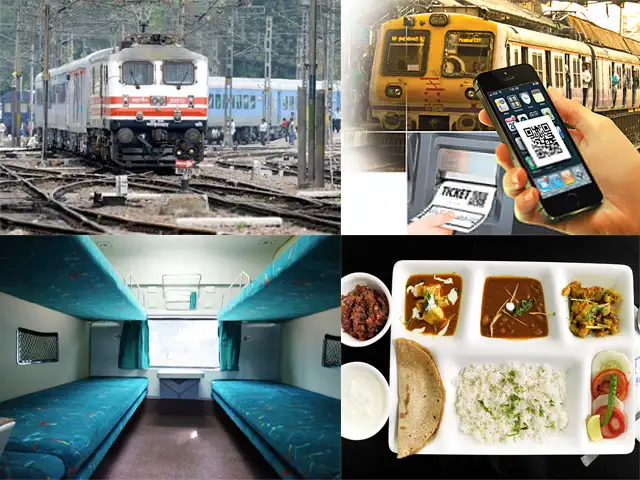
In a Railway Budget focused on enhancing passenger experience, Rail Minister Suresh Prabhu on Thursday announced multiple initiatives including better ticketing facilities, upgraded stations and cleaner trains.
Prabhu increased the funds allotment for passenger amenities by 67%. "We are launching initiatives that will systematically address customer concerns about cleanliness, comfort, accessibility, service quality and speed of trains," Prabhu said.
"We are directing our efforts to make travel on Indian Railways a happy experience with a mix of various initiatives," he said in the Rail Budget speech.
We take a look at 15 main areas in Prabhu's Rail Budget that will improve common man's train journey: