
Why air travel is the best option during coronavirus times
1/6
A positive sign for airlines
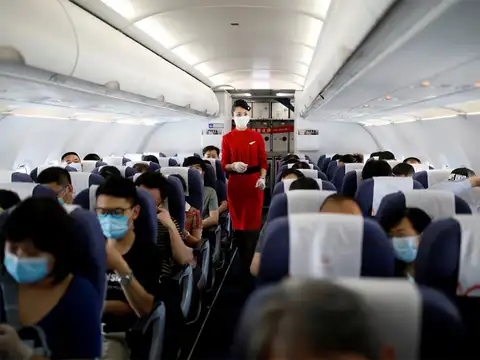
The risk of exposure to the coronavirus on flights is very low, a U.S. Department of Defense study released on Thursday found, a positive sign for the airline industry as it tries to rebound from the pandemic's crushing effect on travel.
2/6
How risky is it?
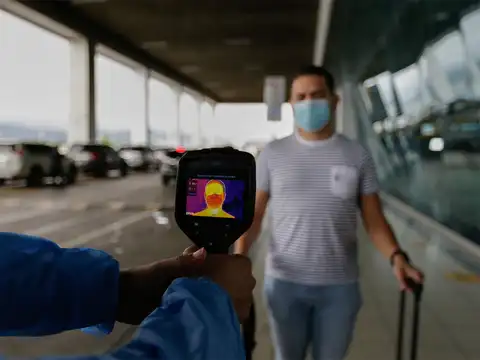
As per the study, when a seated passenger is wearing a mask, an average 0.003% of air particles within the breathing zone around a person's head are infectious, even when every seat is occupied, it found. The testing assumed only one infected person on the plane and did not simulate the effects of passenger movement around the cabin.
3/6
Mask a Must
The study, conducted aboard United Airlines Boeing 777 and 767 aircraft, showed that masks helped minimize exposure to infection when someone coughed, even in neighbouring seats. About 99.99% of particles were filtered out of the cabin within 6 minutes due to fast air circulation, downward air ventilation and the filtration systems on the aircraft. It estimated that to receive an infectious dose, a passenger would need to fly 54 hours on a plane with an infectious person.
Amazon Top Deals
POWERED BY

Crompton Ozone 75 Litres Desert Air Cooler for home | Large & Easy Clean Ice Chamber | 4-Way Air Deflection | High Density Honeycomb Pads | Everlast Pump | Auto Fill| 3 Year Brand Warranty
₹9,798Buy Now43%
OFF

atomberg Studio Smart+ 1200mm BLDC Ceiling Fan with IoT & Remote | BEE 5 star Rated Energy Efficient Ceiling Fan | High Air Delivery with LED Indicators | 3 Year Warranty (Earth Brown)
₹5,882Buy Now36%
OFF

LG 32 L Convection Microwave Oven (MC3286BRUM, Black, 360° Motorised Rotisserie for Bar-be-queing, 301 Auto Cook Menu, Stainless steel cavity, Indian Cuisine, Tandoor Se, Steam Clean & Diet Fry)
₹19,340Buy Now19%
OFF
4/6
Minimum risk even in a full flight
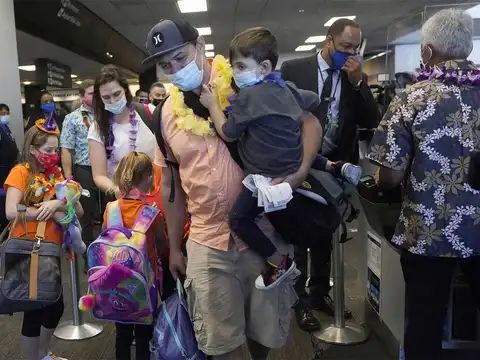
United Airlines, which also provided pilots for the test, took pains to present the results in its favor. As per United Airlines' Chief Customer Officer, Toby Enqvist chances of COVID exposure on a United aircraft are nearly non-existent, even if the flight is full.
5/6
Elaborate tests
The research, conducted over six months, involved 300 tests during 38 hours of flight time and 45 hours of ground testing. It was done by releasing particles the same size as the novel coronavirus across the entire cabin by section, each of which had 42 sensors representing other passengers who could potentially come in contact with the particles. Each test released 180 million particles – the number of particles that would be produced by thousands of coughs.
6/6
Real data backs theory
The International Air Transport Association (IATA) said it has identified only 44 flight-related COVID-19 cases since the beginning of 2020 versus some 1.2 billion passengers who have travelled during that time. While "nothing is completely risk-free," the published cases of potential inflight COVID-19 transmission show that "the risk of contracting the virus on board appears to be in the same category as being struck by lightning," IATA Director General Alexandre de Juniac said.