Union Budget 2015: Telecom sector hopes further growth in demand for data services
The telecom operators are facing significant litigation owing to the position adopted by the tax authorities that the independent distributors.
Updated:
By Rohit Verma, Senior tax professional, EY India
Indian telecommunications Industry has seen exponential growth in the recent past, with the sector playing vital role in the growth of the Indian economy. The sector is expecting further growth in demand for data services with the Modi Government's focus to make a 'Digital India'.
The Industry is upbeat with expectations soaring high from the Modi Government's first full-fledged budget to bring in radical tax reforms and address the key tax issues the Industry is facing. Some of the key expectations of the Industry are:
I. Withholding tax litigation on margin allowed to pre-paid distributors
The telecom operators are facing significant litigation owing to the position adopted by the tax authorities that the independent distributors, appointed by the telecom operators on a principal to principal basis to sell telecom vouchers to the end users through retailers, act as an agent of the telecom operators. Resultantly, margin allowed to such distributors is alleged to be 'commission' subject to tax withholding at the rate of 10%.
Given the quantum involved in litigation and very low margins earned by the distributors, the Industry expects the Government to put the controversy to rest by rationalizing the provisions and prescribing a lower withholding tax rate (say 1%) on margins allowed to the distributors. It should also be specifically clarified that 'penalty' would not be imposed against the telecom operators for past years.
II. Rationalisation of the royalty provisions for exclusion of standard telecom services
Financial Year 2012 brought several retrospective amendments to the income-tax legislation, one of them being expansion of the royalty provisions to clarify that 'process' includes transmission by satellite, cable, optic fibre or by any other similar technology, whether or not such process is secret.
The above amendment has been ambiguously worded and is resorted to by the tax authorities to allege that even standard telecom services fall within the ambit of royalty and impose additional withholding tax burden on the telecom operators, including for the payments made in the past. The amendment is also being relied upon to tax telecom charges paid to non-resident telecom operators covered by tax treaties, which are largely tax protected.
This amendment is clearly in conflict with the internationally accepted position that a mere right to receive a service cannot be categorized as 'royalty' and would have significant adverse consequences for the Industry. A clarification is, thus, expected to provide that standard telecom services are specifically excluded from royalty provisions. Further, it should also be clarified that Royalty definition under the domestic law should not be read into the tax treaties.
III. Provision of tax incentives
The Industry expects investment linked tax incentives and sops to provide impetus to the Industry players, especially the tower companies and equipment manufacturer. This would lead to reduction of the cost of telecom services, reinvigorate the production activity and also, generate employment in the economy.
IV. Goods and Service Tax (' GST') regime
On the indirect tax front, faster implementation of GST is one of the key demands. However, as this is a big reform having far reaching ramifications, the Industry expects adequate consultation with the Industry bodies and players on various issues prior to finalizing the rules for a seamless transition.
V. Reduction in Special Additional Duty ('SAD')
Currently, SAD of customs is an additional cost to the overall telecom infrastructure. The Industry expects the Union Government to bring in legislation to either reduce the same and make it equal to central sales tax (of 2%) or remove it altogether.
VI. CENVAT credit
It is the need of the hour that specific clarification be issued to address ambiguities pertaining to availability of CENVAT credit on towers and shelters to telecom companies or other expenses, which are restricted.
Besides, easing out of the compliance requirements for certain provisions relatable to availment of CENVAT credit such as limitation of 6 months for availment of CENVAT credit of input and input services, 30% rate of interest on delayed deposit and high amounts of mandatory pre - deposit for preferring appeal, is also required.
The Industry keenly awaits, keeping its fingers crossed, Budget 2015 with expectations of policy changes in the tax legislation to address the concerns of the Industry players.
(Views expressed are personal)
Indian telecommunications Industry has seen exponential growth in the recent past, with the sector playing vital role in the growth of the Indian economy. The sector is expecting further growth in demand for data services with the Modi Government's focus to make a 'Digital India'.
The Industry is upbeat with expectations soaring high from the Modi Government's first full-fledged budget to bring in radical tax reforms and address the key tax issues the Industry is facing. Some of the key expectations of the Industry are:
I. Withholding tax litigation on margin allowed to pre-paid distributors
The telecom operators are facing significant litigation owing to the position adopted by the tax authorities that the independent distributors, appointed by the telecom operators on a principal to principal basis to sell telecom vouchers to the end users through retailers, act as an agent of the telecom operators. Resultantly, margin allowed to such distributors is alleged to be 'commission' subject to tax withholding at the rate of 10%.
Given the quantum involved in litigation and very low margins earned by the distributors, the Industry expects the Government to put the controversy to rest by rationalizing the provisions and prescribing a lower withholding tax rate (say 1%) on margins allowed to the distributors. It should also be specifically clarified that 'penalty' would not be imposed against the telecom operators for past years.
ADVERTISEMENT
II. Rationalisation of the royalty provisions for exclusion of standard telecom services
Financial Year 2012 brought several retrospective amendments to the income-tax legislation, one of them being expansion of the royalty provisions to clarify that 'process' includes transmission by satellite, cable, optic fibre or by any other similar technology, whether or not such process is secret.
The above amendment has been ambiguously worded and is resorted to by the tax authorities to allege that even standard telecom services fall within the ambit of royalty and impose additional withholding tax burden on the telecom operators, including for the payments made in the past. The amendment is also being relied upon to tax telecom charges paid to non-resident telecom operators covered by tax treaties, which are largely tax protected.
This amendment is clearly in conflict with the internationally accepted position that a mere right to receive a service cannot be categorized as 'royalty' and would have significant adverse consequences for the Industry. A clarification is, thus, expected to provide that standard telecom services are specifically excluded from royalty provisions. Further, it should also be clarified that Royalty definition under the domestic law should not be read into the tax treaties.
ADVERTISEMENT
III. Provision of tax incentives
The Industry expects investment linked tax incentives and sops to provide impetus to the Industry players, especially the tower companies and equipment manufacturer. This would lead to reduction of the cost of telecom services, reinvigorate the production activity and also, generate employment in the economy.
ADVERTISEMENT
IV. Goods and Service Tax (' GST') regime
On the indirect tax front, faster implementation of GST is one of the key demands. However, as this is a big reform having far reaching ramifications, the Industry expects adequate consultation with the Industry bodies and players on various issues prior to finalizing the rules for a seamless transition.
V. Reduction in Special Additional Duty ('SAD')
Currently, SAD of customs is an additional cost to the overall telecom infrastructure. The Industry expects the Union Government to bring in legislation to either reduce the same and make it equal to central sales tax (of 2%) or remove it altogether.
VI. CENVAT credit
It is the need of the hour that specific clarification be issued to address ambiguities pertaining to availability of CENVAT credit on towers and shelters to telecom companies or other expenses, which are restricted.
Besides, easing out of the compliance requirements for certain provisions relatable to availment of CENVAT credit such as limitation of 6 months for availment of CENVAT credit of input and input services, 30% rate of interest on delayed deposit and high amounts of mandatory pre - deposit for preferring appeal, is also required.
The Industry keenly awaits, keeping its fingers crossed, Budget 2015 with expectations of policy changes in the tax legislation to address the concerns of the Industry players.
(Views expressed are personal)
Start a SIP with as low as ₹500 with ET Money App!
Download
The Economic Times News App for Quarterly Results, Latest News in ITR, Business, Share Market, Live Sensex News & More.
The Economic Times News App for Quarterly Results, Latest News in ITR, Business, Share Market, Live Sensex News & More.
Related Articles
 India's telecom ARPU to grow 7% CAGR through FY29; narrowing tariff gap with global markets: Report2026-06-16T06:10:45Z
- India's next telecom battle could be fought on highways, with connected cars2026-06-15T06:25:31Z
- India Inc remains bullish on FY27; Telecom, defence, banking seen driving growth: Report2026-06-11T08:45:28Z
Text: ET Bureau
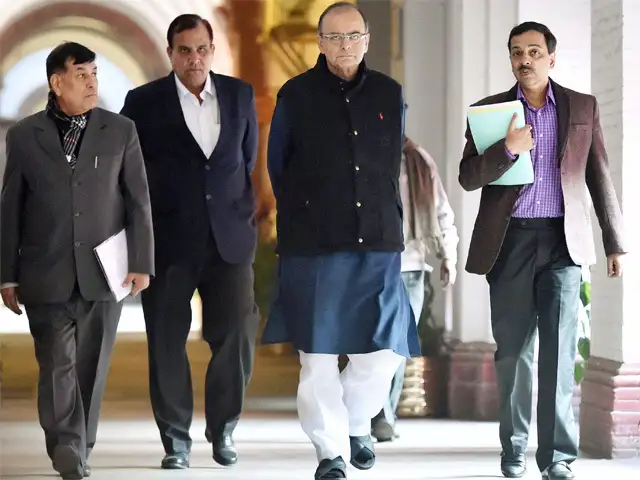
ET looks at the recent speeches of finance minister Arun Jaitley for clues to the budget for FY16. The budget is widely expected to lay down the agenda for the remaining four years of the Narendra Modi government.
In Pic: Jaitley arrives at the Pre-Budget Consultation with the representatives of Trade Union, in New Delhi.
ET looks at the recent speeches of finance minister Arun Jaitley for clues to the budget for FY16. The budget is widely expected to lay down the agenda for the remaining four years of the Narendra Modi government.
In Pic: Jaitley arrives at the Pre-Budget Consultation with the representatives of Trade Union, in New Delhi.