Delay in vaccine availability likely as India banks only on local makers
India has the capacity and tie-ups to manufacture about 2 billion vaccine doses but its strategy to bank only on local production and not enter into any pre-purchase agreements with multiple global drugmakers could delay the availability of vaccin...
New Delhi | Mumbai: India has the capacity and tie-ups to manufacture about 2 billion vaccine doses but its strategy to bank only on local production and not enter into any pre-purchase agreements with multiple global drugmakers could delay the availability of vaccines in the country. Union health minister Harsh Vardhan on Thursday said India was in dialogue with vaccine companies and up to 500 million doses would be available by July 2021. A Duke University report said India has firm access to 2 billion vaccine doses. Serum Institute of India (SII) has the capacity to manufacture 1.6 billion doses of the AstraZeneca-Oxford University vaccine and it is also expected to manufacture one billion doses of the Novavax vaccine.
In addition, Biological E has a tie-up with Johnson & Johnson for making its vaccine candidates, and Dr Reddy’s Laboratories has a manufacturing tie-up for Russia’s Sputnik V vaccine, with Mankind as the distribution partner. But India has no tie up or pre-purchase agreements with Pfizer and Moderna - the two companies that have emerged as leaders in the vaccine race - and who are expected to launch by the end of this year or early next year. The US, Canada, Japan, and many countries of the EU have booked orders from them and will first have access to their vaccines. Clinical trials for these vaccines have also not been conducted in India. As a member of the Covax facility, the country will have access to the Moderna vaccine but it is not clear what will be its quota and when will it be made available.
“There are many choices, but due to intense competition, advance bookings should be made, to cover at least high-risk groups. Low risk groups can be covered later with more vaccines which would be available by then,” said Anoop Misra, chairman, Fortis CDoc, a multi-speciality hospital in Delhi. Among so many contenders for vaccines, we should choose one that provides optimal efficacy (about 90%) and complete safety, he said.
A public health expert, on condition of anonymity, said rich countries were doling out billions of dollars to leading contenders and pre-booking their supplies. “I fail to understand why India can’t enter into one such deal and secure doses for its people. This only makes me feel that there is no value for human life here,” he said. However, some experts urged caution.
“We need to book only what’s affordable and feasible,” said Giridhara Babu of Public Health Foundation of India. In addition to safety and efficacy, the vaccine procurement strategy should focus on implementation in the field and affordability, he said. The country’s health authorities believe there’s no need to pre-book vaccines. “We don’t need all the vaccines at one go. No country on the world is even looking to inoculate the entire population. The vaccines will be given to high priority groups in tranches and hence there is no need for us to book vaccines or secure them in advance,” said a senior government official.
Here are some of the limitations India may face with Moderna and Pfizer's COVID vaccine
1/5
According to a report by TOI, US drugmakers Moderna Therapeutics Inc. and Pfizer's innovative COVID-19 vaccines have emerged as the strongest competitors in the race. Many are pegging them as the frontrunners in the league. Currently, in phase III, both vaccine candidates are going neck-to-neck in the race to release a vaccine for the world first. Before we get our hopes up about these probable COVID-19 vaccines under testing, here are some of the limitations India may face.
According to a report by TOI, US drugmakers Moderna Therapeutics Inc. and Pfizer's innovative COVID-19 vaccines have emerged as the strongest competitors in the race. Many are pegging them as the fro..
Read More
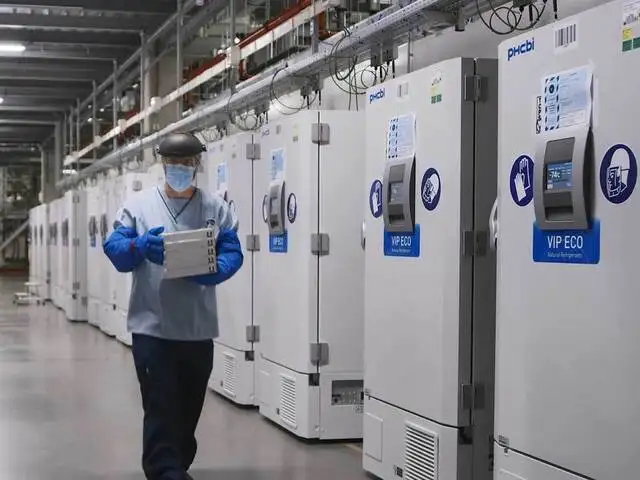
Unlike medicines, vaccines require a lot more precise scientific know-how and strict storage conditions. Pfizer's COVID-19 vaccine, BNT-162, which has been developed in collaboration with German pharma major BioNTech is novel in its approach but requires extreme temperature settings to be stored in. According to experts, Pfizer's two-dose shots need to be stored in -94 degrees Fahrenheit (-70 degree Celsius), which is an ultra-low temperature setting.
Unlike medicines, vaccines require a lot more precise scientific know-how and strict storage conditions. Pfizer's COVID-19 vaccine, BNT-162, which has been developed in collaboration with German phar..
Read More
Moderna's dose, much like Pfizer, needs special storage and temperature settings as well. However, the only way Moderna gains a slight edge over Pfizer is that it can stay stable in any environment, under a given setting for 30-60 days, which cannot happen with Pfizer's deep-freeze vaccine.
Moderna's dose, much like Pfizer, needs special storage and temperature settings as well. However, the only way Moderna gains a slight edge over Pfizer is that it can stay stable in any environment, ..
Read More
Unlike these mRNA vaccines, Oxford, which is also a frontrunner in the race, makes use of a simplified storage setting, making it much easier to deliver all across the world. Other vaccine companies are also working on producing and delivering an easy to use, low-cost vaccine shot which could benefit billions, without bringing additional hiccups. However, it will take a longer time for them to come out right now.
Unlike these mRNA vaccines, Oxford, which is also a frontrunner in the race, makes use of a simplified storage setting, making it much easier to deliver all across the world. Other vaccine companies ..
Read More
mRNA vaccines make use of special enzymes (vaccinia capping enzyme) which not just degrade faster, but are also considered to be one of the costliest ingredients in the world and difficult to procure. Cold storage, in places where it isn't possible, would also require the use of additional resources and shoot up prices as well. It is expected that both Moderna and Pfizer will be rather expensive once commercial contracts with different countries are finally inked.
mRNA vaccines make use of special enzymes (vaccinia capping enzyme) which not just degrade faster, but are also considered to be one of the costliest ingredients in the world and difficult to procure..